BOOK OF THE MONTH: THE ILLUMINED HEART

Week 3: Fasting
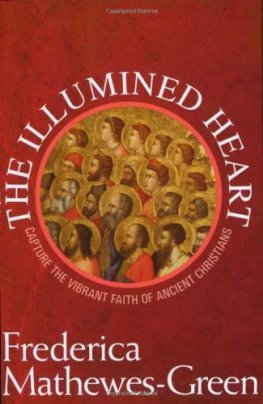
Illumined Heart cover

In The Illumined Heart, Frederica Mathewes-Green explores the wisdom and practices of the early Church.

Fasting is one such ancient practice. Mathewes-Green discusses details of how and when early Christians fasted. Just as important is her exploration of Christian attitudes toward the body:

Our bodies are a part of the creation God pronounced “very good,” and Jesus demonstrated God’s blessing on the human body when he became incarnate. He made the blessing more emphatic when he was resurrected, not as a mere spirit, but in a scar-marked body capable of eating fish. He sealed the blessing in the Ascension, taking that body into the very courts of heaven.

*****

So why do we need to fast?

Our bodies are blessed, but we don’t know how to live harmoniously in them. We drive them like vehicles, use them like tools to dig pleasure, and in the process damage them and distort our capacity to understand them. Fasting disciplines help us quiet these impulsive demands, so that we can better hear what they need and how they are meant to work. It is a turning toward health, a way of honoring creation and preparing for eternity.

*****

Read more.

For reflection:

Mathewes-Green week 3

FRIDAY FAVORITES FOR PRAYER AND WRITING

Each Friday I share some of my favorite finds related to praying or writing. If I think it could help you pray or write better, or just “be” better, I’ll include it below.

Do you have someone else’s article or post to share? Join the Contemplative Writers Facebook group, comment on today’s post on my Facebook page, or follow me on Twitter (@LisaKDeam) to nominate your favorite articles, blog posts, and books by Thursday at noon each week.

*****

Exit Through the Wilderness via Zach Hoag (a guest post on grace and giving up at Shawn Smucker’s website)

Daily Riches: The Practice of Waiting via William Britton (we all have to wait sometimes- how can we wait well?)

What You Can Learn From Declaring a Mystery via Tania Lombrozo (on learning from unexplainability)

Before you can be with others, first learn to be alone via Jennifer Stitt (in case you’re still not convinced of the benefits of solitude!)

7 Slippery-Slope Reasons Writers Shouldn’t Blog via Leslie Leyland Fields (so interesting considering just about everyone I know still has a blog)

*****

Hey y’all, I wanted to let you know that Friday Favorites will be taking a break next week. We’ll see you on July 28!


The Practice of Memorizing Poetry

I love thinking about the ways that writing and spirituality intersect in my life. Recently I’ve been reading about a unique practice that ties the two together — the memorization of poetry. I suppose that this practice isn’t exactly unique, but it seems so given the way memorization has fallen out of favor today.

First, let’s look at the writing angle. In a recent post, writing coach Ann Kroeker says that “poetry, if we let it, can seep into us and change us with its funny, surprising, and serious ways of processing life and ideas.” It might help us with our writing by introducing us to surprising imagery and new ways of thinking. Kroeker writes:

In poetry, you’ll find freedom from some of the mechanics expected in prose, such as proper comma placement. In poetry, you’ll find fresh phrasings that throw your brain off its expected track and into novel ways of thinking and imagining. This can happen when you read a poem, but it works best when you take it to heart.

*****

Is this something you’ve ever tried? I believe poetry memorization can serve as a playful, creative activity that will add energy, ideas, and allusions to the rest of our writing.

That might be something I’m willing to try. Poetry may have additional benefits, too. According to some, memorizing and reciting poetry is akin to a spiritual practice. In an article in iNews, Allie Esiri, a noted poetry promoter, writes:

We talk a lot about ‘mindfulness’ these days. Well, reading a poem, and giving yourself over to the movements of rhythm and meter, is an excellent way to bring about peace of mind. But better still is reciting a poem. Forming each phrase for yourself, and focusing on the lines that follow, there is little room for unbidden thoughts, and you truly lose yourself in the words.

*****

A study by University of Cambridge into memorising poetry found that most participants described the learning of a poem by heart as an ‘enriching, life-enhancing experience’. In times of need, the poems we learn are always ours to fall back on.

Poems help us feel less alone — teenagers discover in great verse that they are not the only ones who have felt hardship or pain. And there is evidence, too, that learning poetry keeps our minds sharp. Alzheimer’s patients often respond well to poems and pieces of music they learnt when young. They’re with us for life.

*****

Both these articles have helpful suggestions for choosing a poem and tips for memorization. So how about it? Do you think, for the sake of your spiritual and creative life, that you’re up for the challenge of memorizing a poem?
 

BOOK OF THE MONTH: BEFRIENDING SILENCE

Week 1: The Gift of Sacred Stories

Befriending Silence

In Befriending Silence: Discovering the Gifts of Cistercian Spirituality, Carl McColman shares what we can learn from an ancient monastic tradition. McColman himself is a Lay Cistercian affiliated with the Trappist Monastery of the Holy Spirit in Conyers, Georgia.

Befriending Silence explores eleven gifts from the Cistercian tradition. The chapter “Sacred Stories” diagnoses a problem: “Our society as a whole has forgotten who we are, and the consequences are devastating,” McColman writes. “[W]e have forgotten that we all are created in the image of God.” He goes on to explain how Scripture and other spiritual writings can help us live in God’s story and remind us who we truly are. Reading sacred story is a sacred tradition.

*****

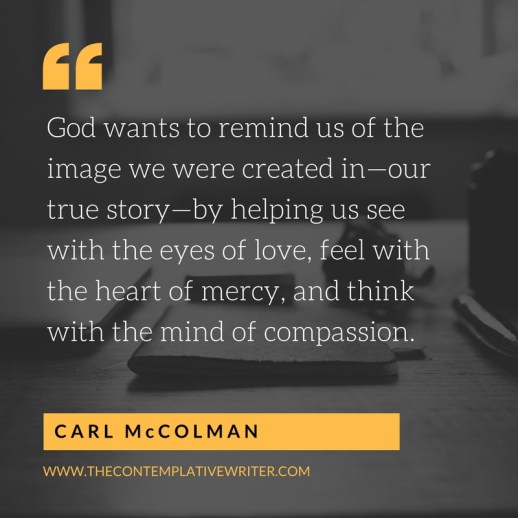
God wants to remind us of the image we were created in—our true story—by helping us see with the eyes of love, feel with the heart of mercy, and think with the mind of compassion.

*****

The gift of Christian, Benedictine, and Cistercian wisdom and memory is that these timeless stories and teachings from the past provide the foundation on which we can build our own spiritual identity, our own sense of what it means to respond to God’s grace, in our time.

*****

For people of faith, reading can be a doorway not to greater control but greater surrender, a way to open our minds and hearts to the transfiguring and life-giving Word of God.

*****

Following the chapter, McColman explains the practice of lectio divina, or sacred reading, giving advice and guidance to those beginning on this path:

*****

Although lectio divina originated in monasteries and remains a core spiritual practice for monks and nuns, it is something anyone may learn, practice, and enjoy. By making lectio divina a regular part of your life, you participate in a practice that has nurtured Cistercians and other monastics for centuries.

*****

[L]ectio divina is like spending time with someone special. The purpose is to linger, savoring the time spent together.

*****

Remember, the purpose of lectio divina is not to gather more information but to seek God’s living word for your life.

*****

Read more.

For reflection:

McColman - week 1 (alt)


FRIDAY FAVORITES FOR PRAYER AND WRITING

Each Friday I share some of my favorite finds related to praying or writing. If I think it could help you pray or write better, then I’ll include it below.

Do you have someone else’s article or post to share? Tag me on the Contemplative Writers Facebook group, comment on today’s post on my Facebook page, or follow me on Twitter (@LisaKDeam) to nominate your favorite articles, blog posts, and books by Thursday at noon each week.

To Experience Resurrection (a Poem for Holy Week) via Kelly Chripczuk

Journeying with Jesus Through Holy Week via April Yamasaki

Monday Merton: Why We Wish to Destroy Our Enemies via Ed Cyzewski

The Disciplines Aren’t The Point via Nathan & Richard Foster (Renovaré podcast)

5 Reasons Fellow Writers Are Essential to Your Writing Life via Brian Klems

8 Writers on How to Face Writer’s Block and the Blank Page via Open Culture (a 5-minute video)

BOOK OF THE MONTH: THE CLOUD OF UNKNOWING

Week Two: A Short Prayer Penetrates Heaven

Cloud of Unknowing cover

The modern Centering Prayer movement teaches practitioners to choose one word to say and focus on during prayer. This technique has its origins in The Cloud of Unknowing (among other historical works) — our featured book of the month.

I grew up listening to long and wordy prayers in church. But the Cloud‘s 14th-century author explains why short prayers can be better prayers. I especially like his colorful example of a person who uses one word to cry for help in the midst of a fire. Aren’t we all crying out for help when we pray?

*****

Contemplatives seldom use words when they pray, but if they do, they choose only a few, and the fewer the better. They prefer a short one-syllable word over a word with two syllables, because the spirit can best assimilate it.

*****

[I]f we pray intently to get anything good, we should cry out in word, thought, or longing nothing but this word—God, nothing else. No other words are needed; for God’s very nature is goodness, and he’s the source of everything good.

*****

Why does this short little prayer of one small syllable penetrate heaven? Because you pray it with all that you are and all that you can be . . . the deepest wisdom of your soul is contained in this single tiny word, which is long in feeling . . .

*****

When a person is terrified by a fiery catastrophe . . . they cry out for help. That’s obvious. But what do they say? I can promise you a person in danger won’t pray a long string of words or even a word of two syllables. Why not? When desperate, you’ve got no time to waste . . . you’ll scream ‘Fire!’ or ‘Help!’ and this one-word outburst works best.

*****

I’ve been enjoying the Cloud of Unknowing in a newer translation that renders the text in a modern English idiom. Read more here.

For Reflection

Cloud quote - week 2

FRIDAY FAVORITES FOR PRAYER AND WRITING

Each Friday I share some of my favorite finds related to praying or writing. If I think it could help you pray or write better, then I’ll include it below.

Do you have someone else’s article or post to share? Join the Contemplative Writers Facebook group, comment on today’s post on my Facebook page, or follow me on Twitter (@LisaKDeam) to nominate your favorite articles, blog posts, and books by Thursday at noon each week.

BOOK OF THE MONTH: THE CLOUD OF UNKNOWING

Week One:Cloud of Unknowing cover
Prayer as Rest

The Cloud of Unknowing is a contemplative treatise written in the late 14th century. It forms the basis (along with a few other historical texts) of the modern Centering Prayer movement.

The Cloud‘s anonymous author was a monk or priest who addressed his treatise to a young disciple just setting out in a religious vocation. Although written in a monastic context, the Cloud (and its “sequel,” the Book of Privy Counsel), has advice for anyone who wants to pursue a life of prayer.

Reading the Cloud of Unknowing, I’m especially drawn to the author’s description of contemplative prayer as rest and even akin to sleep. I don’t know about you, but I think rest is something most of us need in a culture characterized by a lot of striving. Are you tired and anxious? The Cloud author writes:

*****

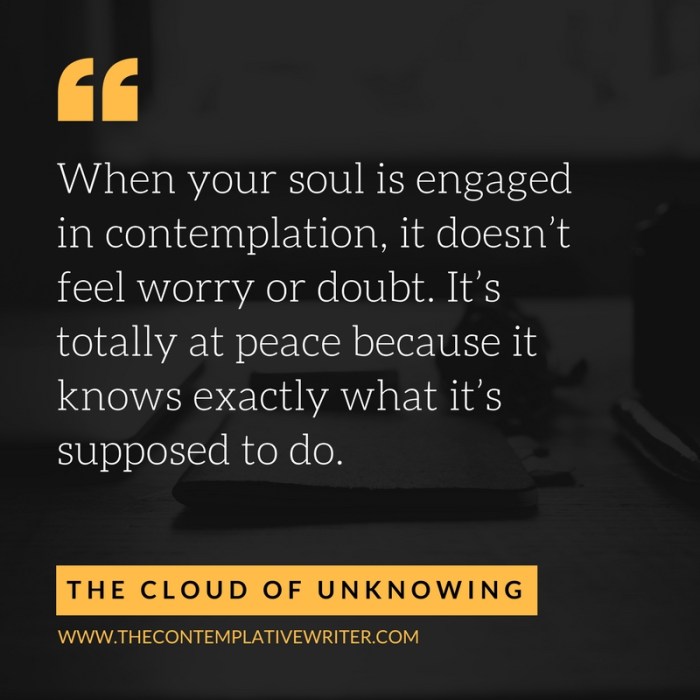
I . . . call [contemplative prayer] ‘rest’ for two reasons: When your soul is engaged in contemplation, it doesn’t feel worry or doubt. It’s totally at peace because it knows exactly what it’s supposed to do.

*****

It makes sense to compare the work of contemplation to sleep. When we’re asleep, the functions of our physical faculties are suspended so that our bodies can get complete rest. Sleep nourishes and strengthens our bodies in every way. The same is true of the spiritual ‘sleep’ of contemplative prayer. The stubborn questions of our restless spirituality and all our creative and rational thoughts are firmly bound and totally emptied, so the happy soul can sleep soundly, resting profoundly in the loving awareness of God as he is, completely nourished and strengthened in spirit.

*****

When you are seeking God, you won’t rest until you rest in him . . .

*****

I’ve been enjoying the Cloud of Unknowing in a newer translation that renders the text in a modern English idiom. Read more here.

For Reflection

Featured Book Cloud - week 1

Featured Book: Finding Grace at the Center

Week Three: Prayer without Judgment or Evaluation

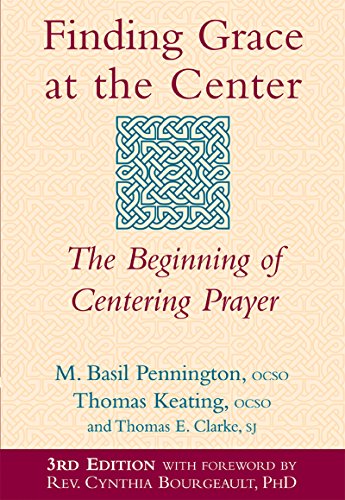
finding-grace-at-centerIn Finding Grace at the Center: the Beginning of Centering Prayer, a collection of essays by M. Basil Pennington, Thomas Keating, and Thomas E. Clarke, Thomas Keating provides an extremely helpful introduction to centering prayer based on The Cloud of Unknowing, a Carthusian monk’s prayer guide for novices dated to around the 14th century.

Keating is especially careful to avoid overselling what “happens” during centering prayer. One may not expect incredible revelations or to even be fully in control of what happens during this prayer. Rather, intention becomes essential as we enter this form of prayer.

Keating writes:


*****

“[Centering prayer] is not an end in itself, but a beginning. It is not to be done for the sake of an experience, but for the sake of its fruits in one’s life.”

*****

“The presence of God is like the atmosphere we breathe. You can have all you want of it as long as you do not try to take possession of it and hang on to it.”

*****

“Accept each period of centering prayer as it comes, without asking for anything, having no expectations. In that way its fruits will grow faster.”

*****

“We always want to possess. That is why it is so hard to leg go–why we want to reflect on moments of deep peace or union in order to remember how we got there and thus how to get back. But charity is non-possessive. It gives all back to God as fast as it comes. It keeps nothing for itself.”

*****

“Take everything that happens during the periods of centering prayer peacefully and gratefully, without putting a judgment on anything, and just let the thoughts go by. It does not matter where they come from, as long as you let them go by. Don’t worry about them.”

*****

Read more…


Friday Favorites for Prayer and Writing

Each Friday I share some of my favorite finds related to praying or writing. If I think it could help you pray or write better, then I’ll include it below.

Do you have someone else’s article or post to share? Join the Contemplative Writers Facebook group, comment on today’s post on my Facebook page, or follow me on Twitter (@edcyzewski) to nominate your favorite articles, blog posts, and books by Thursday at noon each week.


Hygge: A Heart-warning Lesson from Denmark (found via Michelle DeRusha’s newsletter)

Not All Habits Are Equal (Just read a lot, ok?)

9 Practices for Post-Election Contemplative Resiliency  (Since we don’t have a time machine yet…)

How to NOT Be Driven by Your Aversions

Characteristics of Healthy Spirituality


Keep the Contemplative Writer Sustainable

The Contemplative writer is ad-free and never shares sponsored content, but it is a lot of work to maintain. We rely on affiliate links from the books we share and the generous donations of our readers. An automated monthly gift as low as $1 per month or a one-time gift of $5 goes a long way to sustaining our mission to provide contemplative prayer resources for our readers.

Learn how your support, through a one-time gift or small monthly gifts can keep this website running: Support Us Today