Setting the World on Fire

April 28 – Wednesday of last week – was the Feast Day of St. Catherine of Siena, the 14th-century saint, mystic, reformer, and Doctor of the Church. I wanted to post about St. Catherine last week, but I was swimming in book edits.

On Catherine’s Feast Day, I noticed the quotations everyone was posting, especially this one: “Be who God meant you to be and you will set the world on fire.” This is surely Catherine’s most popular saying today. We see in it an encouragement to fulfill our destiny and bring our unique spirit to the world. Very good. Except this isn’t what Catherine said. Not exactly.

The quote we know is a paraphrase from one of Catherine’s letters to a nobleman named Stefano di Corrado Maconi, one of her disciples. For a long time, she tried to persuade Stefano to enter the monastery because she saw his spiritual depth. She also needed his practical help. In a letter, she asks him to use his influence on the Sienese government to support Pope Urban VI against the antipope (Clement VII). At the end of the letter, she says,

If you are what you ought to be, you will set fire to all Italy, and not only yonder.

Setting fire to Italy is no small thing. Italy was Catherine’s and Stefano’s primary sphere of influence. But she adds the words “and not only yonder,” by which she perhaps means the larger Christian world as well.

Stefano is to light this fire by being who he “ought to be.” But not on his own. Reading Catherine’s letter, it’s clear that Stefano should be who he ought to be in Christ. He needs to be filled with the remembrance and love of God and so embrace his true identity. He is to do this in two ways. First, he needs to stop monkeying around about his faith. Catherine quotes the time Jesus warned Christians about being lukewarm:

I, Catherine, servant and slave of the servants of Jesus Christ, write to thee in His precious Blood: with desire to see thee arise from the lukewarmness of thy heart, lest thou be spewed from the mouth of God, hearing this rebuke, ‘Cursed are ye, the lukewarm! Would you had at least been ice-cold!’
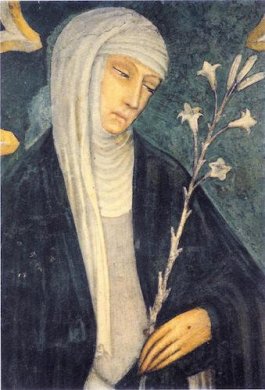
CatherineofSienaAnd second, Catherine urges haste. Stefano seems to be dithering in his support of the Church and in what Catherine believes to be his true vocation. She writes her letter to him with an urgency that I love. I read her words as if written to us today. The time is short, she seems to say. The day draws to a close. And I —you, we—are called to step into being who we are in Christ. Don’t be lukewarm! Be on fire for Jesus! Be filled with gratitude. God needs us, so let’s get to work. Now!

Being who we are in Christ is no small thing. It is, in fact, one of our biggest tasks in life. The world needs what we, each of us uniquely, have been gifted. It needs our God-given passions. It needs our fire. It needs us to illuminate our little spheres of influence, “and not only yonder.” But to set our Italys on fire, we need first to be filled with the fire of the Spirit. We can’t do it on our own.

It was only after Catherine died that Stefano embraced his vocation and became a Carthusian monk. How about us? Will we dither? Or will we embrace our God-given fire? Why do we delay? The time is short. The world is waiting.



LIVING IN PANDEMIC TIME: by Prasanta Verma

We’ve heard of kairos time and chronos time. Maybe, tongue in cheek, now we have “pandemic time”. Indeed, how do we define time during a pandemic? There is the slow, thick movement of monotonous days at home during quarantines. Simultaneously, there is the sense of urgency and flurry of activity at a hospital in the epicenter, where mere moments matter in saving a life. Time moves at both of these ends as well as somewhere in the middle, in the in-between. Maybe we are even naming our days “B.P.” for “Before Pandemic” and “A.P.” for “After Pandemic.”

Perhaps this is how we do name this strange time: an in-between time, a “pandemic time”. We are in-between what life used to be and what life will be on the other end of this particular stretch of time. In a sense, though, we have always really existed in an in-between time: we are constantly between any two tasks of a day, between morning and evening, between life and death, between the temporal and eternal.

Yet perhaps now we feel the existence of this middle state a little more keenly than we did before. We are distinctly more aware of this space of waiting, this “in-between” time.

I am reminded of the words of Madeleine L’Engle, who wrote in Walking In Water, “When I am constantly running there is no time for being. When there is no time for being there is no time for listening.”

I ponder these words, “no time for “being.” Who was I “being” before? Who do I need to be now, amidst the pandemic? And how much of the running B.P. (Before Pandemic) was necessary, fruitful, helpful? Does anything need to change? Who do I need to “be” After Pandemic?

What do I need to listen to in the midst of social isolation? Who should I listen to? With the usual face-to-face meetings and group gatherings turned virtual or disappearing for a while, what am I listening to? What was I missing amidst the noise, during the other routine, the before routine? Even now, it is hard to stick to a routine with the lack of structure and all other activities put on hold. Yet, I am asking myself what am I listening to now, and what do I need to listen to after, in this in-between time?

L’Engle continues, “but BEing time is never wasted time. When we are BEing, not only are we collaborating with chronological time, but we are touching on kairos, and are freed from the normal restrictions of time.”

How freeing it is to consider that our “BEing time is never wasted.” Even as we are trying to balance working from home while children may be tugging at our knees, amidst the challenges of finding new routines, new work-flows, the lack of structure, and the new challenges and blessings of more family time, we are not wasting our days if we are truly being in them. Anytime we are truly being in our days is not wasted, pandemic or no pandemic.

“If we are to be aware of life while we are living it, we must have the courage to relinquish our hard-earned control of ourselves,” writes L’Engle. The unique factor about our situation is the encompassing nature of it, as the entire world has been catapulted into a new reality and we all experience it simultaneously, in varying degrees. This situation is occurring beyond our control and we are on the back-end, maneuvering our way through and beyond. While the people on this planet together share the uncertainty and trauma of this new state of being, we are also learning, each in our own unique way, how much control we did not have. We each have new boundaries, new norms, new paradigms, and we will all face a new state of being “after”. As we have never lived through such a pandemic, we have no fallbacks, no “way-back-whens”, no other comparables. We are walking into the future together, yet also separate, in our own aloneness and our own new states of post-pandemic being, with the lessons the pandemic taught us.

While we may be living in isolation these days, L’Engle reminds us that, “Our story is never written in isolation. We do not act in a one-man play. We can do nothing that does not affect other people, no matter how loudly we say, ‘It’s my own business.’ ”

As we stand in this in-between place of Before Pandemic and After Pandemic, we are not truly existing in isolation. While we may not yet be able to visualize the practicalities and realities of our post-pandemic world, we can be certain that even while we operate in social isolation, our stories and our “beings” are all woven together in a social fabric of connection and belonging.

We, as individuals, as nations, as a planet, are undergoing challenges to our previous ways of being. We certainly do not have all the answers yet for those realities, but one thing we can control is our own individual attentiveness to “being” present where we are. It may be months or years before all of the stories and truths learned from these days will be presented or even manifested. But for now they exist, simmering under the surface, breathing silently in these days of isolation, in these in-between days, waiting for the right time to be unveiled. Each untold story being written right now will have its own perfect time of being.

***

Prasanta Verma, a poet, writer, and artist, is a member of The Contemplative Writer team. Born under an Asian sun, raised in the Appalachian foothills, Prasanta currently lives in the Midwest, is a mom of three, and also coaches high school debate. You can find her on Twitter @VermaPrasanta, Instagram prasanta_v_writer, and at her website: https://pathoftreasure.wordpress.com/.


Talking to God with Ignatius of Loyola

In 1548, Ignatius of Loyola published one of the most popular devotional books in Christian history – the Spiritual Exercises. This book is a compilation of meditations, prayers, and other practices. It is intended for use of a spiritual director, who is to guide individuals through the exercises.

I haven’t yet had the opportunity to do the Exercises with a spiritual director. Reading through them, however, I was struck by a couple things. One is Ignatius’s use of imaginative prayer, a form of contemplation that places us at the scene of a biblical story, inviting us to interact and converse with the characters. This is a very different type of contemplation than centering prayer, in which the mind is quiet and still, emptied of everything except a prayer word.

I was also intrigued by the “colloquy,” which is a conversation with God. Ignatius says that a colloquy is made “in the way one friend speaks to another . . . now begging a favor, now accusing oneself of some misdeed, now telling one’s concerns and asking counsel about them.” It usually occurs at the end of the exercise.

In the first Spiritual Exercise, which focuses on original sin, Ignatius suggests that we meditate on the cross of Christ. Then he suggests this colloquy, or conversation, with Christ:

Imagine Christ our Lord suspended on the cross before you, and converse with him in a colloquy: How is it that he, although he is the Creator, has come to make himself a human being? How is it that he has passed from eternal life to death here in time, and to die in this way for my sins?

This colloquy could be an interesting exercise for Holy Week. I realize that I am taking it out of context, but I wonder if it could function as a form of visio divina, in which we prayerfully meditate on a scene of the Crucifixion. Ignatius probably means for us imagine this scene in our mind’s eye, but I’m pairing it here with a painting of the Crucifixion (1627) by Francisco de Zurbarán, a Spanish artist who lived a bit later than Ignatius.

Zurbarán, Crucifixion

In this painting, Zurbarán puts the Crucifixion before our eyes with no distractions. There are no other figures in the painting and no background. We become the figures standing before the cross.

As you look at this painting, think of what you might say to Jesus this Holy Week. In the Spiritual Exercises, Ignatius suggests three ways we can talk to God. First, as quoted above, he says that we begin by marveling at Christ’s work on the cross: How is it that he, although he is the Creator, has come to make himself a human being? How is it that he has passed from eternal life to death here in time, and to die in this way for my sins?

Ignatius also suggests that we examine ourselves. He says:

In a similar way, reflect on yourself and ask: What have I done for Christ? What am I doing for Christ? What ought I to do for Christ?

Finally, Ignatius suggests simply talking to God. As you gaze on Christ, “speak out whatever comes to your mind.”

Marveling, examining, conversing: three rich ways to prayerfully engage with God this Holy Week.

So . . . what is on your heart? What would you say to Jesus? You can be sure that he is listening to you.


The Prayers of St. Catherine of Siena: A Video Series

Given what has come upon us — the pandemic, social distancing, uncertainty, isolation — I wanted to put some encouragement into the world. I’ve begun a video series in which I read a prayer, or a portion of a prayer, by St. Catherine of Siena, the 14th-century mystic, lay Dominican, church reformer, and Doctor of the Church. The first two readings are posted below.

Catherine’s prayers are beautiful and passionate, and I hope they will encourage you during this difficult time. I’m especially moved that St. Catherine so often prays for mercy and salvation for the entire world.

In this first prayer, Catherine pleads for mercy for the world:


The following prayer is very short and is a personal plea for God to renew our spirit:


Blessings and peace to all of you!


I’ll Pass; Or, How to Age Like a Star

This week, I’m sharing an article I recently wrote for The Perennial Gen on aging like a star, with help from the medieval mystic Hildegard of Bingen. You can begin here and continue at The Perennial Gen’s website. Thanks for reading! And…shine on.

***

Dedicated to Polaris, “a rapidly aging giant star”


The other day, I played a little game with my husband. I asked him, “What do you think? Could I pass for forty?”

He looked at me. Squinted a little. “Yes,” he said, and I think he was telling the truth.

“What about thirty-eight?” I pressed.

“Sure,” he said.

I should have left it there, but something made me continue. “Thirty-five?”

At that point he began to look skeptical.

This game with my husband was affectionate; we laughed and teased. But behind it lies a serious hang-up. The fact is, I play this age game all the time. I don’t always play it overtly, but I do it in my mind. Because I have small children, I reason, that surely makes me seem younger to people I meet. Because I choose my best photo for my social media avatar, maybe I seem more youthful online.

When I play this game, I’m not just holding on to youthful beauty. I also want to be relevant. Vibrant. Involved. I want to have something to offer. So I try to convince myself (and others) that I can pass for a woman who is younger than she is.

Read the rest at The Perennial Gen.


Scar on the Cheek: Betrayal: A Post by Prasanta Verma

As we meditate and pray during this season of Lent, one aspect of the upcoming days of Jesus’ trial is clear: there was a betrayal. This betrayal led the guards to finding Jesus, arresting him, and eventually his dying a brutal death nailed to a cross.

What is quite remarkable, however, is how Jesus responds to Judas. Even though Jesus knew what would happen, he still kept Judas near him as one of his twelve disciples.

The same is true for Peter. Jesus knew that Peter would deny him, yet Jesus still washed Peter’s feet.

Jesus still kept them near. He did not deny them nor betray them, but served and loved them.

If it were not Judas, though, it would have been someone else. It could have been me. Or you. God’s plan will be carried out. If we are honest, we know we also betray Jesus. Have we denied him? We betray him.

“There is no one righteous, not even one…” (Romans 3:10). Even so, to all of us who are unrighteous, we are all offered the gift of reconciliation to God Himself. We are all offered the hope of restoration and redemption. The scabs of our wounds, the scars of sin, and the scratches of pain may be healed, restored, and transformed into gifts that flow from our words, hands, and feet. We are new creatures, sewn up from the inside, able to give love and shine a light into darkness around us.

We have hope to live an abundant life on earth. We have hope for eternal life spent with God. With this kind of hope, this kind of love, our pain transforms into joy, which spreads to others in this hurting world—all made possible by forgiveness. That is love. That is Jesus.

Below is a poem I wrote a few years ago, meditating about Judas’ betrayal, our betrayal, Jesus’ response, and the hope and love that flowers and blossoms out of God’s love for us.

***


Scar on the Cheek

The kiss on the cheek
planted swift, turns
to thorny scratch, burns
long and thin, drips

red on black dirt.
Fragile petals live a breath
away, a thin vein from death.
Roses keep distant,

far from drawn swords
ready to impale petal-skin.
Repent and attempt
to pluck stems

of delicate short-lived beauty,
for arrangements in a vase,
that fragrance may erase
the scent of love’s demise.

But watch when red drips:
seeds bloom anew,
emit ethereal perfume, transform
into wild, vibrant, hybrid,

blood-red rose. Are you a rose?
Are you a thorn?
Or one scratched by scorn
of deceiver’s kiss?

Show me your scar.

(Prasanta, 2011)

***

Prasanta Verma, a poet, writer, and artist, is a member of The Contemplative Writer team. Born under an Asian sun, raised in the Appalachian foothills, Prasanta currently lives in the Midwest, is a mom of three, and also coaches high school debate. You can find her on Twitter @ pathoftreasure, Instagram prasanta_v_writer, and at her website: https://pathoftreasure.wordpress.com/.

Holy Tears and the Spiritual Joy of Lent

When I was growing up, my best friend and I often gave up Carmex (the medicated lip balm) for Lent. I’m not sure why we felt that was the best way to prepare for the resurrection of Jesus. I guess we believed that we had a Carmex addiction and were relinquishing something very dear to us.

During this season, I like to see what the ancients of the Church say about Lenten practices. Their views are much richer than what I knew of Lent as a child. Last week, we explored St. John Chrysostom’s full-orbed view of fasting. This week, let’s see what St. Benedict (ca. 480-547), founder of the Benedictine monastery at Monte Cassino, has to say.

In his Rule for Monasteries, written in the sixth century, St. Benedict includes a chapter entitled, “On the Observance of Lent.” He writes:

Although the life of a monk
ought to have about it at all times
the character of a Lenten observance,
yet since few have the virtue for that,
we therefore urge that during the actual days of Lent
the brethren keep their lives most pure
and at the same time wash away during these holy days
all the negligences of other times.
And this will be worthily done
if we restrain ourselves from all vices
and give ourselves up to prayer with tears,
to reading, to compunction of heart and to abstinence.


During these days, therefore,
let us increase somewhat the usual burden of our service,
as by private prayers and by abstinence in food and drink.
Thus everyone of his own will may offer God
“with joy of the Holy Spirit” (1 Thess. 1:6)
something above the measure required of him.
From his body, that is,
he may withhold some food, drink, sleep, talking and jesting;
and with the joy of spiritual desire
he may look forward to holy Easter.

For his monks, St. Benedict advises the moderate withholding of food, drink, sleep, and talking. But, like St. John Chrysostom, Benedict also has a fuller view of Lent. He suggests that ideally, Lent is a way of life. A difficult way, to be sure. Yet we are called to prepare our hearts for resurrection during all seasons.

Also note that St. Benedict has suggestions on what to add to our Lenten diet, not just what to give up. We might forego certain foods, but we can add prayer with tears, reading, and compunction of heart—that is, repentance; a holy desire to sin no more.

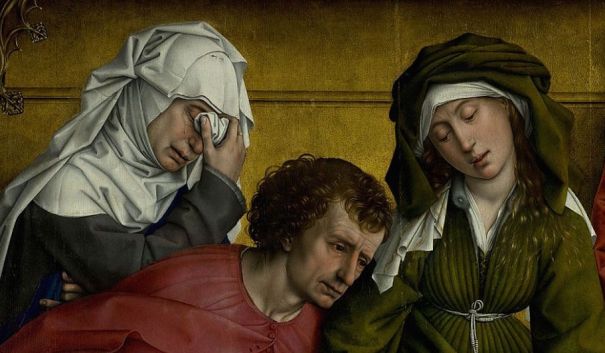
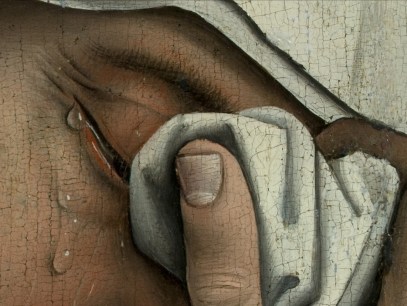
Speaking of tears, I love the depiction of the weeping Mary of Clopas in Rogier van der Weyden’s Descent from the Cross (ca. 1435). I think about this painting every year during Lent and Holy Week. In the painting, Mary and her companions express overwhelming sorrow as the body of Jesus is taken down from the cross. Mary of Clopas is the figure on the far left. Her tears, which escape from the cloth she has pressed to her eyes, are sacred outpourings of grief that we might emulate on our own journey to the cross.

Deposition - tears
Rogier van der Weyden, Descent from the Cross, ca. 1435, detail
Tears - van der Weyden
Rogier van der Weyden, Descent from the Cross, detail of Mary of Clopas

Yet Benedict ultimately moves us from tears to joy. At the end of the passage, he says that during Lent, Christians are to look forward to Easter with the “joy of spiritual desire.” We know that Easter brings joy, but so should the darker season of Lent bring a somber kind of joy — that of yearning for Christ, whose resurrection we await.

May this unique joy be yours as you prepare for resurrection and renewal in your own life.


Do You Fast? Prove It!

Among the practices we associate with Lent, fasting usually tops the list. Fasting from food and delicacies can be a form of preparation for Easter. We respond with our body to our soul’s hunger for God and for new spiritual life. More recently, fasting from social media has become popular.

Yet St. John Chrysostom (c. 349-407), Archbishop of Constantinople and early Church Father, bids us be careful about fasting. He recommends the practice wholeheartedly, devoting several sermons to its benefits. But he also has words of caution. He warns against boasting and asks if we have remembered to fast not just from food but also from some of our more pernicious behaviors. “For the honor of fasting consists not in abstinence from food, but in withdrawing from sinful practices,” he said. In Homily XVI (Homilies on the Statues), Chrysostom writes:

It is common for every one to ask in Lent, how many weeks each has fasted; and some may be heard saying they have two, others three, and others that they have fasted the whole of the weeks. But what advantage is it, if we have gone through the fast devoid of works? If another says, “I have fasted the whole of Lent,” you should say, “I had an enemy, but I was reconciled; I had a custom of evil-speaking, but I put a stop to it; I had a custom of swearing, but I have broken through this evil practice.”

In his book, Fasting, Scot McKnight calls this a “full-orbed” view of fasting because it’s a way of life, not merely a limited and temporary practice. Here’s another taste (if you’ll forgive the pun) from St. Chrysostom:

Do not just let your mouth fast, but also the eye and the ear and the feet and the hands and all the members of our bodies. Let the hands fast by being pure from theft and avarice. Let the feet fast by ceasing from running to the unlawful spectacles . . . Let the mouth fast as well from disgraceful speeches and railing.

Chrysostom also mentions that fasting can include serving those in need: “Do you fast? Prove it by your good works . . . If you see a poor man, take pity on him!” The point of a fast is not to endure a temporary privation, but to enter a new way of life. The fast goes on, even when Lent is over and we’re all stuffing our faces again.

I love Chrysostom’s emphasis on serving and on being reconciled with our enemies. He seems to imply that he’s not even going to believe that you’re fasting unless you’re ALSO looking out for your neighbor. Fasting can be not just a path to spiritual growth, but a means of justice as well.

In what ways might you consider fasting this season?

The Making: A Lenten Poem by Prasanta Verma

The Making
 

Scattered, broken particles
must be remade
after life on earth snaps,
crushes each bone, sinew, organ
into first-born
molecules

Dust catches in throat
chokes irrelevancy

Smeared ashes
reconstruct
into wooden cross beams

unmade – made – remade


***


Prasanta Verma, a poet, writer, and artist, is a member of The Contemplative Writer team. Born under an Asian sun, raised in the Appalachian foothills, Prasanta currently lives in the Midwest, is a mom of three, and also coaches high school debate. You can find her on Twitter @ pathoftreasure, Instagram prasanta_v_writer, and at her website: https://pathoftreasure.wordpress.com/.


The Smallest Thing Will Not Be Forgotten

Last week, we explored Julian of Norwich’s famous phrase, “All will be well.” We found that it refers to the “necessity” of sin and God’s grand plan of salvation. It points us to the end of time, when God’s purposes for the world will be accomplished. But I want to emphasize that Julian’s saying is also full of comfort for the here and now.

In the Showings, Julian continues to marvel and reflect on the idea that “all will be well.” She says:

He [God] wants us to know that he takes heed not only of things which are noble and great, but also of those which are little and small, of humble men and simple, of this man and that man. And this is what he means when he says: Every kind of thing will be well. For he wants us to know that the smallest thing will not be forgotten. (231-232)

How I love this thought. The smallest thing will not be forgotten. We have a God who sees the small and the simple. And that means that he sees us; sees you and me. God delights not (just) in grand gestures and great deeds; he notices the humblest acts of faith. He loves not just the heroes and saints; he loves this particular man and that particular woman. He loves us in all our marvelous idiosyncracies. In our unique presence. Our ordinariness. And in our insignificance.

hazelnutThis passage on smallness reminds me of one of Julian’s earlier visions. God showed Julian something no bigger than a hazelnut lying in the palm of her hand.

Julian says, “I looked at it and thought: What can this be? And I was given this general answer: It is everything which is made.” (130) God preserves such a small thing, Julian writes, because he created it and loves it.

In something as small as a hazelnut, the whole world can be contained. In something as small as you and me, God finds something of incredible value. Something worth rectifying the world for.

We have to wait until the end – until God’s time – to see exactly how he will rectify every thing, both large and small. But we have this consolation now: we are not lost. We are not forgotten. God takes heed of us. We are swept up in his plans to make all things well.

Julian says that in God’s promise to make well even the smallest of things, we find rest and peace. We are powerfully comforted.

Do you believe, as small and insignificant as you are, that “all will be well” both for the world and for you? I leave you with Lady Julian’s encouragement:

“Accept it now in faith and trust, and in the very end you will see truly, in fulness of joy.”