Blog

CONTEMPLATIVE PROFILE: THE MYSTICISM OF ST. AUGUSTINE

Most of us know St. Augustine as a Church Father and theologian. This week, I discovered that Augustine can also be considered a mystic. The church historian Dom Cuthbert Butler called him “the Prince of Mystics” because, in works like the Confessions, Augustine speaks of traveling inward to meet God. He also writes of experiencing the divine presence of God and of seeing God invisibly.

I suppose it’s not too surprising to think of Augustine as a mystic since, according to some–and this is a view I also espouse–every Christian is a mystic. We’re designed to encounter God, to experience his divine presence, and to yearn for greater intimacy with him.

In that vein, I want to quote a somewhat mystical passage from Augustine’s Confessions. I have long loved this passage for the beauty of Augustine’s language and the passion with which he seeks to meet God within. This is a spirituality of longing, and it’s on my heart this week. Early in the Confessions, Augustine calls upon God to come to him–to come into him, in fact. But no sooner does he call than questions arise:

But what place is there in me where my God can enter into me? . . . Where may he come to me? Lord my God, is there any room in me which can contain you?

A little later, Augustine gives the answer. There’s not just a room but a house. However, there are some problems with this house:

The house of my soul is too small for you to come to it. May it be enlarged by you. It is in ruins: restore it. In your eyes it has offensive features. I admit it, I know it; but who will clean it up? Or to whom shall I cry other than you?

We cry out to God in mercy to rebuild and restore the house of our soul. God cleans up the house he intends to inhabit. That’s a good first step on the mystical journey, and it’s where I am right now. I’m feeling my own lack and asking God to restore my house that I might meet him there. I’m encouraged that there’s the potential for such a beautiful and spacious place inside me.

Does your heart similarly cry out to God? Have you ever experienced this intense longing for the Creator?

Read St. Augustine’s Confessions here.

WEEKLY PRAYER

Pilot of the soul,
Guide of the righteous,
and Glory of the saints:
grant us, O Lord, eyes of knowledge ever to see thee
and ears also to hearken unto thy word alone.
When our souls have been filled with thy grace,
create in us pure hearts, O Lord,
that we may ever understand thy greatness,
who art good and a lover of men.
O our God, be gracious to our souls,
and grant unto us thy humble servants
who have received thy body and blood,
a pure and steadfast mind,
for thine is the Kingdom, O Lord,
blessed and glorious, Father, Son, and Holy Spirit.

— an Ethiopian liturgical prayer (source)

WEEKLY PRAYER: CATHERINE OF SIENA

A prayer from St. Catherine of Siena (1347-1380):

O Holy Spirit, come into my heart;
by your power draw it to yourself, God,
and give me charity with fear.

Guard me, Christ, from every evil thought,
and so warm and enflame me again
with your most gentle love
that every suffering may seem light to me.

My holy Father and my gentle Lord,
help me in my every need.
Christ love! Christ love!

Source

HOLY SATURDAY’S WORK: A POEM BY KELLY CHRIPCZUK

Today is Good Friday. Instead of posting our usual Friday Favorites, I thought it would be more appropriate to give us a beautiful piece on which to reflect as we head into Easter weekend.

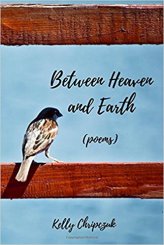
So, today, I’d like to share a poem by Kelly Chripczuk, an amazing writer and a friend of The Contemplative Writer. Her poem, entitled “Holy Saturday’s Work,” is from her new book, Between Heaven and Earth. I hope that you’ll savor Kelly’s words today and especially tomorrow as you wait in the already-but-not-yet of Holy Saturday.

*****

Holy Saturday’s Work

(for that which is already, but not yet)

Go outside and kneel
beside still-sleeping beds.
Strip away all that’s dead;
the leaves, brown and curled,
and the dry, empty stems
of last year’s flowers.
Straighten, one-by-one,
the scallop-edged bricks
that have stood, leaning,
all year-long like forgotten
gravestones. Roll the giant
flowerpot aside and wonder
at the sound of stone
scraping against stone.

*****

Kelly Chripczuk is a writer, speaker, and spiritual director who lives on a small farm in Central PA. Read more and sign up for her monthly email reflections at www.thiscontemplativelife.org.

Kelly's book
Kelly’s new book of poems, Between Heaven and Earth, is available here.


A PRAYER FOR HOLY WEEK

A prayer for Holy Week from Henri Nouwen:

Dear Lord, your disciple Peter wanted to know who would betray you. You pointed to Judas but a little later also to him. Judas betrayed, Peter denied you. Judas hanged himself, Peter became the apostle whom you made the first among equals. Lord, give me faith, faith in your endless mercy, your boundless forgiveness, your unfathomable goodness. Let me not be tempted to think that my sins are too great to be forgiven, too abominable to be touched by your mercy. Let me never run away from you but return to you again and again, asking you to be my Lord, my Shepherd, my Stronghold, and my Refuge. Take me under your wing, O Lord, and let me know that you do not reject me as long as I keep asking you to forgive me. Perhaps my doubt in your forgiveness is a greater sin than the sins I consider too great to be forgiven. Perhaps I make myself too important, too great when I think that I cannot be embraced by you anymore. Lord, look at me, accept my prayer as you accepted Peter’s prayer, and let me not run away from you in the night as Judas did.

Bless me, Lord, in this Holy Week, and give me the grace to know your loving presence more intimately. Amen.

Source

BOOK OF THE MONTH: WONDROUS ENCOUNTERS BY RICHARD ROHR

Week 5: The Way Up is the Way Down

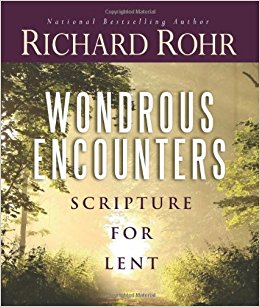
Rohr Lent coverIn our final week of Wondrous Encounters by Richard Rohr, we’re contemplating the beautiful early Christian hymn found in Philippians 2. This is a good passage to ponder at the beginning of Holy Week because it lets us see the mind of Christ—the mind that chose to embrace death for our sake.

In many ways, the mind of Christ is not like our mind at all. Rohr writes:

God . . . has chosen to descend—in almost total counterpoint with our humanity that is always trying to climb, achieve, perform, and prove itself. He invites us to reverse the process too.

***

The hymn says that Jesus leaves the ascent to God, in God’s way, and in God’s time. What freedom! And it happens, better than any could have expected. “And because of this, God lifted him up, and gave him the name above all other names.” We call it resurrection or ascension. . . Who would have presumed that the way up could be the way down? It is, as Paul says, “the Secret Mystery.”

***

God draws us into Christ’s ascent, Christ’s mind, and this gives us freedom:

Trust the down, and God will take care of the up. This leaves humanity in solidarity with the life cycle, but also with one another, with no need to create success stories for itself . . . Humanity in Jesus is free to be human and soulful instead of any false climbing into “Spirit.” This was supposed to change everything, and it still will.

***

Scripture Reading:

Your mind must be the same as Christ’s. Though he was in the form of God, he did not deem equality with God as something to be clung to. Instead he emptied himself, and became like a slave, and was born in the likeness of humanity . . . obediently accepting even death. — Philippians 2:5-7

***

May the way up be the way down for you this Holy Week.

Read Wondrous Encounters here.

FRIDAY FAVORITES FOR PRAYER AND WRITING

Welcome back to Friday Favorites, a weekly round-up of finds related to prayer and writing. If I think something could help you pray or write better, or just “be” better, I’ll include it below.

Do you have someone else’s article or post to share? Join the Contemplative Writers Facebook group, comment on today’s post on my Facebook page, or follow me on Twitter (@LisaKDeam) to nominate your favorite articles, blog posts, and books by Thursday at noon each week.

*****

The Blessing of the In-Between Space via Leah Abraham (on the in-between spaces in the journey of life) #WOCwithpens

Joy & My Writing Tribe via Jasminne Mendez (finding joy even when someone tries to rob you of it) #WOCwithpens

God’s Greening Work via Laura M. Fabrycky (let the medieval mystic Hildegard of Bingen and the Latin concept of viriditas help you welcome in the season of spring) #Lent

Why Many Evangelicals Struggle with Prayer (TLDR: We’re Winging It) via Ed Cyzewski (why it’s good to join with the community of saints when you pray)

How Far Will You Walk to Get to Jerusalem via Lisa Deam (listen in as I’m interviewed on KFUO radio about medieval pilgrimage and our own journey of faith) #Lent

Literature as a Gospel Forerunner: Finding Hope in A Wrinkle in Time via Tatyana Claytor (a great post about climbing the rungs of stories to reach the Gospel)

The Secret to Being Fully Present via Ann Patchett (Ann Patchett, an author I love, talks about reading as an antidote to fragmentation and distraction. I think writing is also a wonderful way to be more fully present, don’t you?)

BOOK OF THE MONTH: WONDROUS ENCOUNTERS BY RICHARD ROHR

Rohr Lent coverWeek Four: What Is Life and What Is Death?

This month at The Contemplative Writer, we’re reading Wondrous Encounters by Richard Rohr. Rohr is leading us through some Scripture meditations for the season of Lent.

The Scripture reading for yesterday, the fifth Sunday of Lent, is John 11:1-45, and its theme is key: life and death. Rohr writes:

Humans are the  only creatures who have knowledge of their own death . . . This places humans in a state of anxiety and insecurity from our early years.

***

On this last Sunday before Palm Sunday, we dare to look at the “last enemy,” death. And the only way we can dare to part the curtain and view death is to be told about our resurrection from it!

***

We get a foretaste of resurrection in the raising of Lazarus, from the Gospel of John. Many of us are familiar with this story: in calling forth Lazarus from the grave, Jesus conquers death! I love what Rohr emphasizes about this passage:

[I]n a final brilliant finale to the story, he [Jesus] invites the onlookers to join him in making resurrection happen: “Move the stone away!. . . Unbind him, and let him go free!” It seems that we have a part to play in creating a culture of life and resurrection. We must unbind one another from our fears and doubts about the last enemy, death.

***

The stone to be moved away is always our fear of death, the finality of death, any blindness that keeps us from seeing that death is merely a part of the Larger Mystery called Life. It does not have the final word.

***

Scripture Reading:

‘This sleep is not to end in death, but is instead to reveal the glory of God’. . . . With a sigh that came straight from the heart . . . He cried out in a loud voice, ‘Move the stone away! . . . Lazarus, come forth!’ . . . ‘Now, you unbind him and let him go free.’ — Jon 11:4, 34, 38, 43-44

***

Even as we prepare to accompany Jesus to his own death during this Lenten season, may we always remember that he is the resurrection and the life.

Read Wondrous Encounters here.