Contemplative Profiles: Thomas Merton

This month’s contemplative profile by historian Lisa Deam is Thomas Merton:

In several of his written works, Thomas Merton explores the idea of the spiritual life as a journey. While we may like to envision our path as being clearly laid out and free of obstruction, Merton realizes that in reality we’re often groping in the dark. He highlights one of the great paradoxes of the Christian faith—we travel, sometimes blindly, to a destination that we already possess. His reflections on life’s journey offer hope as we take the road to Bethlehem this Advent season.

*****

“In one sense we are always traveling, and traveling as if we did not know where we were going. In another sense we have already arrived. We cannot arrive at the perfect possession of God in this life, and that is why we are traveling and in darkness. But we already possess Him by grace, and therefore, in that sense, we have arrived and are dwelling in the light. But oh! How far have I to go to find You in Whom I have already arrived!” (The Seven Storey Mountain)

*****

“My Lord God, I have no idea where I am going. I do not see the road ahead of me. I cannot know for certain where it will end. Nor do I really know myself, and the fact that I think that I am following your will does not mean that I am actually doing so. But I believe that the desire to please you does in fact please you. And I hope I have that desire in all that I am doing. I hope that I will never do anything apart from that desire. And I know that if I do this you will lead me by the right road though I may know nothing about it. Therefore will I trust you always though I may seem to be lost and in the shadow of death. I will not fear, for you are ever with me, and you will never leave me to face my perils alone.” (Thoughts in Solitude)

*****

Reflection: Where am I on my journey with God today?


About Lisa Deam

Lisa Deam writes and speaks about Christian spiritual formation from a historical perspective. She’s the author of A World Transformed: Exploring the Spirituality of Medieval Maps. Visit her on Twitter @LisaKDeam and at lisadeam.com.
 

Contemplative Profiles: Thomas Merton

This month’s contemplative profile by historian Lisa Deam is Thomas Merton:

Thomas Merton (1915-1968) was a Trappist monk, a beloved modern contemplative, and a prolific writer. He left us many books and essays on the spiritual life. When I read Merton, I’m especially struck by the way he confronts and even embraces the difficulties of living the Christian life. Following Jesus is not easy, and Merton knows this. His frank admission of his struggles ministers to us in our own.

Regarding his internal struggles and contradictions, Merton writes:

*****

“I have become convinced that the very contradictions in my life are in some ways signs of God’s mercy to me: if only because someone so complicated and so prone to confusion and self-defeat could hardly survive for long without special mercy.” (A Thomas Merton Reader)

*****

“Paradoxically, I have found peace because I have always been dissatisfied. My moments of depression and despair turn out to be renewals, new beginnings . . . All life tends to grow like this, in mystery inscaped with paradox and contradiction, yet centered, in its very heart, on the divine mercy . . . and the realization of the ‘new life’ that is in us who believe, by the gift of the Holy Spirit. “ (A Thomas Merton Reader)

*****

Such paradoxes define the life of faith. About each person’s struggle with both internal and external darkness, Merton says:

*****

“Those who continue to struggle are at peace. If God wills, they can pacify the world.  For he[/she] who accepts the struggle in the name of Christ is delivered from its power by the victory of Christ.” (A Thomas Merton Reader)

*****

Read more about Merton at the Abbey of Gethsemani.

Reflection

How willing am I to embrace and learn from the contradictions and struggles in my spiritual life?


About Lisa Deam

Lisa Deam writes and speaks about Christian spiritual formation from a historical perspective. She’s the author of A World Transformed: Exploring the Spirituality of Medieval Maps. Visit her on Twitter @LisaKDeam and at lisadeam.com.

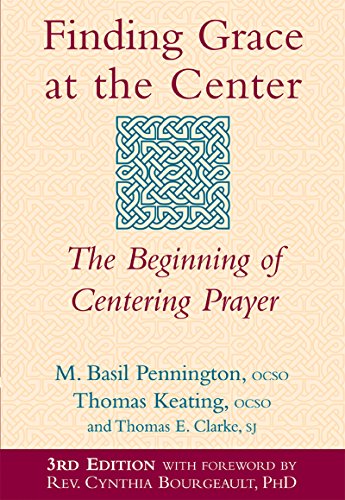
Featured Book: Finding Grace at the Center

Week Three: Prayer without Judgment or Evaluation

finding-grace-at-centerIn Finding Grace at the Center: the Beginning of Centering Prayer, a collection of essays by M. Basil Pennington, Thomas Keating, and Thomas E. Clarke, Thomas Keating provides an extremely helpful introduction to centering prayer based on The Cloud of Unknowing, a Carthusian monk’s prayer guide for novices dated to around the 14th century.

Keating is especially careful to avoid overselling what “happens” during centering prayer. One may not expect incredible revelations or to even be fully in control of what happens during this prayer. Rather, intention becomes essential as we enter this form of prayer.

Keating writes:


*****

“[Centering prayer] is not an end in itself, but a beginning. It is not to be done for the sake of an experience, but for the sake of its fruits in one’s life.”

*****

“The presence of God is like the atmosphere we breathe. You can have all you want of it as long as you do not try to take possession of it and hang on to it.”

*****

“Accept each period of centering prayer as it comes, without asking for anything, having no expectations. In that way its fruits will grow faster.”

*****

“We always want to possess. That is why it is so hard to leg go–why we want to reflect on moments of deep peace or union in order to remember how we got there and thus how to get back. But charity is non-possessive. It gives all back to God as fast as it comes. It keeps nothing for itself.”

*****

“Take everything that happens during the periods of centering prayer peacefully and gratefully, without putting a judgment on anything, and just let the thoughts go by. It does not matter where they come from, as long as you let them go by. Don’t worry about them.”

*****

Read more…


Friday Favorites for Prayer and Writing

Each Friday I share some of my favorite finds related to praying or writing. If I think it could help you pray or write better, then I’ll include it below.

Do you have someone else’s article or post to share? Join the Contemplative Writers Facebook group, comment on today’s post on my Facebook page, or follow me on Twitter (@edcyzewski) to nominate your favorite articles, blog posts, and books by Thursday at noon each week.


Hygge: A Heart-warning Lesson from Denmark (found via Michelle DeRusha’s newsletter)

Not All Habits Are Equal (Just read a lot, ok?)

9 Practices for Post-Election Contemplative Resiliency  (Since we don’t have a time machine yet…)

How to NOT Be Driven by Your Aversions

Characteristics of Healthy Spirituality


Keep the Contemplative Writer Sustainable

The Contemplative writer is ad-free and never shares sponsored content, but it is a lot of work to maintain. We rely on affiliate links from the books we share and the generous donations of our readers. An automated monthly gift as low as $1 per month or a one-time gift of $5 goes a long way to sustaining our mission to provide contemplative prayer resources for our readers.

Learn how your support, through a one-time gift or small monthly gifts can keep this website running: Support Us Today


Contemplative Profiles: Evelyn Underhill

Week Three: United in Praise

Contemplative profiles are back with the help of author and historian Lisa Deam. This month we’re featuring Evelyn Underhill:

We belong to different denominations and often have different approaches to prayer and worship. Yet God’s truth unites us. In her book, Worship, Evelyn Underhill describes the various streams of Christianity coming together to praise the God who became incarnate in time and space:

“The monk or nun rising to recite the Night Office that the Church’s praise of God may never cease, and the Quaker waiting in silent assurance on the Spirit given at Pentecost; the ritualist, ordering with care every detail of a complicated ceremonial that God may be glorified thereby, and the old woman content to boil her potatoes in the same sacred intention; the Catholic burning a candle before the symbolic image of the Sacred Heart or confidently seeking the same Divine Presence in the tabernacle, and the Methodist or Lutheran pouring out his devotion in hymns to the Name of Jesus; the Orthodox bowed down in speechless adoration at the culminating moment of the Divine Mysteries, and the Salvationist marching to drum and tambourine behind the banner of the Cross – all these are here at one. Their worship is conditioned by a concrete fact; the stooping down of the Absolute to disclose Himself within the narrow human radius, the historical incarnation of the Eternal Logos within time.”

Many practices, one praise. What a beautiful picture of God’s diverse people becoming one in response to the gift of his son!

For Reflection

How can I use my distinctive faith tradition to pray to and worship God this week?


About Lisa Deam

Lisa Deam writes and speaks about Christian spiritual formation from a historical perspective. She’s the author of A World Transformed: Exploring the Spirituality of Medieval Maps. Visit her on Twitter @LisaKDeam and at lisadeam.com.
Scripture Meditation: Don’t Think Too Hard about It…

“The Lord knows people’s thoughts; he knows they are worthless! Joyful are those you discipline, Lord, those you teach with your instructions.”
– Psalm 94:11-12, NLT

What better motivation to pursue the silence and rest of contemplative prayer than to read that God knows our thoughts are worthless!

While there is a great deal in scripture that praises meditating on scripture and remembering God’s laws, this Psalm offers a reality check for the times when we rely on our own wisdom. Most importantly, we find that even when God sees our inadequacies and failures, he responds with mercy and instruction.

Even when God knows that we will fall short over and over again, he desires to give us the joy of his instruction and discipline. May we find God’s loving direction, even as we discover the folly of our wisdom.

Book of the Month: Finding Grace at the Center

finding-grace-at-centerWeek Two: Transformed in Silence

In Finding Grace at the Center: the Beginning of Centering Prayer, a collection of essays by M. Basil Pennington, Thomas Keating, and Thomas E. Clarke, M. Basil Pennington writes about the transformation that comes in the practice of centering prayer.

Perhaps the most surprising aspect of centering prayer for those new to it is the manner in which God transforms our lives in silence. There is no way to measure or evaluate your progress in the moment.

The transformation of our lives happens gradually by faith, much like the way a branch that abides in its vine can grow fruit.


*****

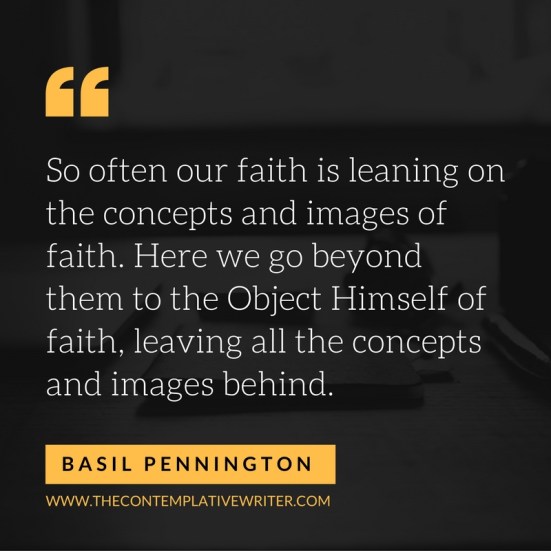
“Perhaps in this prayer we will for the first time really act in pure faith. So often our faith is leaning on the concepts and images of faith. Here we go beyond them to the Object Himself of faith, leaving all the concepts and images behind.”

*****

“If we have lots of thoughts-good, lots of tension is being released; if we have few thoughts-good, there was no need for them… All these are purely accidental; they do not touch the essence of prayer, which goes on in all its purity, whether these be present or not.”

*****

“If we are faithful to this form of prayer, making it a regular part of our day, we very quickly come to discern-and often others discern it even more quickly-the maturing in our lives of the fruits of the Spirit.”

*****

“We begin… to experience the presence of God in all things, the presence of Christ in each person we meet. Moreover, we sense a oneness with them.”

*****

Read more…


For Reflection

featured-book-november-14


Scripture Meditation: Servants Don’t Need to Be in Charge

“Mary responded, ‘I am the Lord’s servant. May everything you have said about me come true.’ And then the angel left her.” Luke 1:38, NLT

How do we live by faith today? Mary faced one of the greatest stretches of faith that anyone could face, and she remained able to fully trust in God’s provision and plan because she knew her place.

As God’s servant, Mary only had to trust what God showed her.

It wasn’t up to Mary to figure out the plan or to provide the means. She didn’t imagine that she was in charge in any way, and with herself entrusted to God’s care, she didn’t have to be worry about what happens next.

Living by faith as the servants of God makes it possible to approach the challenges of each day with a peaceful confidence in God’s provision.

Book of the Month: Finding Grace at the Center

Week One: We Are Made to Love and to Be Loved

finding-grace-at-centerIn Finding Grace at the Center: the Beginning of Centering Prayer, a collection of essays by M. Basil Pennington, Thomas Keating, and Thomas E. Clarke, we find a brief and generally accessible (2 out of 3 essays at least) introduction to centering prayer and contemplation. The most important step at the outset is to reorient ourselves around God’s reality rather than our own.

We simply won’t proceed into centering prayer without accepting God’s love for us, learning to stop expending effort in order to pray, and stepping away from our many priorities and activities.

This opening essay by M. Basil Pennington offers several grounding statements that can provide the foundation we need to move forward into prayer:

*****

“We have been baptized into Christ. We are in some very real, though mysterious way, Christ, the Son of God, the Second Person of the Blessed Trinity. ‘I live, now not I, but Christ lives in me’ (Gal. 2:20). As we go to the depths we realize in faith our identity with Christ the Son.”

*****

“In a movement of faith that includes hope and love, we go to the center and turn ourselves over to God in a simple ‘being there,’ in a presence that is perfect and complete adoration, response, love, and ‘Amen’ to that movement that we are in the Son to the Father.”

*****

“In practice most of us work as though God could not possibly get things done if we did not do them for Him. The fact is there is nothing that we are doing that God could not raise up a stone in the field to do for Him.”

*****

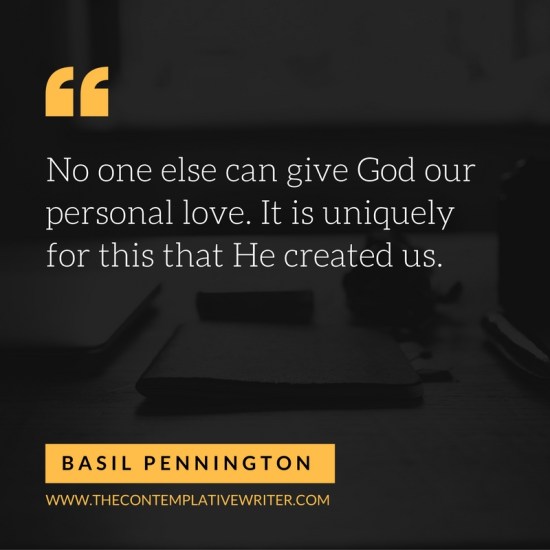
“No one else can give God our personal love. It is uniquely for this that He created us.”

*****

“If we expend great effort, then when it is done we can pat ourselves on the back and salute ourselves for our great accomplishment. This prayer leaves no room for pride. We have but to let go and let it be done unto us according to His revealed Word.”

*****

Read more…


For Reflection

Featured Book November 7.jpg

Contemplative Profiles: Evelyn Underhill

Contemplative profiles are back with the help of author and historian Lisa Deam. This month we’re featuring Evelyn Underhill:

Lately I’ve enjoyed getting to know some of the modern contemplatives and mystics. One of these is the Anglo-Catholic writer Evelyn Underhill (1875-1941). Underhill offered scholarly studies on great mystics from the past — she called them giants and heroes. At the same time, she insisted that the life of prayer and contemplation belongs to every ordinary person. No heroism necessary.

Underhill also believed that contemplation belongs to every era — eras of conflict and eras of peace. One of her early books, Practical Mysticism (free on Kindle!), was released at the beginning of World War I. Underhill almost postponed its publication out of concern that its subject matter would seem inapplicable or, even worse, selfish and otherworldly. But she decided that there was no better time to nourish the spiritual life.

We, too, live in times of turmoil and conflict. As Christians, we’re acutely aware of the world’s brokenness. This month we’ll explore what, according to Underhill, Christian contemplation offers us in troubled (as well as more peaceful) times.

I’ll leave you with some quotes from Practical Mysticism on the applicability of contemplation for every Christian.

For those who embrace it, the contemplative life “will teach them to see the world in a truer proportion, discerning eternal beauty beyond and beneath apparent ruthlessness. It will educate them in a charity free from all taint of sentimentalism; it will confer on them an unconquerable hope . . .”

*****

“Though it is likely that the accusation will annoy you, you are already in fact a potential contemplative: for this act, as St. Thomas Aquinas taught, is proper to all . . .  is, indeed, the characteristic human activity.”

Read more about Underhill in the Fuller Studio.


About Lisa Deam

Lisa Deam writes and speaks about Christian spiritual formation from a historical perspective. She’s the author of A World Transformed: Exploring the Spirituality of Medieval Maps. Visit her on Twitter @LisaKDeam and at lisadeam.com.