FRIDAY FAVORITES FOR PRAYER AND WRITING

Welcome, friends, to Friday Favorites. The world seems a bit different this week, doesn’t it? There is fear and anxiety over the rapidly emerging public health crisis. There is disappointment as events are cancelled and loneliness creeps in. There is concern for the most vulnerable in our society.

This week, Prasanta Verma and I offer prayers and posts to help us in these troubled times. The first four links below concern the Coronavirus and our spiritual response to it. We also have a post on holding on to hope and a beautiful resource for Lent.

Keep prayer, hope, and beauty in your lives this week and always.

Love from Lisa and Prasanta

***


A Coronavirus Prayer via Kerry Weber (a prayer for this time)

Social Distancing with Jesus via Michelle Van Loon (finding comfort and courage in a time of concern)

The Spiritual Practice of Social Distancing via Charlotte Donlon (social distancing to protect the vulnerable among us)

The Surprising Gift of Cancelling Plans and Staying Home via Lesley Sebek Miller (with forced stillness and quarantines, we have the opportunity for quality time and creativity . . . what will you do with this gift?)

Are You Tending a Deep Hope? via April Yamasaki (when you’re tending a deep hope yet not seeing results)

The Lent Project via Biola University (daily Scripture reading, artwork, poem, and devotional–beautifully done)

Holy Tears and the Spiritual Joy of Lent

When I was growing up, my best friend and I often gave up Carmex (the medicated lip balm) for Lent. I’m not sure why we felt that was the best way to prepare for the resurrection of Jesus. I guess we believed that we had a Carmex addiction and were relinquishing something very dear to us.

During this season, I like to see what the ancients of the Church say about Lenten practices. Their views are much richer than what I knew of Lent as a child. Last week, we explored St. John Chrysostom’s full-orbed view of fasting. This week, let’s see what St. Benedict (ca. 480-547), founder of the Benedictine monastery at Monte Cassino, has to say.

In his Rule for Monasteries, written in the sixth century, St. Benedict includes a chapter entitled, “On the Observance of Lent.” He writes:

Although the life of a monk
ought to have about it at all times
the character of a Lenten observance,
yet since few have the virtue for that,
we therefore urge that during the actual days of Lent
the brethren keep their lives most pure
and at the same time wash away during these holy days
all the negligences of other times.
And this will be worthily done
if we restrain ourselves from all vices
and give ourselves up to prayer with tears,
to reading, to compunction of heart and to abstinence.


During these days, therefore,
let us increase somewhat the usual burden of our service,
as by private prayers and by abstinence in food and drink.
Thus everyone of his own will may offer God
“with joy of the Holy Spirit” (1 Thess. 1:6)
something above the measure required of him.
From his body, that is,
he may withhold some food, drink, sleep, talking and jesting;
and with the joy of spiritual desire
he may look forward to holy Easter.

For his monks, St. Benedict advises the moderate withholding of food, drink, sleep, and talking. But, like St. John Chrysostom, Benedict also has a fuller view of Lent. He suggests that ideally, Lent is a way of life. A difficult way, to be sure. Yet we are called to prepare our hearts for resurrection during all seasons.

Also note that St. Benedict has suggestions on what to add to our Lenten diet, not just what to give up. We might forego certain foods, but we can add prayer with tears, reading, and compunction of heart—that is, repentance; a holy desire to sin no more.

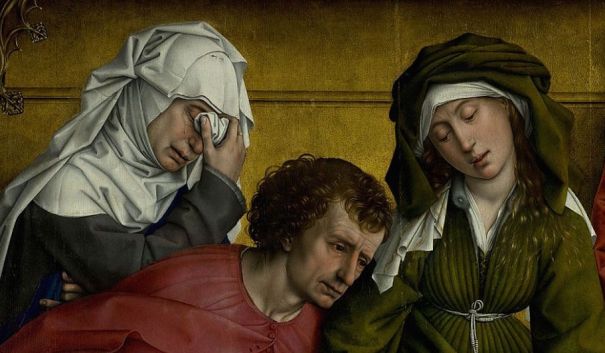
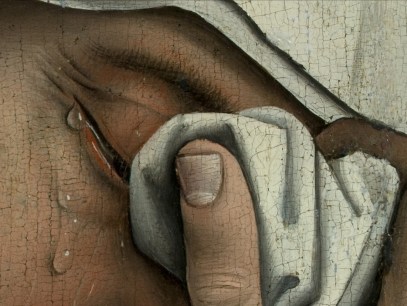
Speaking of tears, I love the depiction of the weeping Mary of Clopas in Rogier van der Weyden’s Descent from the Cross (ca. 1435). I think about this painting every year during Lent and Holy Week. In the painting, Mary and her companions express overwhelming sorrow as the body of Jesus is taken down from the cross. Mary of Clopas is the figure on the far left. Her tears, which escape from the cloth she has pressed to her eyes, are sacred outpourings of grief that we might emulate on our own journey to the cross.

Deposition - tears
Rogier van der Weyden, Descent from the Cross, ca. 1435, detail
Tears - van der Weyden
Rogier van der Weyden, Descent from the Cross, detail of Mary of Clopas

Yet Benedict ultimately moves us from tears to joy. At the end of the passage, he says that during Lent, Christians are to look forward to Easter with the “joy of spiritual desire.” We know that Easter brings joy, but so should the darker season of Lent bring a somber kind of joy — that of yearning for Christ, whose resurrection we await.

May this unique joy be yours as you prepare for resurrection and renewal in your own life.


A PRAYER MEDITATION FOR LENT

Today’s meditation reminds us that although we can fast with our body, a traditional Lenten practice, we can also and more importantly fast — and feast — with our minds, our hearts and our life.

***

Fast from judging others;
Feast on Christ dwelling in them.
Fast from fear of illness;
Feast on the healing power of God.
Fast from words that pollute;
Feast on speech that purifies.
Fast from discontent;
Feast on gratitude.
Fast from anger;
Feast on patience.
Fast from pessimism;
Feast on hope.
Fast from negatives;
Feast on encouragement.
Fast from bitterness;
Feast on forgiveness.
Fast from self-concern;
Feast on compassion.
Fast from suspicion;
Feast on truth.
Fast from gossip;
Feast on purposeful silence.
Fast from problems that overwhelm;
Feast on prayer that sustains.
Fast from anxiety;
Feast on faith.

Source

FRIDAY FAVORITES FOR PRAYER AND WRITING

Welcome to Friday Favorites! Each week, Prasanta Verma and I round up some of our favorite posts on prayer, writing, and the contemplative life. We hope they’ll be a source of hope and encouragement for you.

This week, our round-up includes posts on Lent, songs of lament, and the 500-year-old sounds of Hagia Sophia. Enjoy, and be blessed.

***

Psalms for Lent via Andrea Bridges (a simple devotional practice — reading the Psalms each day during Lent)

Lenten Chaos via Duane Arnold (Lent is a time of spiritual practices, but only God can create in us a new heart)

Sing the Wounds [reflections on lament, song, and hope] via Sarah J. Hauser (lamenting and singing in times of grief)

Disruptive Love via Catherine McNeil (may we disrupt the powers of the world through our compassion, generosity, and love)

Pathmaking, Forgetfulness, and the Recovery of Memory via Drew Miller (remember, anticipate, and live through treasured stories and songs)

Listen: The Sound Of The Hagia Sophia, More Than 500 Years Ago via NPR (listen to what a Christian choir might have sounded like inside Istanbul’s Hagia Sophia in the 13th century)


Do You Fast? Prove It!

Among the practices we associate with Lent, fasting usually tops the list. Fasting from food and delicacies can be a form of preparation for Easter. We respond with our body to our soul’s hunger for God and for new spiritual life. More recently, fasting from social media has become popular.

Yet St. John Chrysostom (c. 349-407), Archbishop of Constantinople and early Church Father, bids us be careful about fasting. He recommends the practice wholeheartedly, devoting several sermons to its benefits. But he also has words of caution. He warns against boasting and asks if we have remembered to fast not just from food but also from some of our more pernicious behaviors. “For the honor of fasting consists not in abstinence from food, but in withdrawing from sinful practices,” he said. In Homily XVI (Homilies on the Statues), Chrysostom writes:

It is common for every one to ask in Lent, how many weeks each has fasted; and some may be heard saying they have two, others three, and others that they have fasted the whole of the weeks. But what advantage is it, if we have gone through the fast devoid of works? If another says, “I have fasted the whole of Lent,” you should say, “I had an enemy, but I was reconciled; I had a custom of evil-speaking, but I put a stop to it; I had a custom of swearing, but I have broken through this evil practice.”

In his book, Fasting, Scot McKnight calls this a “full-orbed” view of fasting because it’s a way of life, not merely a limited and temporary practice. Here’s another taste (if you’ll forgive the pun) from St. Chrysostom:

Do not just let your mouth fast, but also the eye and the ear and the feet and the hands and all the members of our bodies. Let the hands fast by being pure from theft and avarice. Let the feet fast by ceasing from running to the unlawful spectacles . . . Let the mouth fast as well from disgraceful speeches and railing.

Chrysostom also mentions that fasting can include serving those in need: “Do you fast? Prove it by your good works . . . If you see a poor man, take pity on him!” The point of a fast is not to endure a temporary privation, but to enter a new way of life. The fast goes on, even when Lent is over and we’re all stuffing our faces again.

I love Chrysostom’s emphasis on serving and on being reconciled with our enemies. He seems to imply that he’s not even going to believe that you’re fasting unless you’re ALSO looking out for your neighbor. Fasting can be not just a path to spiritual growth, but a means of justice as well.

In what ways might you consider fasting this season?

FRIDAY FAVORITES FOR PRAYER AND WRITING

Welcome to Friday Favorites! It really is a joy to us to share the good posts we’ve found each week. There are so many people putting beautiful and hopeful words into the world. We hope the ones featured here will bless you today. So, without further ado, Prasanta Verma and I bring you this week’s faves…

***

The First Sunday of Epiphany–Jesus’ Baptism via Malcom Guite (a sonnet for Epiphany plus a song written by Steve Bell inspired by the poem)

Aundi Kolber: Try Softer via Aundi Kolber and Caroline Triscki (an interivew with Aundi upon the release of her book about compassion, healing, and being God’s beloved)

How the Deep, Dark Season of Winter Nourishes the Soul via Judith Valente (what spiritual lessons does the darkest season teach us?)

Koselig via Ashley Canter (you’re not wasting time . . . you’re changing the world)

What’s a Woman Worth? via Quina Aragon (what does the Bible say about women? A spoken word video)

Spring 2020 Most Anticipated Books for Christian Readers via Englewood Review of Books (make your reading lists for this spring)

FRIDAY FAVORITES FOR PRAYER AND WRITING

This is a wonderful season in the year and in the life of the Church. We recently rang in the New Year, and on Monday we celebrated the Feast of the Epiphany, commemorating the visit of the Magi to the Christ Child. Epiphany ushers in an entire season that lasts until Ash Wednesday.

For this week’s Friday Favorites, Prasanta Verma and I are including posts about the New Year and the season of Epiphany, as well as some good resources for reading and writing to kick 2020 into high gear.

Wishing each one of you a blessed season!

***

New Year, Same Past via Cassidy Hall (the new year may not bring sudden joy, but it does bring the miracle of being)

A New Year’s Prayer for Nearly Everyone via James Martin, S. J. (how to do an annual examen on the model of St. Ignatius of Loyola)

What is the Season of Epiphany? via Daniel McDonald (learn about how Epiphany is more than just one day and how it ushers us into God’s story)

The Day of Epiphany Is Here! via Emily Huff (the Epiphany tradition of chalking and blessing the home)

7 Simple Ways to Read More This Year via Anne Bogel (tips and strategies if you’re resolved to read more in the new year)

How to Gather Momentum When Your Writing’s at a Standstill via Ann Kroeker (how to rev up your engines if your writing projects stalled over the holidays)


FRIDAY FAVORITES FOR PRAYER AND WRITING

Our Advent theme continues as Prasanta Verma and I bring you poems, essays, and resources for this season of anticipation. May you be filled with hope as we await the coming of the savior.

***

Can I Find Time to Pray While I Travel? via Ed Cyzewski (do your spiritual practices fall into chaos when you travel? Read this…)

When We Adorn the Dark via Abby King (when Christmas doesn’t look like it’s “supposed” to)

Love Hates via Amy Julia Becker (what does Mary’s song, the Magnificat, tell us about Advent?)

Observing Advent Makes Me Feel Less Alone via Charlotte Donlon (on reminding ourselves that even in suffering, our story is part of a larger one)

Seven Advent Practices to Find Quiet in the Bustle via Diana Gruver (some practical steps to cultivate an Advent spirit)

Good News via Michael Card (an Advent reflection)

Incarnational via Jennie Cesario (what the movie The Man Who Invented Christmas can teach us about both the Incarnation and the human creative process)

A Medium Aevum Advent

I’m heartened to see more and more Christians keeping Advent—not rushing to the feast, but spending time in holy expectation. The historian in me approves. When we observe Advent, we deepen our preparation for Christ’s coming by embracing the liturgical rhythms of the ancient Church. Some historical Advent practices, such as fasting, many of us do not keep today. Others, like the annual Christmas pageant, are still going strong (in the medieval Church the pageant was performed by choirboys).

This year, as I watch my daughters perform one of their own practices, I’ve been drawn to some wonderful medieval teachings on Advent. Perhaps I should say Advents. In one of his sermons for the season, written in the mid twelfth century, Bernard of Clairvaux speaks of not one but three comings of Christ. A century later, Thomas Aquinas adds yet another. That’s three more comings than most of us prepare for. It has taken my two children to help me absorb what these four advents might mean for me.

***

Christ’s first coming–no surprise here–is his historical advent. My daughters have developed an elaborate practice to prepare for this event: the manger scene. My girls set up their manger with the precision of an HGTV reality show. Everything must be just so. The picture on the box is consulted: Mary must stand here, Joseph there. The manger must be centered. Then and only then is the baby tenderly placed therein. But not for long; Jesus requires much more attention than that. He is taken out and taken care of, cradled and coddled until it is deemed the right time to lay him down again. I sometimes think God sent his son as a baby for the benefit of maternally inclined five-year-olds.

My girls’ mothering reminds me of a beautiful fourteenth-century devotional text, Meditations on the Life of Christ. In this text, readers are asked to imagine their way into the manger scene: “Kiss the beautiful little feet of the infant Jesus who lies in the manger and beg his mother to let you hold him a while.” Later, we are advised to step in and help Mary: “Be ready to give your services as if you could, meditate on them, delight and rejoice in them . . . and often gaze upon that face which angels desire to look upon.” Caring, with all our imaginative and spiritual faculties, for the baby Jesus: what a wonderful meditational exercise for the Advent season. I wonder if the infant Jesus slept through the night?

This exercise leads to another, perhaps deeper, form of preparation. In his sermon, Saint Bernard notes that Jesus not only came in the flesh. He also comes to our heart. He is hidden there: “Only his chosen see him in themselves, and they shall heal their souls.” I like to think of Jesus’ indwelling in us as a continuation of Mary’s work. Mary gave birth to Jesus and cared for him physically. Now it is our job to spiritually receive Christ and raise him up. He must grow to maturity in our heart.

My daughters pick baby Jesus up and put him down. They take him to town. They sing to him. Watching them play reminds me how much care Jesus needs to grow in me. It makes my heart tender but also afraid. I feel keenly my own lack. Sometimes I fail to care for my children the way I should. How can I possibly provide for Jesus? I need not only the baby but also the full-grown savior. My yearning for Christ’s grace is as great as my desire to cradle him in my heart.

Of course we know that Jesus’ cradle leads to the cross and the grace we so desperately need. These two yearnings are depicted in one of my favorite paintings, the Adoration of the Magi by the Flemish artist Rogier van der Weyden.
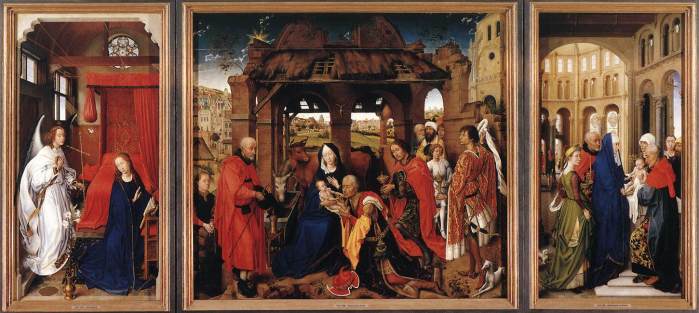
St. Columba Altarpiece

As one of the kings leans forward to kiss the infant Jesus, almost exactly as recommended by the Meditations on the Life of Christ, we see a small crucifix nailed to a post above his head.

Columba detailThis is a good painting for Advent because it keeps us from sentimentalizing the birth of Christ. If you want to grow up the baby Jesus, remind yourself that he’s headed to the cross. That will do it every time.

But Advent looks even farther ahead in the life of Christ. In his sermon, Bernard of Clairvaux reminds the Church that within Christ’s coming in the flesh is embedded the promise of his coming again. Jesus will return to earth, and the world will be made new. We are assured that whatever darkness surrounds us, God will bring his story to the glorious conclusion he foretold.

As we reflect on the teaching of the Mellifluous Doctor, we realize that Advent is truly ancient-future. It harks back to the birth of Jesus (and before that to the prophecies about him). It takes place in the present as he is born in our heart. And it looks forward to the end of earthly time. Advent is a season to meditate on the entire history of salvation through Jesus Christ, a season to both celebrate and yearn for the world’s redemption.

Admittedly, my girls seem far more earthly than eschatological when they play with their manger scene:

“He doesn’t want his blanket.”

“Yes, he does! All babies need their blanket!”

But, as Saint Bernard shows, the birth of Jesus is wrapped up in his other advents, even the ones that are invisible or that take place in a distant future. Christ’s comings cannot be separated one from another; one form of yearning leads to the next. It is strange to watch my daughters play and feel so much ache mixed in with my delight. When my girls are older I will tell them about the complex theology behind their childlike faith.

I could end my Advent meditation here. Bernard of Clairvaux does. His sermon, as I mentioned, teaches three comings of Christ—in the flesh, in our hearts, and at the end of time. But in an Advent sermon preached in 1271, Thomas Aquinas adds a fourth coming of Jesus. Christ comes, writes the Angelic Doctor, at the hour of our death. This coming is necessary to bring his “just ones” not only grace, but also glory.

I confess that with this teaching, my yearning grinds to a halt. It seems easier to long for the end of time than for my personal end. Yet Saint Thomas is not the only one to advise me on this subject. Centuries earlier, the desert father Pachomius said, “Have, therefore, the hour of your death ever before your eyes.” Even in Advent? Even when my children are so full of life and the whole world is telling me to be joyful? Upon reflection, I conclude that there is no better time. During this season, we prepare for a savior who came to defeat death—yes, even our own. When he comes for us, it will be to take us to glory.

And so, as I watch over my children, I learn to watch my heart. I coax and guide it to think on its final hour. If I can’t yet yearn for this coming of Christ, I can at least be alert. I ask my heart, are you ready? Christ will return for you one day, and this advent is every bit as real as his birth in the flesh and his coming again.

Thanks to two daughters and two doctors of the church, my Advent preparations are a strangely medieval mix of delight, yearning, and rather intense soul-searching. As a mother, I look for the coming of a baby, one as fleshy and sweet as my girls. I also remember that the baby Jesus grew up to save the world and that he will come again, both at the end of time and, likely before that, for me. May my heart be prepared to mother him now and to meet him when my time comes.

***

This essay was originally published on my website, lisadeam.com.

FRIDAY FAVORITES FOR PRAYER AND WRITING

Welcome, friends, to Friday Favorites! Each week, Prasanta Verma and I round up our favorite links related to prayer, spirituality, and writing. We hope it will enrich your life and help you to find the best the web has to offer.

Do you have someone else’s article or post that you’d like to see on Friday Favorites? Find me on Twitter (@LisaKDeam) to nominate your favorite articles, blog posts, etc. by Thursday noon each week.

Read, be encouraged, and be blessed.

***

Engaging Scripture With Our Whole Selves via Nicole T. Walters (experiencing God through the Ignatian practice of imaginative prayer)

Encouragement When the World Feels Like a Mess via Julia Walsh (inspiration when the outer and inner world is just a mess)

Laughter Came From Every Brick via Ryan Cagle (listen to Ryan read a beautiful poem by the contemplative mystic Teresa of Avila on the Signposts podcast)

12 Essential Books on Writing for National Novel Writing Month via Modern Mrs. Darcy (are you participating in NaNoWriMo? check out these writing reads for help and motivation)

The Best Poems for November via Interesting Literature (new month…new poems)

Your Morning Walk with Sophfronia via Sophfronia Scott (in this episode, lessons learned from Madeleine l’Engle about writing and dry spells)