FRIDAY FAVORITES FOR PRAYER AND WRITING

Welcome back to Friday Favorites! This week, Prasanta Verma and I have a great round-up of links related to prayer, Scripture, remembering, joy, and writing. Enjoy, and be blessed.

***

A Prayer Amid an Epidemic via Kerry Weber (a prayer for individuals and groups)

Why Do We Cling to Scripture? Our Lives Depend on It via Patricia Raybon (why black Americans dive deep into the Word, and an invitation for everyone to take the dive)

The Spiritual Practice of Remembering via Nicole T. Walters (the importance of remembrance in our lives)

The Verdant Greening of Joy via Erin Jean Warde (in honor of Hildegard of Bingen, whose Feast Day was Sept. 17)

Of Being via Denise Levertov (a poem)

The Necessity of Pruning via Caroline Langston (pruning in the garden, in the spiritual life, and in writing)

Katelyn Beaty and Al Hsu — Publishing in the Time of COVID via Jen Pollock Michel and ERB (a podcast episode about the state of Christian publishing and favorite books)

WEEKLY PRAYER: EVELYN UNDERHILL

This week’s prayer is from Evelyn Underhill, a twentieth-century English writer, theologian, and mystic. “Enter and irradiate every situation and every relationship,” she pleads. We pray:

***

Give me, O Lord, I beseech you, courage to pray
for light and to endure the light here,
where I am on this world of yours,
which should reflect your beauty but which we
have spoiled and exploited.
Cast your radiance on the dark places,
those crimes and stupidities I like to ignore and gloss over.
Show up my pretensions, my poor little claims and
achievements, my childish assumptions of importance,
my mock heroism.
Take me out of the confused half-light in which I live.
Enter and irradiate every situation and every relationship.
Show me my opportunities, the raw material of love,
of sacrifice, or holiness, lying at my feet,
disguised under homely appearance
and only seen as it truly is, in your light.

Source

WEEKLY PRAYER: ST. GREGORY THE GREAT

This week’s prayer is from Saint Gregory the Great, whose feast day was September 3. Saint Gregory was a sixth-century bishop, pope, and church reformer.

***

O God, the Protector of all who trust in you, without whom nothing is strong, nothing is holy, increase and multiply upon us your mercy; that, with you as our Ruler and Guide we may so pass through things temporal that we finally lose not the things eternal. Grant this, O heavenly Father, for Jesus Christ’s sake our Lord. Amen.

Source

Are You A Contemplative?

As I prepared to kick off The Contemplative Writer this fall, I spent some time thinking about that word in the website’s title — “contemplative.” It’s easy to toss the word around, and I more or less know what I mean when I say it . . . until you ask me. What does this term really mean? What or who is a contemplative? Am I? Are you?

As many of you probably know by now, I often turn to history for answers. A look at Christian history has helped me begin to grasp what it means to be a contemplative or perhaps just a contemplative person (or writer).

Christian contemplation originated early on and in a monastic context. It was one stage in lectio divina, or sacred reading – an important monastic discipline and one that many Christians still practice today. Lectio leads us to read the Bible but is not a form of Bible study. Instead, it’s a way to prayerfully and reflectively engage with a passage and listen to what God might be saying to us through it.

The traditional stages or parts of lectio divina are:

  • Read
  • Meditate
  • Pray
  • Contemplate

In this practice, contemplation is the final stage; it’s meant to flow naturally from reading Scripture, meditating on its meaning, and then praying. During contemplation, we enter a time of prayer in which we “hear” or “speak” the word of God largely without words. We are attentive and open to God’s love. Some describe this as “resting” in God’s presence.

Throughout the Middle Ages, contemplation remained a part of lectio divina. But it also became an independent exercise in The Cloud of Unknowing, a spiritual treatise written in the late 14th century. The anonymous author, a monk, gives guidance and even some steps for contemplation, which include the repetition of a single word to help focus the attention on God. He mostly refers to contemplation as a “special prayer.” Today, we call this practice contemplative prayer or centering prayer. To learn more, check out this book by M. Basil Pennington, Thomas Keating, and Thomas E. Clarke.

Contemplation can sometimes sound a bit esoteric. And historically, it was; it was limited to the literate, the scholarly, and/or to those in a monastic context. But a number of history’s monks and mystics highlight its relevance to “ordinary” people like you and me. The Cloud author, for example, describes contemplative prayer as a yearning for or reaching out to God. Even though God is in a large sense unknowable, our longing for him is the key.

In 1915, the Anglican mystic Evelyn Underhill wrote:

Though it is likely that the accusation will annoy you, you are already in fact a potential contemplative: for this act, as St. Thomas Aquinas taught, is proper to all . . .  is, indeed, the characteristic human activity (from Underhill’s book, Practical Mysticism).

Underhill describes contemplation as “the” characteristic human activity because all seek to draw near to God . . . even if our drawing near happens in a kind of cloud.

Drawing on these historical sources, I might summarize the contemplative life as a deep-rooted, daily desire to draw near to God. Prayer and silent prayer are good aids to this life, and other practices might be, too – Bible reading, general reading, experiencing the natural world, and sacred friendship, to name a few.

I also love this definition by a group of Poor Clares: “The contemplative life is a life long journey to God in prayer and worship, turning from all else that could make the journey less direct.”

We are all on this journey, friends; the journey of life! And this means:

The Contemplative Writer is for you.

Contemplation is for you.

And, above all —

God is for you.

WEEKLY PRAYER: Thomas à Kempis

The Contemplative Writer is back after our summer hiatus! We hope you are keeping well and whole in what are truly challenging times. Our goal is to continue offering resources that help us pray, write, and live.

We begin with a prayer from Thomas à Kempis, author of one of the most popular devotional treatises of the late Middle Ages, the Imitation of Christ (ca. 1390-1400). This is a prayer for friends, those wonderful people who see us and love us anyway, the people for whom we’d do anything and who we’ll love until the end.


***

Almighty, everlasting God, have mercy on your servants our friends. Keep them continually under your protection, and direct them according to your gracious favor in the way of everlasting salvation; that they may desire such things as please you, and with all their strength perform the same. And forasmuch as they trust in your mercy, vouchsafe, O Lord, graciously to assist them with your heavenly help, that they may ever diligently serve you, and by no temptations be separated from you; through Jesus Christ our Lord. Amen.


Source


FRIDAY FAVORITES FOR PRAYER AND WRITING

Welcome to Friday Favorites, a round-up of great links on the web brought to you by The Contemplative Writer team — Prasanta Verma and myself.

This week, our posts begin with reflection and prayer, move to a consideration of our spiritual habits as we navigate the world of social media, and end with some writing tips. It’s been a while since we featured some really practical posts on writing, and we wanted to be sure to do that this time around. Even in the midst of a pandemic, many of us still struggle to find the time and the resources to get good writing done.

We hope you enjoy this week’s posts. Be blessed.

***

Praying for 100,000 via Summer Kinard (“It would take years to sing enough for one hundred thousand people”)

An Examen of the Senses via Carl McColman (a beautiful exercise based on Ignatius of Loyola’s prayer practice)

Lamentation Over Individualism via Rohadi Nagassar (lamenting, waiting, hoping, and praying together)

What Am I Actually Looking for on Social Media? via Ed Cyzewski (forming good habits and finding freedom from the relentless draw of social media)

Improve Your Writing by Getting Back to the Basics via Ann Kroeker (building the four fundamental elements of any project into your process)

Ten Questions to Ask To Find Extra Time To Write via Katharine Grubb (a super-practical list of questions to help yourself dig out some extra time to write)


THOMAS MERTON’S PRAYER FOR PENTECOST

This Sunday, May 31, is Pentecost, commemorating the descent of the Holy Spirit on the disciples of Jesus and in the life of his followers today. To prepare, let’s pray Thomas Merton’s prayer for the Vigil of Pentecost. It’s long but worth reading and praying in its entirety.

***

Today, Father, this blue sky lauds you. The delicate green and orange flowers of the tulip poplar tree praise you. The distant blue hills praise you together with the sweet-smelling air that is full of brilliant light. The bickering flycatchers praise you together with the lowing cattle and the quails that whistle over there. I too, Father, praise you, with all these my brothers, and they all give voice to my own heart and to my own silence. We are all one silence and a diversity of voices.

You have made us together, you have made us one and many, you have placed me here in the midst as witness, as awareness, and as joy. Here I am. In me the world is present and you are present. I am a link in the chain of light and of presence. You have made me a kind of centre, but a centre that is nowhere. And yet I am “here,” let us say I am “here” under these trees, not others.

For a long time I was in darkness and in sorrow, and I suppose my confusion was my own fault. No doubt my own will has been the root of my sorrow, and I regret it merciful father, but I do not regret it because this formula is acceptable as an official answer to all problems. I know I have sinned, but the sin is not to be found in any list. Perhaps I have looked to hard at all the lists to find out what my sin was and I did not know that it was precisely the sin of looking at all the lists when you were telling me that this was useless. My “sin” is not on the list, and is perhaps not even a sin. In any case I cannot know what it is, and doubtless there is nothing there anyway.

Whatever may have been my particular stupidity, the prayers of your friends and my own prayers have somehow been answered and I am here, in this solitude, before you, and I am glad because you see me here. For it is here, I think, that you want to see me, and I am seen by you. My being here is a response you have asked of me, to something I have not clearly heard. But I have responded, and I am content: there is little to know about it at present.

Here you ask of me nothing else than to be content that I am your Child and your Friend. Which simply means to accept your friendship because it is your friendship and your Fatherhood because I am your son. This friendship is Son-ship and is Spirit. You have called me here to be repeatedly born in the Spirit as your son. Repeatedly born in light, in knowledge, in unknowing, in faith, in awareness, in gratitude, in poverty, in presence and in praise.

If I have any choice to make, it is to live here and perhaps die here. But in any case it is not the living or the dying that matter, but speaking your name with confidence in this light, in this unvisited place: to speak your name of “Father” just by being here as “son” in the Spirit and the Light which you have given , and which are no unearthly light but simply this plain June day, with its shining fields, its tulip trees, the pines, the woods, the clouds and the flowers everywhere.

To be here with the silence of Sonship in my heart is to be a centre in which all things converge upon you. That is surely enough for the time being.

Therefore Father, I beg you to keep me in this silence so that I may learn from it the word of your peace and the word of your mercy and the word of your gentleness to the world: and that through me perhaps your word of peace may make itself heard where it has not been possible for anyone to hear it for a long time.

To study truth here and learn here to suffer for truth.

The Light itself, and the contentment and the Spirit, these are enough.

Source

FRIDAY FAVORITES FOR PRAYER AND WRITING

Hello and welcome to Friday Favorites! This week, the links that Prasanta Verma and I chose take us from prayer and reflection through silence, a bit of church history, and the redeeming power of art. A few of these are on the long side, longer than what we usually share — one is a full-length film! But they’re worth a deep dive to bring some beauty, wonder, and joy to your day.

Enjoy, and be blessed.

***

Praying: An Invitation to Silence via Andō (Andō shares a meditative poem from Mary Oliver)

In Pursuit of Silence via Patrick Shen (this film on silence is screening free during this pandemic time — so restorative for the soul)

Reading Hope in Trying Times, with Parker Palmer via Writing For Your Life (Parker Palmer shares about the lessons of depression and hope)

Permission to Ponder via Chris Alford and Tracy Balzer (Balzer encourages us with the beauty of creation as seen through the lens of Celtic Christianity)

The Nuns Who Wrote Poems via Nick Ripatrazone (get a taste of some divine poetry from literary nuns)

The Soul in Paraphrase via Joy Clarkson and Matthew Rothaus Moser (in this podcast episode, Moser explores transforming love in the poetry of Dante, a wonderful guide for our pilgrimage through life)


My Sunday With the Quakers: A Guest Post from Traci Rhoades

This week, I’m happy to feature a guest post from writer and blogger Traci Rhoades. Traci’s new book, Not All Who Wander (Spiritually) Are Lost, just came out; it’s a memoir about going to church and mostly about finding common faith ground in the midst of our differences. Christian unity is such a worthwhile topic to explore right now!

Traci’s post features a subject we’ve discussed many times at The Contemplative Writer: silence. Some historical forms of prayer, such as centering prayer, involve sitting in silence with God. Below, Traci writes about how she came across an entire church service service that met her “deep hunger” for silence. I invite you to savor Traci’s words and maybe to think about where in your own life you’ve encountered God in moments of silence.

***

Never in my entire evangelical existence has my church family sat in silence for sixty minutes. In fact, I recall only one time of silence during any worship service and that was because someone missed her cue. The staff heard about it on Monday morning.

That’s how the Quakers do it though, or so I’d been told. Months earlier, an online friend put me in touch with Jason, a “Friend” in the Quaker sense. He attended unprogrammed services (a time of silent waiting for the Spirit) on the campus of Aquinas College in Grand Rapids. After a few messages back and forth Jason encouraged me to visit when I had an opportunity to do so. They meet on Sunday mornings so it would need to be a time when I didn’t have any obligations at my own church.

A snowy day last December showed itself to be the right time. Surprisingly, my daughter agreed to attend with me. We asked another friend of ours, who asked a friend of hers. The four of us met up on the Catholic college campus to attend the Quaker service.

At first we weren’t sure we were in the right place, until a man rode up on his bicycle and put the sign in the ground by the front steps. The Friends Meeting was in session. A nice man greeted us at the door and asked us to sign the guest book. He assured us they frequently have guests. We took our places in the roughly-formed circle of about twenty individuals, and promptly at 10am, silence fell upon us.
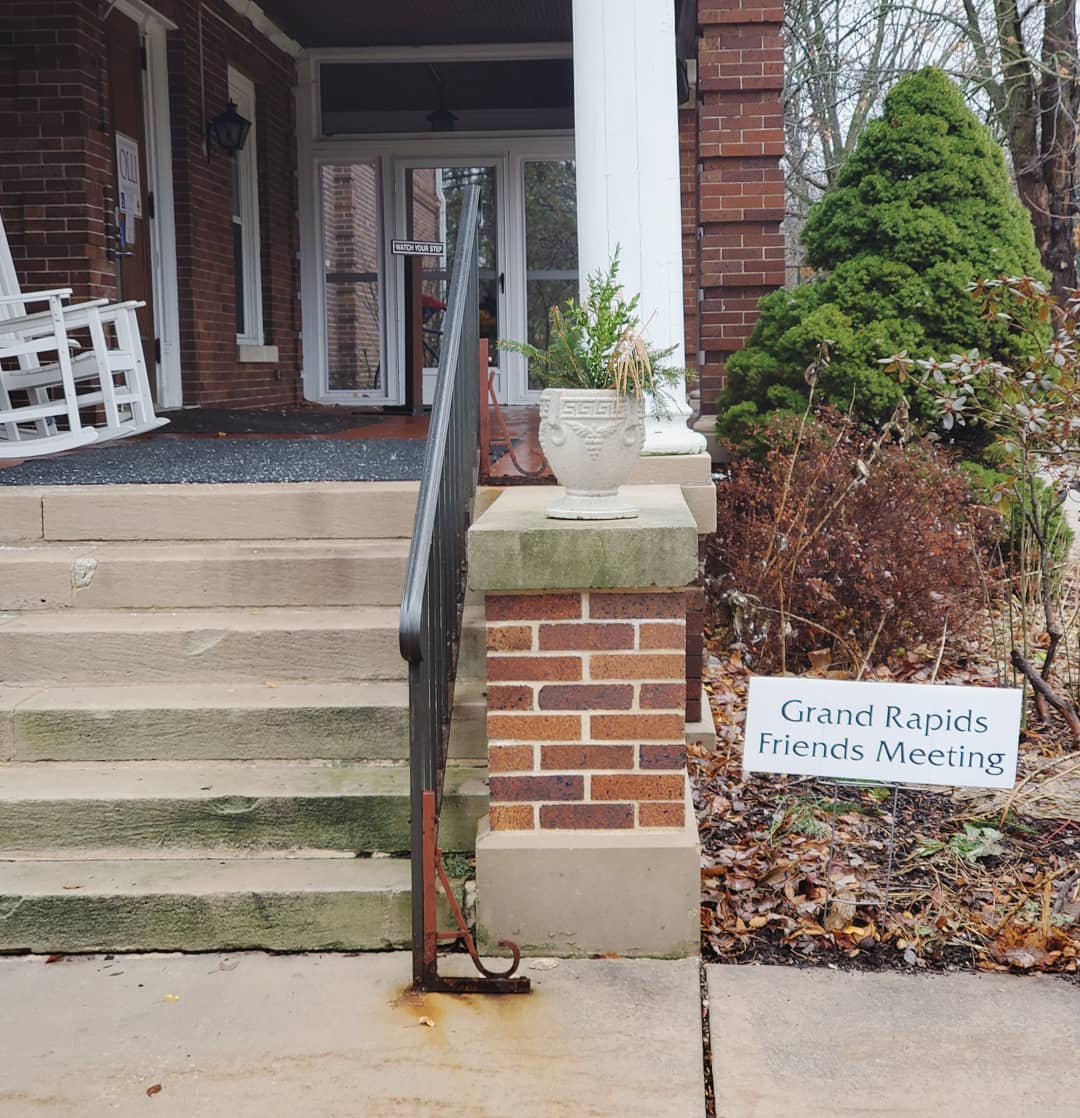
Rhoades blog post
What do you do for sixty minutes of silence? The Spirit didn’t prompt anyone to talk the entire time. I took my prayer rope out of my purse and prayed the Jesus Prayer. I offered up lots of intercessory prayer, for individuals God brought to mind and for each person seated around that circle. I sung a few hymns in my head. I wondered what other people were thinking about. A prominent thought kept popping into my head, you could never leave from here angry. Pacifism came to mind. Quakers are pacifists, correct? My daughter sat pretty still for the first fifteen minutes or so. After that, she fidgeted off and on. The few times I caved and made eye contact with her, she mouthed the words, “how much longer?”

We made it. After the service of silence, we went around the circle and gave our names. When it came time for my daughter to give her name, she gave a made up one. I asked her why and she said, “I wasn’t going to give a roomful of strangers my name.”

After going around the circle giving our first names, a man asked why we don’t divulge our full names. It occurred to me I knew this one. “If we’re a circle of friends, we’re on a first name basis.”

Afterward I talked with my contact, Jason, some more. He shared with me he’d grown up United Methodist. He missed the music offered in a more traditional worship service the most. I thought for the 3,017th time, why can’t a worship service offer it all?

Following this experience I read a couple books I had on my bookshelf, written by Quakers. One author is a Quaker pastor, certain branches of this church tradition do have clergy. In The Same, but Different, Phil Baisley explains that moments of silence are part of every Quaker gathering. “When Friends gather for worship, no matter whether a pastor is present, they are gathering with Christ to worship God in spirit and in truth.” Indeed, this extends to business meetings, classroom settings and basically every conversation a Friend has with another human being.

I enjoyed my first unprogrammed service and will attend again. The people were kind and encouraging, but I left feeling as if I hadn’t gone to Sunday church. Was that a programmed response or do I personally need more? It’s hard to say when you’ve only visited one Sunday.

In Brent Bill’s book Holy Silence, he paints a vivid picture of how God has spoken in moments of silence throughout his lifetime; on Sunday mornings, in his home, at weddings, when he leads moments of holy silence at ecumenical services in their vacation town. There’s more to corporate silence I need to explore. Bill writes, “The deep silence of the soul is our Eucharist.” Maybe that explains my deep hunger for silence. I am thirsty for a word from the Spirit. I love the idea of Him speaking corporately in communion of another kind. The Quakers are teaching me. We need each other. We really do.


WEEKLY PRAYER

Today’s prayer comes from the Book of Common Prayer, collect 24.

***

Almighty God our heavenly Father, you declare your glory
and show forth your handiwork in the heavens and in the
earth: Deliver us in our various occupations from the service
of self alone, that we may do the work you give us to do in
truth and beauty and for the common good; for the sake of
him who came among us as one who serves, your Son Jesus
Christ our Lord, who lives and reigns with you and the Holy
Spirit, one God, for ever and ever. Amen.