FRIDAY FAVORITES FOR PRAYER AND WRITING

Each Friday I share some of my favorite finds related to praying or writing. If I think it could help you pray or write better, or just “be” better, I’ll include it below.

Do you have someone else’s article or post to share? Join the Contemplative Writers Facebook group, comment on today’s post on my Facebook page, or follow me on Twitter (@LisaKDeam) to nominate your favorite articles, blog posts, and books by Thursday at noon each week.

*****

Prayer Made Sense When Henri Nouwen Told Me To Give Up via Ed Cyzewski

Martin Sheen: Spirituality of Imagination via Krista Tippett

The Contemplative Way as a Practice in Death via Drew Jackson

101 Books to Dive into this Summer: A Massive Reading List via Rebekah Barnett and Chelsea Catlett (TED-speaker recommended books – just in case you don’t have enough piled on your nightstand right now)

7 Prayers I Pray for People I Love via Judy Douglass

Nothing and Everything (Reflections on a Retreat) via Lisa Bartelt

CONTEMPLATIVE PROFILE: FLANNERY O’CONNOR ON WRITING

I don’t know whether the American writer and essayist Flannery O’Connor (1925-1964) can really be called a contemplative — although she did ask God to make her a mystic. She has been described as a devout believer and also as a “turbocharged Catholic.”

Reading O’Connor’s Prayer Journal, which she wrote in 1946-1947, I was interested in what she says about the intersection of faith and writing. She wrote the journal while studying writing and working on her first novel. In the journal, she begs to know and want God and also to become a “fine writer.” Where do these two desires intersect? In radical dependence on God. O’Connor writes:

My dear God, how stupid we people are until You give us something. Even in praying it is You who have to pray in us. I would like to write a beautiful prayer but I have nothing to do it from.

*****

Dear God, tonight it is not disappointing because you have given me a story. Don’t let me ever think, dear God, that I was anything but the instrument for Your story — just like the typewriter was mine.

*****

If I ever do get to be a fine writer, it will not be because I am a fine writer but because God has given me credit for a few of the things He kindly wrote for me. Right at present this does not seem to be His policy. I can’t write a thing. But I’ll continue to try — that is the point. And at every dry point, I will be reminded Who is doing the work when it is done & Who is not doing it at that moment.

Read more about Flannery O’Connor here. Read her Prayer Journal here.

For reflection: Where do faith and writing intersect for you?

BOOK OF THE MONTH: THE REVELATIONS OF DIVINE LOVE

Week Four: Desire and Divine Will

All Shall Be Well

In The Revelations of Divine Love, Julian of Norwich describes our desires and the divine will as these relate to prayer. God gives us what he wills us to have, and then he makes us yearn for it.

I’m pretty blown away by the idea that in prayer, we ask for what God already plans to give us. It’s hard to wrap my mind around that concept! Here’s what Julian says:

Christ told me from whom our prayers come when He said, “I am the Ground.” And we see how they come to life in the centers of our being when He said, “It is my will first that you have whatever it is, and then I make you yearn for it.” The second thing God wants us to understand about prayer is how we should carry it out. The answer to this is that we choose with all our mental powers to align our desires with the Divine Will; this is what He meant when He said, “Then I make you yearn for it.”

*****

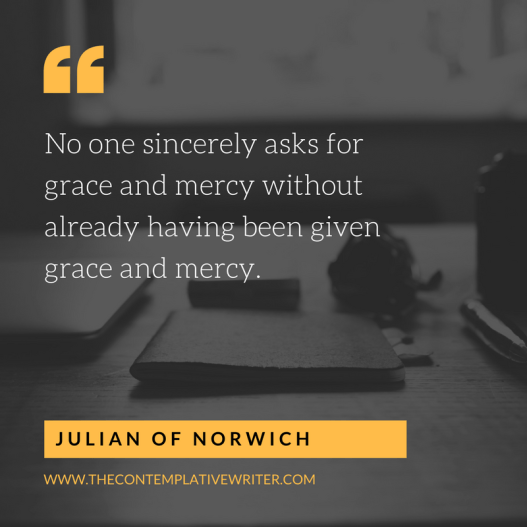
No one sincerely asks for grace and mercy without already having been given grace and mercy.

*****

[T]he greatest acts of God have already been accomplished (just as the Church teaches), and as we meditate on this, we pray for the action that is already being accomplished: that God directs us while we live on Earth, so that God is enriched by our lives, and that we be brought to Divine Joy in Heaven. And then God will have accomplished everything.

*****

Our Protector wants us to pray for everything, whether in general or in particular, that God has laid out to happen. As far as I can see, the thanks, joy, delight, and worth that God grants us in return is beyond our ability to comprehend!

*****

Julian of Norwich (1342 – c. 1416) was an English visionary, mystic, anchoress, and writer. Read about her here.

I’ve been enjoying the Divine Revelations in a modern translation entitled All Shall Be Well.

For reflection:

Julian of Norwich Week 4

FRIDAY FAVORITES FOR PRAYER AND WRITING

Each Friday I share some of my favorite finds related to praying or writing. If I think it could help you pray or write better, or just “be” better, I’ll include it below.

Do you have someone else’s article or post to share? Join the Contemplative Writers Facebook group, comment on today’s post on my Facebook page, or follow me on Twitter (@LisaKDeam) to nominate your favorite articles, blog posts, and books by Thursday at noon each week.

*****

Of Killer Whales and Killers via Leslie Leyland Fields (on not giving up on despair, longing, our country, and God)

Why Do We Bother? via Emily Polis Gibson (“We get up to see just what might happen…”)

The Skeptic’s Guide to Spiritual Practices: Prayer via Stina Cook (in which Marilla Cuthbert helps us learn the value of structured prayer)

Many Ways to Pray: Walking A Labyrinth via Jodi Gehr (discover how to pray using this ancient practice)

To discover one’s heart is an act of reintegration . . . via Fr Aidan (Alvin) Kimel (linking our breath to the Jesus Prayer)

You know you’re a Serious Reader when . . . via Anne Bogel (Anne dishes with Shawn Smucker on favorite books and summer reading)

GUEST POST: An Excerpt from Flee, Be Silent, Pray by Ed Cyzewski

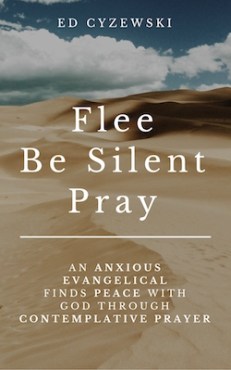
Flee be silent pray cover ebook final copyToday, I’m excited to offer an excerpt from Flee, Be Silent, Pray: An Anxious Evangelical Finds Peace with God through Contemplative Prayer, a new book by Ed Cyzewski, founder of The Contemplative Writer. Ed’s book released this week.

In the excerpt below, Ed explains why solitude, rather than more information and more effort, might be a good place to start when struggle, burn out, or crisis occurs. I know you’ll appreciate the wisdom he offers here.

*****

A spiritual struggle, burn out, or breakdown in my conservative Christian tradition is often treated with more information. The assumption is that you forgot something, never learned it, or distorted the information in the first place, despite your best efforts. I remember worrying that my own sincerity or grasp of the information didn’t click. If I could just line up the right information with the proper mental outlook, things would finally fall into place. This is why so many young evangelicals struggle with sin and then pray the sinner’s prayer again (and again) or rededicate their lives to God.

The sentiment is admirable, as we can all relate to wanting to grow spiritually or getting on the right path, but such an approach to spiritual transformation remains more or less in our control and fails to proceed beyond a confession of faith. Professing our faith and commitment to Christ is certainly a good place to start, but it’s hardly what mature, growing followers of Jesus need.

Solitude isn’t my cure-all that guarantees a vibrant spiritual life, but it has become a vital refuge that saves me from my own inadequate remedies and faulty illusions of myself and others. Nouwen speaks of solitude as the furnace of transformation. “Without solitude we remain victims of our society and continue to be entangled in the illusions of the false self” (The Way of the Heart 25). I can think of no better thing for anxious evangelicals who have come to the limits of personal effort and knowledge. Entering solitude with open hands can free us to receive whatever God will give us. I have often gone into solitude with my own plans and agenda.

I’m not naturally comfortable with mystery, especially with a mysterious God, after dedicating so much time to theological study. Solitude strips away the script that theology can provide for God. In silence before God alone, I am forced to surrender any scripture verses that I may be tempted to manipulate in my moment of need, as if I could trap God by using his own words against him. I can only surrender to the mystery of God in the silence.

There are deep mysteries to God’s love and presence, and solitude is one of the ways I have inched closer to them. What I know of God’s love and presence feels very much like drops of water from a limitless stream. What we’ve come to believe and trust may crumble to dust in the pursuit of solitude. This is just as well. Any illusions or false conceptions of ourselves or of God will crumble eventually regardless.

Solitude allows us to preemptively expose these illusions before they let us down in the midst of a crisis. In solitude, we “die” to ourselves so that God can raise us up. Nouwen wrote, “In solitude, our heart can slowly take off its many protective devices, and can grow so wide and deep that nothing human is strange to it” (Out of Solitude 45).

*****

The desert fathers and mothers saw solitude as a way to replace martyrdom when Christianity became the official religion of the Roman Empire. In his introduction to the spirituality of the desert fathers and mothers, John Chryssavgis writes, “The voice of the desert’s heart replaced the voice of the martyr’s blood. And the Desert Fathers and Mothers became witnesses of another way, another Kingdom” (In the Heart of the Desert 17).

There was no surer way to strip away what they depended on in place of God. This was a kind of “death” for them that lead to new life. They sought the union with Christ that Paul spoke of (1 Corinthians 6:17; Romans 8:9-11) and set aside every possible distraction. Nouwen assures us that “solitude molds self-righteous people into gentle, caring, forgiving persons who are so deeply convinced of their own great sinfulness and so fully aware of God’s even greater mercy that their life itself becomes ministry” (The Way of the Heart 37).

Flee, Be Silent, Pray is available now, $2.99 as an eBook, $9.99 for print:
Kindle | Print | iBooks | Kobo | B&N
Download a Sample Chapter Here

Ed Cyzewski Author Cafe Square


Ed Cyzewski is the author of A Christian Survival GuideFlee, Be Silent, PrayPray, Write, Grow; and other books. He writes at www.edcyzewski.com and is on Twitter at @edcyzewski.



WEEKLY PRAYER

This week’s prayer is from St. Anselm (1033 – 1109):

Lord, because you have made me, I owe you the whole of my love; because you have redeemed me, I owe you the whole of myself; because you have promised so much, I owe you my whole being. Moreover, I owe you as much more love than myself as you are greater than I, for whom you gave yourself and to whom you promised yourself. I pray you, Lord, make me taste by love what I taste by knowledge; let me know by love what I know by understanding. I owe you more than my whole self, but I have no more, and by myself I cannot render the whole of it to you. Draw me to you, Lord, in the fullness of your love. I am wholly yours by creation; make me all yours, too, in love.

Source

BOOK OF THE MONTH: THE REVELATIONS OF DIVINE LOVE

Week 3: Prayer as a Way of Life

All Shall Be WellThe Revelations of Divine Love by English anchoress Julian of Norwich is our book of the month. In this spiritual classic, Lady Julian explains why prayer is a good and necessary part of life.

I am drawn to the ways Julian speaks of prayer, always emphasizing our radical dependence on God. I also like the two metaphors she uses in the first passage below – prayer is like an arrow and prayer is like a shelter. These metaphors seem so different, yet they work together to describe the gift of communing with God.


For prayer is like an arrow shot straight toward joy’s completion in Heaven—and prayer is also like a shelter that covers us with the knowledge that we can trust God to grant all for which we yearn. When we fall short of the joy that has been laid out for us, we are filled with longing; but as we cover ourselves with the knowledge of God’s love and with sweet thoughts of our Rescuer, then we are granted the gift of confidence in God’s firm integrity.

*****

For our part, we must take care to always lovingly choose prayer as a way of life. We may still feel as though we have accomplished nothing—but in reality (whether we can see it or not), we have. And if we do what we can and ask with constancy and faithfulness for mercy and grace, then all that we lack we shall find in God.

*****

Prayer makes the soul one with God. Our souls are like God in their essence, and they are connected to God with bonds of kinship—yet because of sin, our way of being is often not much like God’s. That is why we need to use prayer as an affirmation that our souls are aligned with the Divine Will. What’s more, prayer comforts our uneasy consciences and becomes a conduit for grace to flow into us.

*****

 Julian of Norwich (1342 – c. 1416) was an English visionary, mystic, anchoress, and writer. Read about her here.

I’ve been enjoying the Divine Revelations in a modern translation entitled All Shall Be Well.

For reflection:


Julian of Norwich - week 3

FRIDAY FAVORITES FOR PRAYER AND WRITING

Each Friday I share some of my favorite finds related to praying or writing. If I think it could help you pray or write better, or just “be” better, I’ll include it below.

Do you have someone else’s article or post to share? Join the Contemplative Writers Facebook group, comment on today’s post on my Facebook page, or follow me on Twitter (@LisaKDeam) to nominate your favorite articles, blog posts, and books by Thursday at noon each week.

*****

My morning prayers keep me focused on the Holy Spirit’s presence via Mary Lee Wile (kitchen prayers for discerning the day’s path)

Rewrite Radio #14: Brian Doyle 2012 via the Calvin Festival of Faith and Writing (writer Brian Doyle, who passed away two weeks ago, talks about the power of bearing witness via the stories we tell)

Dealing with writer’s envy via Heather Walker Peterson (on the dark side of writer friendships)

How to Immediately Improve Your Query Letter’s Effectiveness via Jane Friedman (valuable practical advice for your novel queries)

Discover Your Writing Self via Andi Cumbo-Floyd (take this writing course from Andi in July)

Rough Drafts. The Struggle is Real via Stephanie S. Smith (inspiring words on taking risks and “spending it all” on your rough draft)