Scripture Meditation: The Intentional Pursuit of God

Praise the Lord! I will thank the Lord with all my heart as I meet with his godly people. How amazing are the deeds of the Lord! All who delight in him should ponder them.
Psalm 111:1-2

How do we become aware of God’s presence in our lives?

First, we prioritize time spent in Christian community, giving thanks together for the ways God has been present and provided for us. As our faith struggles or falters, we’ll find encouragement through the stories of God’s faithfulness among others.

Second, we grow in our delight of God by pondering the ways that God has been at work in our lives.

We shouldn’t be surprised that we struggle to see God at work if we don’t take time to ponder his presence each day.


For Reflection

meditation-for-october-16

Friday Favorites for Prayer and Writing

Each Friday I share some of my favorite finds related to praying or writing. If I think it could help you pray or write better, then I’ll include it below.

Do you have someone else’s article or post to share? Join the Contemplative Writers Facebook group, comment on today’s post on my Facebook page, or follow me on Twitter (@edcyzewski) to nominate your favorite articles, blog posts, and books by Thursday at noon each week.

This Is How to Resist Distraction

On the Appalachian Trail Combat Veterans Learn to Let Go

3 Truths about Dark Nights of the Soul

Christians Begin to Embrace the Enneagram

From Ed’s Site: The Lie about How to Live the Life You Love


Keep the Contemplative Writer Sustainable

The Contemplative writer is ad-free and never shares sponsored content, but it is a lot of work to maintain. We rely on affiliate links from the books we share and the generous donations of our readers. An automated monthly gift as low as $1 per month or a one-time gift of $5 goes a long way to sustaining our mission to provide contemplative prayer resources for our readers.

Learn how your support, through a one-time gift or small monthly gifts can keep this website running: Support Us Today

Scripture Meditation: Worship and Reconciliation Go Together

“So when you are offering your gift at the altar, if you remember that your brother or sister has something against you, leave your gift there before the altar and go; first be reconciled to your brother or sister, and then come and offer your gift.”
Matthew 5:23-24

How do we enter into prayer and worship? Self-examination is always helpful, especially if we have a reason to confess a wrong to a friend, colleague, or neighbor.

The monks who instructed novices in prayer typically noted that some distractions were a from God. A distraction may illuminate an area of our lives that requires repentance before we are free to pray.

Self-examination preemptively faces our distractions or failures and gives us a chance to take action before we enter into prayer. And if you don’t have time to pray because you’re busy seeking reconciliation, I trust that this obedience is precious to Jesus.


For Reflection

meditation-for-october-4

Book of the Month: Everything Belongs

Week One: Surrender to God’s Mercy

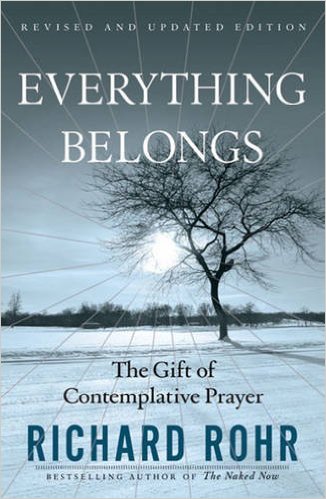
everything-belongs-rohrIf everything belongs in our contemplative practice, then we must give up the charade of denial or wearing a mask to hide our flaws and pain. Our only hope will be completely surrendering to God’s mercy.

Once we face our pain, struggles, and failures, we remove ourselves from religious systems that gain their power from setting moral standards that cannot be violated by their members or call for simplistic answers. This is why those who have faced their own dark sides and found God’s mercy are so able to share mercy with others.

This month we’ll look at Richard Rohr’s book Everything Belongs: The Gift of Contemplative Prayer, with quotes this week about the process of exposing and moving beyond the obstacles that keep us from intimacy with God:


*****

“In God’s reign ‘everything belongs,’ even the broken and poor parts. Until we have admitted this in our own soul, we will usually perpetuate expelling systems in the outer world of politics and class. Dualistic thinking begins in the soul and moves to the mind and eventually moves to the streets. True prayer, however, nips the lie in the bud. It is usually experienced as tears, surrender, or forgiveness.”

*****

“In terms of soul work, we dare not get rid of the pain before we have learned what it has to teach us.”

*****

“We do not find our own center; it finds us… We do not think ourselves into new ways of living. We live ourselves into new ways of thinking.”

*****

“It seems that we Christians have been worshipping Jesus’ journey instead of doing his journey.”

*****

“It is much easier to belong to a group than it is to know that you belong to God. Those who firm up their own edges and identity too quickly without finding their center in God and in themselves will normally be the enemies of ecumenism, forgiveness, vulnerability, and basic human dialogue.”

*****

Read more in Everything Belongs


For Reflection

featured-book-october-3

Why We Need the Restoration of Silence

I’m somewhere in the middle of the Highly Sensitive spectrum, so I’m very aware of how noise impacts my anxiety levels and ability to concentrate. However, some of the most recent research in neuroscience is finding that we don’t just need silence as a break from the noise. We need silence in order for our brains to process information and to more or less “recover” from the noise of life.

Studies are finding that children who grow up near airports, highways, and other noisy environments have higher levels of stress and tend to struggle to concentrate in school. Without down time, our brains become overloaded.

One of the most important benefits of practicing contemplative prayer has been a greater awareness of my mental state and when I need to take a break. Prayer is much easier when my brain isn’t spinning out of control! Here are a few helpful quotes from a LifeHacker article on the importance of silence:

*****

When the brain rests it is able to integrate internal and external information into “a conscious workspace,” said Moran and colleagues.

When you are not distracted by noise or goal-orientated tasks, there appears to be a quiet time that allows your conscious workspace to process things. During these periods of silence, your brain has the freedom it needs to discover its place in your internal and external world.

*****

It has been found that noise can have a pronounced physical effect on our brains resulting in elevated levels of stress hormones. The sound waves reach the brain as electrical signals via the ear. The body reacts to these signals even if it is sleeping. It is thought that the amygdalae (located in the temporal lobes of the brain) which is associated with memory formation and emotion is activated and this causes a release of stress hormones. If you live in a consistently noisy environment that you are likely to experience chronically elevated levels of stress hormones.

*****

According to the attention restoration theory when you are in an environment with lower levels of sensory input the brain can ‘recover’ some of its cognitive abilities. In silence the brain is able to let down its sensory guard and restore some of what has been ‘lost’ through excess noise.

*****

Read the rest of the LifeHacker article here.


Keep the Contemplative Writer Sustainable

The Contemplative writer is ad-free and never shares sponsored content, but it is a lot of work to maintain. We rely on affiliate links from the books we share and the generous gifts of our readers. An automated monthly gift as low as $1 per month or a one-time gift of $5 goes a long way to sustaining our mission to provide contemplative prayer resources for our readers. Thank you!

Choose a recurring monthly donation:

support-patreon-orange

Make a one-time gift via PayPal (credit cards accepted!)


Donate Now Button

Learn more about how to support us.