WEEKLY PRAYER

A prayer from Thomas à Kempis (1380-1471):

Grant me most sweet and loving Jesus, to rest in You above every other creature, above all health and beauty, above all glory and honor, above all power and dignity, above all knowledge and precise thought, above all wealth and talent, above all joy and exultation, above all fame and praise, above all sweetness and consolation, above all hope and promise, above all merit and desire, above all gifts and favors You give and shower upon me, above all happiness and joy that the mind can understand and feel, and finally, above all angels and archangels, above all the hosts of heaven, above all things visible and invisible, and above all that is not You, my God.

Source

WEEKLY PRAYER

A prayer for Holy Week by Origen (c. 185–254):

Jesus, my feet are dirty. Come even as a slave to me, pour water into your bowl, come and wash my feet. In asking such a thing I know I am overbold, but I dread what was threatened when you said to me, “If I do not wash your feet I have no fellowship with you.” Wash my feet then, because I long for your companionship.

Source

Contemplative Profiles: Thomas Merton

This month’s contemplative profile by historian Lisa Deam is Thomas Merton:

Thomas Merton (1915-1968) was a Trappist monk, a beloved modern contemplative, and a prolific writer. He left us many books and essays on the spiritual life. When I read Merton, I’m especially struck by the way he confronts and even embraces the difficulties of living the Christian life. Following Jesus is not easy, and Merton knows this. His frank admission of his struggles ministers to us in our own.

Regarding his internal struggles and contradictions, Merton writes:

*****

“I have become convinced that the very contradictions in my life are in some ways signs of God’s mercy to me: if only because someone so complicated and so prone to confusion and self-defeat could hardly survive for long without special mercy.” (A Thomas Merton Reader)

*****

“Paradoxically, I have found peace because I have always been dissatisfied. My moments of depression and despair turn out to be renewals, new beginnings . . . All life tends to grow like this, in mystery inscaped with paradox and contradiction, yet centered, in its very heart, on the divine mercy . . . and the realization of the ‘new life’ that is in us who believe, by the gift of the Holy Spirit. “ (A Thomas Merton Reader)

*****

Such paradoxes define the life of faith. About each person’s struggle with both internal and external darkness, Merton says:

*****

“Those who continue to struggle are at peace. If God wills, they can pacify the world.  For he[/she] who accepts the struggle in the name of Christ is delivered from its power by the victory of Christ.” (A Thomas Merton Reader)

*****

Read more about Merton at the Abbey of Gethsemani.

Reflection

How willing am I to embrace and learn from the contradictions and struggles in my spiritual life?


About Lisa Deam

Lisa Deam writes and speaks about Christian spiritual formation from a historical perspective. She’s the author of A World Transformed: Exploring the Spirituality of Medieval Maps. Visit her on Twitter @LisaKDeam and at lisadeam.com.

Featured Book: Everything Belongs

Week Five: Free from Fear

everything-belongs-rohrIn Everything Belongs,  Richard Rohr writes that we find freedom from our fears and anxious thoughts by facing them.

In this moment of awareness, we may find that our fears and wounds appear to be even worse than we have realized. There is no way around this. There is no way to avoid this.

As we face our thoughts, we will develop the capacity to trust in our crucified Lord who conquered all of suffering and death, identifying with our weaknesses and still rising to new life.

Much like the silent mystery of the Resurrection, our new life will come from God in ways that we cannot detect but that cannot be denied:


*****

“The wounds to our ego are our teachers and must be welcomed. They must be paid attention to, not litigated. How can a Christian look at the crucified and not get this essential point?”

*****

“A lot that’s called orthodoxy, loyalty, and obedience is grounded in fear. I do a lot of spiritual direction, and when I get underneath the language of orthodoxy and obedience, I find fear… We call it loyalty, but it’s often fear.”

*****

“Most people become their thoughts. They do not have thoughts and feelings; the thoughts and feelings have them… So we have to observe, but also not let the observer become an accusing tyrant.”

*****

“In the silence of contemplation, we will observe the process whereby we actively choose and create what we pay attention to. that’s why the first twenty minutes are usually so terrible.”

*****

“In reality our growth is hidden. It is accomplished by the release of our current defense postures, by the letting go of fear and our attachment to self-image. Thus, we grow by subtraction much more than by addition. It’s not a matter of more and better information.”

*****


For Reflection

featured-book-october-31


Featured Article: How to Face Digital Addiction

This week’s featured article discusses the possibility of a digital addictions disorder (DAD) that could impact roughly 5% of Americans and could impact as many as 30% of people in countries with frequent internet use.

Heavy internet gaming and social media use can distract us from work, interrupt our relationships, and ultimately change the ways that our brains function and seek pleasure or rewards. While most of us need to be online for one reason or another, we all need to recognize the signs of a problem.

Here are a few key quotes to consider from the article:

*****

“A digital addiction is comparable to addictions such as food or drugs in its obsessive nature. As is the case with all addictions, they influence the brain – both in the connections between the cells and in the brain areas that control attention, executive control and emotional processing. It triggers the release of dopamine, providing a temporary “high” on which addicts become dependent.”

*****

“Being stressed out or suffering from anxiety and depression can be a contributing factor in the development of addictions. In addition, people who suffer from DAD are often no strangers to other addictions such as alcohol, drugs, sex or gambling. People who have relationship issues also seem to be at a higher risk of developing an internet addiction. They use digital “connections” to boost their spirits and to escape from their problems.”

*****

Read more…

Book of the Month: Everything Belongs

everything-belongs-rohrWeek Three: Real Freedom… from Ourselves…


What gets in the way of our freedom? Most of the time, we do!

In Everything Belongs, Richard Rohr writes about the way the ego, our desire to uphold our self images, and the ways that we judge others all can lead us away from our true selves, union with God, and union with others.

This week’s quotes include the following:


*****

“When we live out of the ego, we impose our demands on reality. But when we live in God’s presence, we await reality’s demands on us. “

*****

“As long as we are comparing and differentiating from the other, we can’t love the other. We judge it.”

*****

“Most don’t know how to surrender to God. How can we surrender unless we believe there is someone trustworthy out there to surrender to?”

*****

“We don’t live in our bodies where we can feel our own feelings and trust our own experience. Instead, through commercials and advertisements and jingles we live in images and appearances.”

*****

“I’ve seen far too many activists who are not the answer. Their head answer is largely correct but the energy, the style, and the soul are not.”

*****

Read more…


For Reflection

featured-book-october-19

Book of the Month: Everything Belongs

everything-belongs-rohrWeek Two: Replacing Illusion with Reality

In his book Everything Belongs, Richard Rohr writes about the great surrender that must take place before we can find God and our true selves in prayer.

He is quick to note that God is already present. In fact, we cannot escape God’s presence but we can obscure it or overlook it. Our illusions about ourselves or about God can get in the way.

Therefore the great goal of every spiritual practice is to help us move past our illusions, distractions, and oversimplified answers so that we can be truly present for God.


*****

“We have no real access to who we really are except in God. Only when we rest in God can we find the safety, the spaciousness, and the scary freedom to be who we are, all that we are, more than we are, and less than we are. Only when we live and see through God can ‘everything belong.’ All other systems exclude, expel, punish, and protect to find identity for their members in ideological perfection or some kind of ‘purity.’”

*****

“We cannot attain the presence of God because we’re already totally in the presence of God. What’s absent is awareness. Little do we realize that God is maintaining us in every breath we take.”

*****

“All spiritual disciplines have one purpose: to get rid of illusions so we can be present.”

*****

“When we look at the questions, we look for the opening to transformation. Fixing something doesn’t usually transform us. We try to change events in order to avoid changing ourselves. We must learn to stay with the pain of life, without answers, without conclusions, and some days without meaning. That is the path, the perilous dark path of true prayer.”

*****

“When we avoid darkness, we avoid tension, spiritual creativity, and finally transformation. We avoid God, who works in the darkness—where we are not in control! Maybe that is the secret: relinquishing control.”

*****

Read more in Everything Belongs


For Reflection

featured-book-october-10

Featured Article: The Value of Making Time for Rest

Author Michelle DeRusha writes that Shelly Miller’s new book Sabbath Rest encouraged her with a gentle reminder to make more space for rest and for God in her week. DeRusha writes about the benefits prioritizing the Sabbath in this week’s featured post:

*****

“I was all in on Sabbath rest a couple of years ago. I believed in it and was committed to it. But somehow, as weeks passed into months and months passed into years, I chipped away at the edges of my Sabbath practice until finally, there was nothing left. Without even being aware of it, my Sundays became another day of chores, errands, social media and catching up on email.”

*****

“How much of our faith journey is firsthand experience and not just what we know about him? Information helps us know about God, but Sabbath allows us to encounter him.”
-Shelly Miller

*****

“What I’ve come to understand – and what Shelly’s book reiterated for me — is that in order to know God in the way he desires, we need to make space and time for him. And in order to make space and time for him, we have to quiet ourselves. We have to cease our constant busyness, our constant doing and accomplishing.”

*****

Read more here.


Are you enjoying the contemplative writer?

Learn how your support, through a one-time gift or small monthly gifts can keep this website running: Support Us Today

Scripture Meditation: Worship and Reconciliation Go Together

“So when you are offering your gift at the altar, if you remember that your brother or sister has something against you, leave your gift there before the altar and go; first be reconciled to your brother or sister, and then come and offer your gift.”
Matthew 5:23-24

How do we enter into prayer and worship? Self-examination is always helpful, especially if we have a reason to confess a wrong to a friend, colleague, or neighbor.

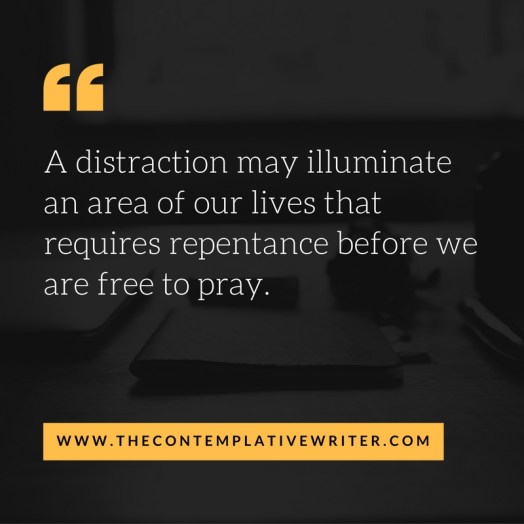
The monks who instructed novices in prayer typically noted that some distractions were a from God. A distraction may illuminate an area of our lives that requires repentance before we are free to pray.

Self-examination preemptively faces our distractions or failures and gives us a chance to take action before we enter into prayer. And if you don’t have time to pray because you’re busy seeking reconciliation, I trust that this obedience is precious to Jesus.


For Reflection

meditation-for-october-4

Featured Contemplative Book: Immortal Diamond

Immortal Diamond by RohrWeek Two: The Struggle with the False Self

Who am I?

This is a foundational question that we’ll forever struggle with in prayer and writing until we finally confront it. There may be no better tool for answering this question than Richard Rohr’s Immortal Diamond: The Search for our True Self.

This is the book that saved my soul, or at least saved me from myself.

The false self won’t be silenced easily. In fact, I have found that the false self is so hard to fight because living into your true self in God’s love requires doing LESS. So much of religion is about doing more or doing something differently. Rohr’s wisdom about the true self appears to be counterintuitive at first.


“Your True Self is who you are, and always have been in God . . . The great surprise and irony is that “you,” or who you think you are, have nothing to do with its original creation or its demise. It’s sort of disempowering and utterly empowering at the same time, isn’t it? All you can do is nurture it.”

* * * * *

“The soul, the True Self, has everything, and so it does not require any particular thing. When you have all things, you do not have to protect any one thing. True Self can love and let go. The False Self cannot do this.”

* * * * *

“Remember, please remember, you do not (you must not!) fear, attack, or hate the False Self. That would only continue a negative and arrogant death energy, and it is delusional and counterproductive anyway. It would be trying to “drive out the devil by the prince of devils,” as Jesus puts it. In the great economy of grace, all is used and transformed, and nothing is wasted. God uses your various False Selves to lead you beyond them.”

* * * * *

“What the ego (the False Self) hates and fears more than anything else is change. It will think up a thousand other things to be concerned about or be moralistic about—anything rather than giving up “who I think I am” and “who I need to be to look good.”


Finding your true self in God’s love is largely a matter of practicing the presence of God rather than trying to do any one thing better. If we let God define who we are, we’ll start to recognize the times when the false sense begins to whisper lies to us.

Once we learn to rest in Christ, we’ll begin to recognize when the imposter of the false self emerges.

Learn more about Immortal Diamond today.


Keep in Touch

Get our latest blog posts delivered to your inbox or sign up for the weekly contemplative email and receive a free eBook: The Contemplative Writer.


For Reflection or Sharing

Do less Contemplative Writer