
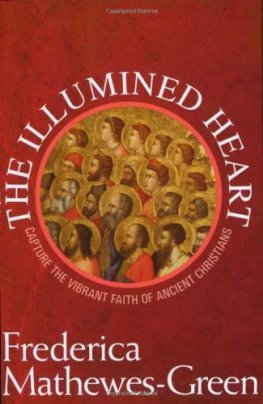
BOOK OF THE MONTH: THE ILLUMINED HEART

Week 3: Fasting
Illumined Heart cover

In The Illumined Heart, Frederica Mathewes-Green explores the wisdom and practices of the early Church.

Fasting is one such ancient practice. Mathewes-Green discusses details of how and when early Christians fasted. Just as important is her exploration of Christian attitudes toward the body:

Our bodies are a part of the creation God pronounced “very good,” and Jesus demonstrated God’s blessing on the human body when he became incarnate. He made the blessing more emphatic when he was resurrected, not as a mere spirit, but in a scar-marked body capable of eating fish. He sealed the blessing in the Ascension, taking that body into the very courts of heaven.

*****

So why do we need to fast?

Our bodies are blessed, but we don’t know how to live harmoniously in them. We drive them like vehicles, use them like tools to dig pleasure, and in the process damage them and distort our capacity to understand them. Fasting disciplines help us quiet these impulsive demands, so that we can better hear what they need and how they are meant to work. It is a turning toward health, a way of honoring creation and preparing for eternity.

*****

Read more.

For reflection:

Mathewes-Green week 3

CONTEMPLATIVE PROFILE: TWO SOURCES ON THE JESUS PRAYER

Most of you are probably familiar with the words of the Jesus Prayer:

Lord Jesus Christ, Son of God, have mercy on me, a sinner.

This prayer originated with the Desert Fathers and Mothers as a form of unceasing prayer, as Paul urges in 1 Thess 5:17.

How does one pray the Jesus Prayer? Have you ever tried it? St Gregory of Sinai (1260s-1346), an Eastern Orthodox monk, gives many instructions, including these:

Sitting in your cell, remain patiently in prayer, according to the precept of the Apostle Paul. Collect your mind into your heart and send out thence your mental cry to our Lord Jesus, calling for His help and saying: ‘Lord Jesus Christ, have mercy upon me’ until you are tired. When tired, transfer your mind to the second half and say: ‘Jesus, Son of God, have mercy upon me!’ Having many times repeated this appeal, pass once more to the first half.

Centuries earlier, the Church Father John Chrysostom (c. 349 – 407) indicated that this prayer was to be said not just while sitting quietly but also while going about the many tasks of monastic and daily life. It is to be repeated until it becomes part of one’s very being:

I implore you, brethren, never to break or despise the rule of this prayer… A monk when he eats, drinks, sits, officiates, travels or does any other thing must continually cry: ‘Lord Jesus Christ, son of God, have mercy upon me!’ so that the name of the Lord Jesus, descending into the depths of the heart, should subdue the serpent ruling over the inner pastures and bring life and salvation to the soul. He should always live with the name of the Lord Jesus, so that the heart absorbs the Lord and the Lord the heart, and the two become one…

Read more about the Jesus Prayer at orthodoxytoday.org and Orthodox Mysticism.

Reflection: Do you pray the Jesus Prayer? How has it shaped your spiritual life?

WEEKLY PRAYER

This week’s prayer is from St. Anselm (1033 – 1109):

Lord, because you have made me, I owe you the whole of my love; because you have redeemed me, I owe you the whole of myself; because you have promised so much, I owe you my whole being. Moreover, I owe you as much more love than myself as you are greater than I, for whom you gave yourself and to whom you promised yourself. I pray you, Lord, make me taste by love what I taste by knowledge; let me know by love what I know by understanding. I owe you more than my whole self, but I have no more, and by myself I cannot render the whole of it to you. Draw me to you, Lord, in the fullness of your love. I am wholly yours by creation; make me all yours, too, in love.

Source

WEEKLY PRAYER

A prayer from St. Ignatius of Loyola (1491 – 1553)

Take, Lord, and receive all my liberty,
my memory, my understanding
and my entire will,
All I have and call my own.

You have given all to me.
To you, Lord, I return it.

Everything is yours; do with it what you will.
Give me only your love and your grace,
that is enough for me.

Source


WEEKLY PRAYER

This week’s prayer is from the Liturgy of St. Mark (2nd century):

O Soverign and almighty Lord, bless all thy people, and all thy flock. Give thy peace, thy help, thy love unto us thy servants, the sheep of thy fold, that we may be united in the bond of peace and love, one body and one spirit, in one hope of our calling, in thy divine and boundless love.

Source.

WEEKLY PRAYER

A prayer before writing or teaching from Christina Rossetti (1830-1894):

Lord Jesus Merciful and Patient, grant us grace, I beseech Thee, ever to teach in a teachable spirit; learning along with those we teach, and learning from them whenever Thou so pleasest. Word of God, speak to us, speak by us, what Thou wilt. Wisdom of God, instruct us, instruct by us if and whom Thou wilt. Eternal Truth, reveal Thyself to us, reveal Thyself by us, in whatsoever measure Thou wilt.

Source

FEATURED ARTICLE: THE LOST LIFE OF LISTENING

A couple weeks ago, we explored a needed Christian virtue: humility. This week’s featured article takes a look at a common vice: pride, or what the Latin fathers called Superbia. Author Paul J. Pastor believes pride to be the defining vice of our age. In an article in ChristianWeek, he defines pride not (only) as a nose-in-the-air type of attitude, but also as self-obsession. Many of us are tempted to think about ourselves so much (whether good thoughts or bad) that we miss what’s going on in the lives of those around us.

We might expect the antidote to pride to be a dose of humility. Perhaps it is. But Pastor believes another important corrective can be found in the practice of listening — of being truly attentive to another person.

*****

As I look around our world, and indeed within my own often-dark heart, I am convinced that listening is the needed thing. Nothing can replace it, nothing can give a short cut to it.

*****

Pride makes true attentiveness impossible. And in the reverse, true attentiveness sends pride fleeing like shadows before a floodlight.

*****

To listen requires us to set aside our view of ourselves as the unrecognized expert or the one of right opinion. To listen requires a measure of personal security that few of us have. To listen, in short, requires love, and love must be learned from the Great Lover.

*****

In fact, listening to others begins with listening to God:

*****

Listening was, you remember, the one command given to the disciples on the Mount of Transfiguration:

A voice came from the cloud, saying, “This is my Son, whom I have chosen; listen to him.” (Luke 9:35 (NIV)

*****

[A]s deeply as I believe anything, I believe this: if we cannot listen to God, we cannot know him. Know about him? Sure! But know him? Never without presence, never without quieting out hearts and turning to him in humility. It is in listening to God that we learn the skill that can be salt and light to our world.

*****

In short: listening can help us be superb while letting go of Superbia.

Read more.