Contemplative Profiles: Julian of Norwich

We best know Julian of Norwich for saying: “All shall be well, and all shall be well, and all manner of things shall be well.” 

Despite her optimism in this statement, Julian lived in the late 1300’s in England, facing plague and violent warfare, to say nothing of a church hierarchy that could turn on her in light of her visions of Christ.

At the age of 13 in May 1373, Julian suffered a severe illness and experienced a series of sixteen “showings” or visions of Christ. These visions revealed the love of God in ways seemed to run counter to the assumptions about God during her time, but she managed to both live a quiet life as a female hermit and to put her experiences down on paper. Julian was the first woman to publish a book in English: Revelations of Divine Love.

41ckwwd378l-_sx331_bo1204203200_


She is remembered by biographer Amy Frykholm as a mystic who embraced suffering–almost to the point that one would raise an eyebrow. However, the depth of her compassion for others cannot be separated from her embracing of the sufferings of Christ and the suffering of others.

Reviewer Jonathan Wilson-Hartgrove writes,

Julian’s compassion grows out of her passion—a suffering both in and of the church, but a suffering that nevertheless reveals the love at the heart of the church. Julian gets God’s love not because she retreated from the world and focused on spiritual things, but because “she chose Jesus over the bliss of heaven.”

Contemplating a crucifix that began to drip blood onto what she thought would be her deathbed, Julian saw and later wrote about a vision of God that was revolutionary to the church authorities of her day—indeed, to many church leaders in our own time.

May we have eyes to see the suffering of others around us.

May we remember that the cross wasn’t just the means of our salvation. It was the way of life that Jesus modeled and expected us to follow.


I want to know Christ and the power of his resurrection and the sharing of his sufferings by becoming like him in his death…

Philippians 3:10, NRSV


Reflection

Remain open to the ways you can share in the suffering of Christ today.


Where to Start with Christian Meditation

There are many Christians who are either unfamiliar with meditation or concerned that it’s inappropriate to practice. However, a brief look at the actual substance of meditation should put any concerns at rest and demonstrate the value of meditation for followers of Jesus today.

Meditation is a way to become mindful of the present, creating space to hear what God is speaking in the present moment rather than allowing our minds to run unchecked. We’re surrounded by noise, choose to add more noise, and may not even realize how much negative noise is coming from our own heads.

Christian meditation is a way to become mindful of what we are thinking so that our thoughts can be open to direction from God.

Stephanie Vozza writes about the basics of meditation for Fast Company:

Mindful people—those who live in the present—can step back and stay on the riverbank, watching their current of thoughts and not getting swept away by their content.


Meditation fosters mindfulness, but the practice seems difficult in today’s world of constant stimulation: “People think the goal of meditation is to empty the mind,” says Brooks. “It’s not about clearing the mind; it’s about focusing on one thing. When the mind wanders, the meditation isn’t a failure. Our brain is like a wayward puppy, out of control. Catching it and putting it back to the object of focus is the mediation.”


Brooks says meditating is like exercise; a full workout is preferred, but there is value in short bursts.

“Research shows that a total of 15 minutes of meditating each day for several weeks produces detectable, positive changes in the brain as well as corresponding reductions in stress, anxiety, and an enhanced sense of well-being,” says Brooks. “You can get the benefits of a formal meditation practice by weaving mini-meditations into your daily life.”

Source: Fast Company

Vozza adds a few simple prompts for meditation that you can incorporate throughout your day:

  • Walking Meditation
  • Red Light Meditation (turn off your radio while waiting at red lights)
  • Exercise Meditation
  • Eating/Drinking Meditation
  • Waiting Meditation
  • Task-Oriented Meditation

For instance, if you’re waiting in line or doing the dishes, turn off the radio or a podcast in order to become aware of God’s presence. I’ve often turned to a prayer word such as “mercy” or “beloved.” I also use the Jesus prayer: “Jesus Christ, only Son of God, have mercy on me, a sinner.”

I have incorporated all of these practices into my life at one point or another and have discovered that left to my own devices I am constantly reliving the past or fearing the future. By practicing these simple meditation practices I’m no longer at the mercy of my guilt or fears. I’m learning to live by faith and trust God in new, deeper ways.


Keep the Contemplative Writer Sustainable

The Contemplative writer is ad-free and never shares sponsored content, but it is a lot of work to maintain. We rely on affiliate links from the books we share and the generous gifts of our readers. An automated monthly gift as low as $1 per month or a one-time gift of $5 goes a long way to sustaining our mission to provide contemplative prayer resources for our readers. Thank you!

Choose a recurring monthly donation:

support-patreon-orange

Make a one-time gift via PayPal (credit cards accepted!)


Donate Now Button

Learn more about how to support us.


Scripture Meditation: Trusting God to Care for Our Souls


“To you, O LORD, I lift up my soul; my God I put my trust in you; . . .”
Psalm 25:1

Meditation

I bible-1440953-1279x852have long wondered what it means to “lift up my soul” to God, but I recently read one suggestion that “lifting up” our souls to God is a surrender. Lifting up my soul is a handing over of control to God.

A weary soul is consumed with the cares of this world, distracted by entertainment and greed, or caught up in pleasing others. Perhaps we “lift up” our souls to others each day as we hope they’ll notice us, affirm us, or meet a deep need.

Trust is no small matter. Is God worthy of our trust? Will God show up if we lift up our souls to him?

The practice of contemplation opens our souls to the presence of God. It’s a lifting of our souls to God, inviting him to care for us and our souls. Over time, we will learn to place greater trust in God, but we must begin by lifting up our souls in faith and expectation.


Reflection

How is your soul today?

Are you lifting up your soul to something or someone other than God?

What does it look like to trust God with your soul


Featured Contemplative Book: Immortal Diamond

Immortal Diamond by RohrWeek Two: The Struggle with the False Self

Who am I?

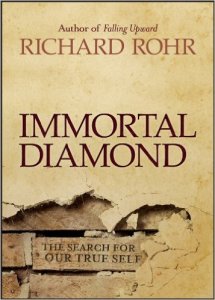
This is a foundational question that we’ll forever struggle with in prayer and writing until we finally confront it. There may be no better tool for answering this question than Richard Rohr’s Immortal Diamond: The Search for our True Self.

This is the book that saved my soul, or at least saved me from myself.

The false self won’t be silenced easily. In fact, I have found that the false self is so hard to fight because living into your true self in God’s love requires doing LESS. So much of religion is about doing more or doing something differently. Rohr’s wisdom about the true self appears to be counterintuitive at first.


“Your True Self is who you are, and always have been in God . . . The great surprise and irony is that “you,” or who you think you are, have nothing to do with its original creation or its demise. It’s sort of disempowering and utterly empowering at the same time, isn’t it? All you can do is nurture it.”

* * * * *

“The soul, the True Self, has everything, and so it does not require any particular thing. When you have all things, you do not have to protect any one thing. True Self can love and let go. The False Self cannot do this.”

* * * * *

“Remember, please remember, you do not (you must not!) fear, attack, or hate the False Self. That would only continue a negative and arrogant death energy, and it is delusional and counterproductive anyway. It would be trying to “drive out the devil by the prince of devils,” as Jesus puts it. In the great economy of grace, all is used and transformed, and nothing is wasted. God uses your various False Selves to lead you beyond them.”

* * * * *

“What the ego (the False Self) hates and fears more than anything else is change. It will think up a thousand other things to be concerned about or be moralistic about—anything rather than giving up “who I think I am” and “who I need to be to look good.”


Finding your true self in God’s love is largely a matter of practicing the presence of God rather than trying to do any one thing better. If we let God define who we are, we’ll start to recognize the times when the false sense begins to whisper lies to us.

Once we learn to rest in Christ, we’ll begin to recognize when the imposter of the false self emerges.

Learn more about Immortal Diamond today.


Keep in Touch

Get our latest blog posts delivered to your inbox or sign up for the weekly contemplative email and receive a free eBook: The Contemplative Writer.


For Reflection or Sharing

Do less Contemplative Writer


Featured Contemplative Book: Immortal Diamond

Immortal Diamond: the search for our true selfWeek One: The Search for Your True Self

Richard Rohr’s book Immortal Diamond offered a lifeline at a point in my life when I was discouraged, somewhat aimless, and deeply insecure. What was the root of my insecurity and overall misery? My false self that hinged on my accomplishment and what other people thought of me.

The false self requires constant reinforcement and progress in order to remain content. There may be no greater threat to contemplative writers than the false self. 

Keeping the false self happy feeds into so many other pitfalls, such as pride and envy. Who has time to pray when there’s a false self that must be maintained? Who can do the deep observation and painstaking editing that good writing requires while ensuring the false self is placated?

Richard Rohr grounds us in the wonderful news about who you are and where you can find rest as you approach God in prayer and then set about your work for the day:

*****

“Your True Self is who you are, and always have been in God . . . The great surprise and irony is that ‘you,’ or who you think you are, have nothing to do with its original creation or its demise. It’s sort of disempowering and utterly empowering at the same time, isn’t it? All you can do is nurture it.”

*****

“The soul, the True Self, has everything, and so it does not require any particular thing. When you have all things, you do not have to protect any one thing. True Self can love and let go. The False Self cannot do this.”

*****

“I promise you that the discovery of your True Self will feel like a thousand pounds of weight have fallen from your back. You will no longer have to build, protect, or promote any idealized self image. Living in the True Self is quite simply a much happier existence, even though we never live there a full twenty-four hours a day. But you henceforth have it as a place to always go back to. “

*****

“Find God, the primary source, and the spring water will forever keep flowing (Ezekiel 47:1-12; John 7:38) naturally. Once you know that, the problem of inferiority, unworthiness, or low self-esteem is resolved from the beginning and at the core.” Pg 31

*****

“In ordinary language, the True Self is held together by the glue of a universal love. ‘For God is love and anyone who lives in love lives in God, and God lives in him” (1 John 4:16). When we live in such abundance, we do not need to fight or defeat our False Self. It naturally fades into the background in the presence of absolute abundance and absolute allowing.” Pg. 55

*****

If you’ve read Daring Greatly by Brene Brown, and I hope you will soon, you know that the key struggle we all face is believing this: “I am enough.” Rohr completes this mantra: “I am enough because of God’s love.” 

The truth that I have found is this: Nothing in this life will ever be good enough or offer a peace and security that compares to God’s love. 

Read more about Immortal Diamond

About Featured Books: Each month I’ll share weekly posts about the month’s featured book.

Keep in Touch

Get our latest blog posts delivered to your inbox or sign up for the weekly contemplative email and receive a free eBook: The Contemplative Writer.

For Reflection or Sharing

True self Contemplative Writer (1)

Announcing The Contemplative Writer: Soul Care and Spiritual Practices for Writers

cropped-the-contemplative-writer-twitter-header.jpg

Where does your identity come from?

I’m going to guess that anyone attracted to a site called The Contemplative Writer looks to their faith and their writing as important parts of their identities. Writing is extremely fulfilling and can serve others, but it will fail anyone who looks to it as as an identity.

The foundational principle for everything that follows at The Contemplative Writer is this: Your identity is determined by God’s love for you, and you’ll only find that identity by caring for your soul. While there are many ways to care for your soul, the goal of this website is to lay a strong foundation of Christian contemplative spiritual practices so that you can pray and write with a healthy, well-grounded soul.

Richard Rohr of the Center for Action and Contemplation says that he focuses on 80% contemplation in order to guide 20% of his action. Our actions (or writing) will be rooted in love and purpose when they are grounded in an identity established by God through our contemplation.

For those of us who write, our identities can be particularly fragile. While anyone can benefit from this website in the weeks and months to come, writers of faith will especially benefit from the practices and mindsets presented in daily posts and weekly newsletters.

If your identity is dictated by outside voices and circumstances, there’s every reason to believe that your soul will suffer and your actions will veer in any number of wrong turns. At the contemplative writer the content I share each day follows Rohr’s 80/20 approach: 80% guiding contemplation and 20% guiding writing practice. If we can use the tools of Christian spirituality to help you connect with God and to care for your soul, I believe we’ll be in a much healthier place for our writing.

Each week you’ll find the following brief blog posts (100-300 words) to aid your contemplative journey:

  • Monday: Quotes from a book of the month on contemplative prayer.
  • Tuesday: Scripture meditation.
  • Wednesday: Featured article or book on contemplative prayer or writing practices.
  • Thursday: Contemplative profile or history.
  • Friday: A list of prayer or writing links.
  • Saturday: Guest writers and spiritual directors (coming soon)

Each month you can also expect a weekly newsletter that will soon be adapted into a podcast as well.

Finally, a small disclaimer…

I have not set up this website because I am the most accomplished or knowledgable contemplative Christian. I do not view myself as an expert. I am merely someone who has immersed himself in Christianity since my youth, and the contemplative prayer practices I started learning in the early 2000’s have been the most important, formative, and longest-lasting aspects of my faith. The more I lean into contemplative prayer, the more essential it becomes for my faith and my calling as a writer.

I set up this website because I wanted to immerse myself in contemplative prayer while also sharing my journey with others. I hope that this new venture helps you find space to meet with God, guidance for the road ahead, and rest for your soul as you create and bless others. I’ll share some simple ways you can keep in touch and support us below.

Thank you for visiting!

Ed

Subscribe to daily blog posts via email (Scroll down for the RSS feed link).

email posts

Join our weekly contemplative email list (Get the new eBook The Contemplative Writer for free too!).

subscribe-today-nl

Support us with monthly or one-time gifts (we don’t run ads or sponsored posts).

Monthly gifts (starting at $1/month)

support-patreon-orange

One-time gifts (suggested $5)

Donate Now Button


Check out the contemplative prayer resources page.


For Reflection or Sharing:

Quote for Contemplative writer launch

Scripture Meditation: The Earth Is Full of God’s Love

bible-1440953-1279x852

Today’s Scripture Reading

“The earth, O LORD, is full of your love; instruct me in your statutes.”
Psalm 119:64

Meditation

When I think of the world these days, I can very easily focus on the anger, fear, and violence that seems to run unchecked sometimes. Today’s Psalm reminds us that God is not only present, but God’s love fills our world.

If I believe in God, do I believe in a loving, merciful God who wants nothing more than for me to pray? Or do I let my imagination create images of an angry, violent, and petty God who is waiting for me to finally mess up enough to justify banishing me from his presence forever?

As you approach God in prayer today, consider that God’s love is abundantly present throughout our world. What if experiencing God’s love is made possibly by overcoming the barriers to it?

Personal Reflection

What keeps me from experiencing God’s abundant love?