Friday Favorites for Prayer and Writing

Each Friday I share some of my favorite finds related to praying or writing. If I think it could help you pray or write better, then I’ll include it below.

Do you have someone else’s article or post to share? Join the Contemplative Writers Facebook group, comment on today’s post on my Facebook page, or follow me on Twitter (@edcyzewski) to nominate your favorite articles, blog posts, and books by Thursday at noon each week.

Seasons of the Soul via Adam McHugh

How Gratitude Made Ann Voskamp a Contemplative Activist

Tips for Handling a Toxic Co-Worker (The contemplative response? compassion)

Thoughts on Contemplative SilenceThoughts on Contemplative Silence

Sleepy Wasps and Ecclesiastes via Tanya Marlow

10 Predictions for the Days After November 8 (Deep breaths folks…)


Keep the Contemplative Writer Sustainable

The Contemplative writer is ad-free and never shares sponsored content, but it is a lot of work to maintain. We rely on affiliate links from the books we share and the generous donations of our readers. An automated monthly gift as low as $1 per month or a one-time gift of $5 goes a long way to sustaining our mission to provide contemplative prayer resources for our readers.

Learn how your support, through a one-time gift or small monthly gifts can keep this website running: Support Us Today

Featured Article: How to Face Digital Addiction

This week’s featured article discusses the possibility of a digital addictions disorder (DAD) that could impact roughly 5% of Americans and could impact as many as 30% of people in countries with frequent internet use.

Heavy internet gaming and social media use can distract us from work, interrupt our relationships, and ultimately change the ways that our brains function and seek pleasure or rewards. While most of us need to be online for one reason or another, we all need to recognize the signs of a problem.

Here are a few key quotes to consider from the article:

*****

“A digital addiction is comparable to addictions such as food or drugs in its obsessive nature. As is the case with all addictions, they influence the brain – both in the connections between the cells and in the brain areas that control attention, executive control and emotional processing. It triggers the release of dopamine, providing a temporary “high” on which addicts become dependent.”

*****

“Being stressed out or suffering from anxiety and depression can be a contributing factor in the development of addictions. In addition, people who suffer from DAD are often no strangers to other addictions such as alcohol, drugs, sex or gambling. People who have relationship issues also seem to be at a higher risk of developing an internet addiction. They use digital “connections” to boost their spirits and to escape from their problems.”

*****

Read more…

Scripture Meditation: Known and Loved

“But even the hairs of your head are all counted. Do not be afraid; you are of more value than many sparrows.”
Luke 12:7, NRSV

God is intimately acquainted with us, knowing our desires, faults, and needs as well as mental, physical, and spiritual identities. We are known deeply and intimately by our creator, and whether that sounds like good news or bad news for you, Jesus assures us that we are deeply valued by God.

Our creator has been deeply invested in our every detail. How could he stop caring for us?

We can talk ourselves out of his love. We can argue that we have sinned too much, become too complacent, and not done enough for God.

When God sees you, he sees a beloved creation that is known from head to toe. You are worthy of love and restoration simply because he is intimately invested in who you are as your creator.


For Reflection

meditation-for-october-25


Book of the Month: Everything Belongs

everything-belongs-rohrWeek Three: Real Freedom… from Ourselves…


What gets in the way of our freedom? Most of the time, we do!

In Everything Belongs, Richard Rohr writes about the way the ego, our desire to uphold our self images, and the ways that we judge others all can lead us away from our true selves, union with God, and union with others.

This week’s quotes include the following:


*****

“When we live out of the ego, we impose our demands on reality. But when we live in God’s presence, we await reality’s demands on us. “

*****

“As long as we are comparing and differentiating from the other, we can’t love the other. We judge it.”

*****

“Most don’t know how to surrender to God. How can we surrender unless we believe there is someone trustworthy out there to surrender to?”

*****

“We don’t live in our bodies where we can feel our own feelings and trust our own experience. Instead, through commercials and advertisements and jingles we live in images and appearances.”

*****

“I’ve seen far too many activists who are not the answer. Their head answer is largely correct but the energy, the style, and the soul are not.”

*****

Read more…


For Reflection

featured-book-october-19

Book of the Month: Everything Belongs

everything-belongs-rohrWeek Two: Replacing Illusion with Reality

In his book Everything Belongs, Richard Rohr writes about the great surrender that must take place before we can find God and our true selves in prayer.

He is quick to note that God is already present. In fact, we cannot escape God’s presence but we can obscure it or overlook it. Our illusions about ourselves or about God can get in the way.

Therefore the great goal of every spiritual practice is to help us move past our illusions, distractions, and oversimplified answers so that we can be truly present for God.


*****

“We have no real access to who we really are except in God. Only when we rest in God can we find the safety, the spaciousness, and the scary freedom to be who we are, all that we are, more than we are, and less than we are. Only when we live and see through God can ‘everything belong.’ All other systems exclude, expel, punish, and protect to find identity for their members in ideological perfection or some kind of ‘purity.’”

*****

“We cannot attain the presence of God because we’re already totally in the presence of God. What’s absent is awareness. Little do we realize that God is maintaining us in every breath we take.”

*****

“All spiritual disciplines have one purpose: to get rid of illusions so we can be present.”

*****

“When we look at the questions, we look for the opening to transformation. Fixing something doesn’t usually transform us. We try to change events in order to avoid changing ourselves. We must learn to stay with the pain of life, without answers, without conclusions, and some days without meaning. That is the path, the perilous dark path of true prayer.”

*****

“When we avoid darkness, we avoid tension, spiritual creativity, and finally transformation. We avoid God, who works in the darkness—where we are not in control! Maybe that is the secret: relinquishing control.”

*****

Read more in Everything Belongs


For Reflection

featured-book-october-10

Scripture Meditation: Worship and Reconciliation Go Together

“So when you are offering your gift at the altar, if you remember that your brother or sister has something against you, leave your gift there before the altar and go; first be reconciled to your brother or sister, and then come and offer your gift.”
Matthew 5:23-24

How do we enter into prayer and worship? Self-examination is always helpful, especially if we have a reason to confess a wrong to a friend, colleague, or neighbor.

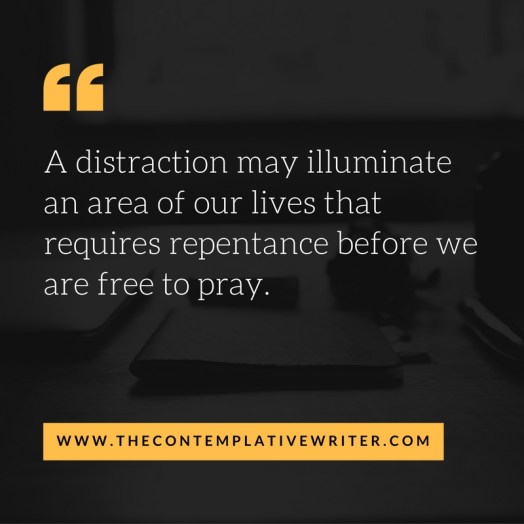
The monks who instructed novices in prayer typically noted that some distractions were a from God. A distraction may illuminate an area of our lives that requires repentance before we are free to pray.

Self-examination preemptively faces our distractions or failures and gives us a chance to take action before we enter into prayer. And if you don’t have time to pray because you’re busy seeking reconciliation, I trust that this obedience is precious to Jesus.


For Reflection

meditation-for-october-4

Book of the Month: Everything Belongs

Week One: Surrender to God’s Mercy

everything-belongs-rohrIf everything belongs in our contemplative practice, then we must give up the charade of denial or wearing a mask to hide our flaws and pain. Our only hope will be completely surrendering to God’s mercy.

Once we face our pain, struggles, and failures, we remove ourselves from religious systems that gain their power from setting moral standards that cannot be violated by their members or call for simplistic answers. This is why those who have faced their own dark sides and found God’s mercy are so able to share mercy with others.

This month we’ll look at Richard Rohr’s book Everything Belongs: The Gift of Contemplative Prayer, with quotes this week about the process of exposing and moving beyond the obstacles that keep us from intimacy with God:


*****

“In God’s reign ‘everything belongs,’ even the broken and poor parts. Until we have admitted this in our own soul, we will usually perpetuate expelling systems in the outer world of politics and class. Dualistic thinking begins in the soul and moves to the mind and eventually moves to the streets. True prayer, however, nips the lie in the bud. It is usually experienced as tears, surrender, or forgiveness.”

*****

“In terms of soul work, we dare not get rid of the pain before we have learned what it has to teach us.”

*****

“We do not find our own center; it finds us… We do not think ourselves into new ways of living. We live ourselves into new ways of thinking.”

*****

“It seems that we Christians have been worshipping Jesus’ journey instead of doing his journey.”

*****

“It is much easier to belong to a group than it is to know that you belong to God. Those who firm up their own edges and identity too quickly without finding their center in God and in themselves will normally be the enemies of ecumenism, forgiveness, vulnerability, and basic human dialogue.”

*****

Read more in Everything Belongs


For Reflection

featured-book-october-3

Featured Contemplative Book: Immortal Diamond

Immortal Diamond by RohrWeek Two: The Struggle with the False Self

Who am I?

This is a foundational question that we’ll forever struggle with in prayer and writing until we finally confront it. There may be no better tool for answering this question than Richard Rohr’s Immortal Diamond: The Search for our True Self.

This is the book that saved my soul, or at least saved me from myself.

The false self won’t be silenced easily. In fact, I have found that the false self is so hard to fight because living into your true self in God’s love requires doing LESS. So much of religion is about doing more or doing something differently. Rohr’s wisdom about the true self appears to be counterintuitive at first.


“Your True Self is who you are, and always have been in God . . . The great surprise and irony is that “you,” or who you think you are, have nothing to do with its original creation or its demise. It’s sort of disempowering and utterly empowering at the same time, isn’t it? All you can do is nurture it.”

* * * * *

“The soul, the True Self, has everything, and so it does not require any particular thing. When you have all things, you do not have to protect any one thing. True Self can love and let go. The False Self cannot do this.”

* * * * *

“Remember, please remember, you do not (you must not!) fear, attack, or hate the False Self. That would only continue a negative and arrogant death energy, and it is delusional and counterproductive anyway. It would be trying to “drive out the devil by the prince of devils,” as Jesus puts it. In the great economy of grace, all is used and transformed, and nothing is wasted. God uses your various False Selves to lead you beyond them.”

* * * * *

“What the ego (the False Self) hates and fears more than anything else is change. It will think up a thousand other things to be concerned about or be moralistic about—anything rather than giving up “who I think I am” and “who I need to be to look good.”


Finding your true self in God’s love is largely a matter of practicing the presence of God rather than trying to do any one thing better. If we let God define who we are, we’ll start to recognize the times when the false sense begins to whisper lies to us.

Once we learn to rest in Christ, we’ll begin to recognize when the imposter of the false self emerges.

Learn more about Immortal Diamond today.


Keep in Touch

Get our latest blog posts delivered to your inbox or sign up for the weekly contemplative email and receive a free eBook: The Contemplative Writer.


For Reflection or Sharing

Do less Contemplative Writer