WEEKLY PRAYER

A prayer from the Sarum Breviary:

Thou, who art the eternal protection and salvation of our souls, arm us, we entreat Thee, with the helmet of hope, and the shield of Thy invincible defence; that so, helped by Thee in the straits of our necessities, we may be filled with joy and gladness with those who love Thee, through Jesus Christ our Lord. 

Source

WEEKLY PRAYER

This week, we are praying Thomas Merton’s most well-known prayer:

My Lord God,
I have no idea where I am going.
I do not see the road ahead of me.
I cannot know for certain where it will end.
nor do I really know myself,
and the fact that I think I am following your will
does not mean that I am actually doing so.
But I believe that the desire to please you
does in fact please you.
And I hope I have that desire in all that I am doing.
I hope that I will never do anything apart from that desire.
And I know that if I do this you will lead me by the right road,
though I may know nothing about it.
Therefore will I trust you always though
I may seem to be lost and in the shadow of death.
I will not fear, for you are ever with me,
and you will never leave me to face my perils alone.

WEEKLY PRAYER

Today the Church celebrates the feast day of St. Francis of Assisi. This week’s prayer is Francis’s Peace Prayer:

Lord, make me an instrument of your peace:
where there is hatred, let me sow love;
where there is injury, pardon;
where there is doubt, faith;
where there is despair, hope;
where there is darkness, light;
where there is sadness, joy.

O divine Master, grant that I may not so much seek
to be consoled as to console,
to be understood as to understand,
to be loved as to love.
For it is in giving that we receive,
it is in pardoning that we are pardoned,
and it is in dying that we are born to eternal life.

Amen.

BOOK OF THE MONTH: HILDEGARD OF BINGEN: A SPIRITUAL READER

Week 4: Get Your Sparkle On

41XzfkDXhhL._SY346_

In reading Hildegard of Bingen’s work, it becomes clear that she highly valued creation and creativity. In our final week exploring Hildegard of Bingen: A Spiritual Reader, we’ll see what she says about this theme.

Two songs that Hildegard wrote tell of God as designer and animator (the titles to these songs were added by Carmen Butcher, who compiled the selections in the spiritual reader):

The First Daylight


You’re the Word of our Father,
the light of the first sunrise,
God’s omnipotent thought.
Before anything was made,
You saw it,
You designed it, and
You tucked Your all-seeing nature in the middle of Your sinew,
like a spinning wheel
with no beginning and no end,
still encircling everything.

*****

The First Verb


The Holy Spirit animates
all, moves
all, roots
all, forgives
all, cleanses
all, erases
all
our past mistakes, and then
puts medicine on our wounds.
We praise this Spirit of incandescence
for awakening
and reawakening
all
creation.

*****

In her letters, Hildegard frequently reminded others of God’s creativity. To the Abbess of Bamberg, she wrote:

In the same way that the stars illuminate the sky at night, God made humanity to sparkle. We’re created for maturity. We’re made to give out light like the sun, the moon, and the stars. If a black cloud covered these, the earth and every creature in it would worry that the end had come.

*****

In a letter to Pope Anastasius IV, Hildegard makes a striking moral statement about creativity. She tells the pope that we must reject corruption, injustice, and evil because they are not creative. They are a form of anti-creativity:

Don’t forget that whatever God made, radiates. So listen. Before God made the world, He said to Himself, “There’s My dear Son!” and from this original Word, the world was formed. Then God said, “Be!” and all kinds of animals appeared. Our God creates, but evil is never creative. It’s nothing, merely the by-product of rebellion. Through His Son, God saved humanity, clearly rejecting immorality—stealing, stubbornness, murder, hypocrisy, and bullies.


That’s why you as pope must never collude with corruption. If you do, you confuse those who look to you as their leader, because, in effect, you’re saying to them, “Embrace what’s really nothing.”

*****

Read more.

For reflection:
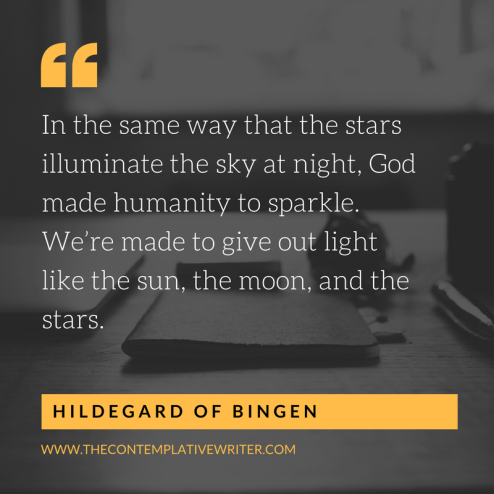
Hildegard week 4.png

BOOK OF THE MONTH: HILDEGARD OF BINGEN: A SPIRITUAL READER

Week Two: Hope for the Church

41XzfkDXhhL._SY346_

Yesterday (Sept. 17) was the Feast Day of Saint Hildegard of Bingen (1098-1179), the Benedictine nun, abbess, and writer. All this month, we’re looking at a selection of her written works  Hildegard of Bingen: A Spiritual Reader (collected and translated by Carmen Acevedo Butcher).

In her theological text, the Scivias, Hildegard records a series of visions she received. I find her apocalyptic visions especially striking. They seem incredibly relevant for our time, when many people voice concerns about the future of Christianity and the Church. Listen to Hildegard’s diagnosis:

Today, the Catholic faith dithers, on a global scale. The Gospel limps its way around the world. The early Church Fathers (who wrote so well) are ignored. People are apathetic. They refuse to read and taste the nourishment in the Scriptures . . .

Does this diagnosis sound familiar? If so, take hope! Despite the dire state of affairs of the Church, its future is assured. In Hildegard’s vision, the voice of heaven says:

Everything on earth is hurrying to its end. The world’s troubles and its many disasters tell you this. But my Son’s bride, the Church, will never ever be destroyed, no matter how many times she’s assaulted. At the end of time she’ll be stronger, more beautiful, more magnificent than ever before. She’ll enjoy the sweet embraces of her Beloved. That’s what the vision you just saw means.

Hildegard ends this vision in her own words:

Then I looked to the East and saw the One-who-shines-so-bright-that-I-can-never-see-Him-clearly, but I was able to see that up close to His breast, He was holding something that looked like a dirty lump, the size of a human heart, decorated around the edge with gems and pearls. This is our gentle Father hugging humanity to Himself. That’s why no one can reject anyone—because the Son of the Father is God incarnate who Himself accepted the human form.

Read more.

For reflection:

Hildegard week 2

WEEKLY PRAYER

The Recollection Prayer of St. Teresa of Avila:

Give me the grace to recollect myself in the little heaven of my soul where You have established Your dwelling. There You let me find You, there I feel that You are closer to me than anywhere else, and there You prepare my soul quickly to enter into intimacy with You…Help me O Lord, to withdraw my senses from exterior things, make them docile to the commands of my will, so that when I want to converse with You, they will retire at once, like bees shutting themselves up in the hive in order to make honey.

Source

BOOK OF THE MONTH: HILDEGARD OF BINGEN: A SPIRITUAL READER

Week One: Combating self-doubt, anger, and pride

41XzfkDXhhL._SY346_

Hildegard of Bingen (1098-1179) was a Benedictine nun, abbess, writer—and so much more. The medievalist Carmen Acevedo Butcher describes her as an:

“abbess/artist/cosmologist/composer/
counselor/dietitian/dramatist/epistoler/
healer/linguist/mystic/naturalist/
philosopher/poet/political consulstant/
preacher/prophet/visionary!”

Butcher collected a selection of this extraordinary medieval woman’s works in Hildegard of Bingen: A Spiritual Reader. We’ll be taking a look at some of these selections this month.

Hildegard’s first major theological text, the Scivias, contains twenty-six visions that Hildegard had. She wrote them down, she said, to help others learn to praise and adore God.

In one part of this work, Hildegard writes passionately of something we all recognize: feelings of self-doubt, anger, and pride.

My self-doubt makes me miserable. I feel oppressed by all things . . . I doubt everything when I feel this way, including my salvation.

Hildegard knows these doubts and feelings are the work of the devil. Here is how she combats them:

But when God helps me remember that He created me, then—even in the middle of my depression—I tell the Devil, “I won’t give in to my fragile clay. I’ll fight you!” How? When my inner self decides to rebel against God, I’ll walk with wise patience over the marrow and blood of my body. I’ll be the lion defending himself from a snake, roaring and knocking it back into its hole. I won’t let myself give in to the Devil’s arrows.

*****

When anger tries to burn up the temple of my body, I’ll look to God’s goodness, which anger never touched. I’ll look to God whom anger never touched, and I’ll become sweeter than the breeze whose gentleness moistens the earth. I’ll look to the God of peace, because then I’ll have spiritual joy as the virtues begin to show themselves in me, strengthening me with their vibrant greenness. I’ll look to God whom anger never touched, and—because I look to Him—I’ll experience God’s calm goodness.

*****

And when hatred tries to diminish who I am, I’ll look to the kindness of God’s Son and to His pain. How will I get myself in hand? I’ll accept the thorns that give off the delicate fragrance of roses. They grew to honor the One who was faithful, and by controlling myself I’ll bring honor to my Lord.

*****

Read more.

For reflection

Hildegard week 1, version 2