CONTEMPLATIVE PROFILE: PERSEVERING IN PRAYER WITH CATHERINE OF SIENA

In last week’s Contemplative Profile, we looked at a letter of St. Catherine, the 14th-century mystic, in which she describes three kinds of prayer. In that same letter, Catherine encourages her niece, a nun, to persevere when faced with difficulties praying. Let’s take her words to heart when we have our own struggles. Catherine writes:

*****

If you encounter different kinds of struggle in your prayer, or if you experience confusing darkness of mind (this is the devil making the soul feel that her prayer is not pleasing to God), you ought, nevertheless, never give up on account of struggles and darkness, but rather to stand firm with courage and perseverance, remembering that the devil does this to draw you away from your mother, prayer, and that God permits it to test the courage and constancy of your soul.

*****

God allows this also so that in your struggle and darkness you may know that of yourself you are nothing, and may know, through the good intention in which you remain, the goodness of God who is the giver and the preserver of a good and holy will.

*****

Catherine of Siena (1347-1380) was a member of the Dominican Order of Penance. She was a mystic, a reformer, and an adviser to popes. Her written work includes over 300 letters and a contemplative treatise, The Dialogue. Read more here.

Read Catherine’s letters here.

.

CONTEMPLATIVE PROFILE: PRAYING WITH CATHERINE OF SIENA

St. Catherine of Siena (1347-1380) was a compassionate spiritual adviser and encourager. Interestingly, she dispensed much of her advise in writing, in the form of letters. Sometimes she wrote to popes and other rulers, sometimes to simple religious folk like herself.

In a letter to her niece, who was a nun, Catherine describes three kinds of prayer. It’s helpful to take a look at her taxonomy. Note: what Catherine calls “mental prayer” (below) appears to be akin to contemplative or silent prayer:

*****

Prayer is of three kinds. The first is unceasing: it is a holy constant desire which prays in the sight of God, no matter what you are doing . . . The glorious saint Paul seemed to be referring to this when he urged: “Pray constantly” (1 Thes 5:17).

*****

The second kind is vocal prayer: you engage in this when you say the office or other prayers aloud.

*****

This is meant to bring you to the third kind, namely, mental prayer. Your soul reaches this kind of prayer through the use of vocal prayer with prudence and humility, so that while the tongue speaks, the heart is not far from God. And when you perceive that God is visiting your mind so that it is drawn in any way to think of its Creator, you ought to abandon vocal prayer and to fix your mind with great love on God’s visitation.

*****

A bit more on mental prayer:

*****

[The soul] rises above herself, that is, above the gross impulse of the senses, and with angelic mind is united with God in intense love. By the light of her intellect she sees and knows, and she clothes herself with truth, becoming the sister of the angels.

*****

Catherine of Siena (1347-1380) was a member of the Dominican Order of Penance. She was a mystic, a reformer, and an adviser to popes. Her written work includes over 300 letters and a contemplative treatise, The Dialogue. Read more here.

Read Catherine’s letters here.

Reflection: Do you practice all three kinds of prayer mentioned by Catherine of Siena?

BOOK OF THE MONTH: BEFRIENDING SILENCE

Week 1: The Gift of Sacred Stories

Befriending Silence

In Befriending Silence: Discovering the Gifts of Cistercian Spirituality, Carl McColman shares what we can learn from an ancient monastic tradition. McColman himself is a Lay Cistercian affiliated with the Trappist Monastery of the Holy Spirit in Conyers, Georgia.

Befriending Silence explores eleven gifts from the Cistercian tradition. The chapter “Sacred Stories” diagnoses a problem: “Our society as a whole has forgotten who we are, and the consequences are devastating,” McColman writes. “[W]e have forgotten that we all are created in the image of God.” He goes on to explain how Scripture and other spiritual writings can help us live in God’s story and remind us who we truly are. Reading sacred story is a sacred tradition.

*****

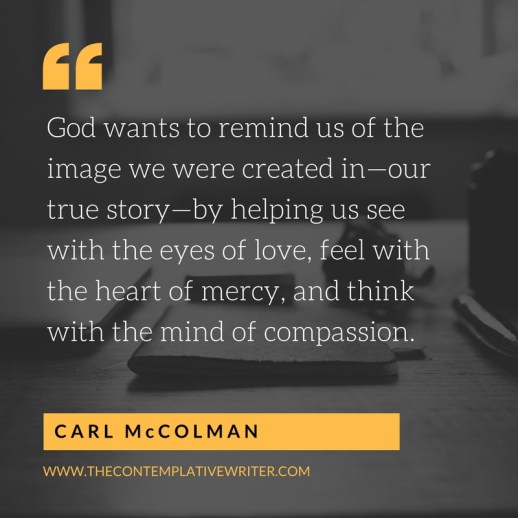
God wants to remind us of the image we were created in—our true story—by helping us see with the eyes of love, feel with the heart of mercy, and think with the mind of compassion.

*****

The gift of Christian, Benedictine, and Cistercian wisdom and memory is that these timeless stories and teachings from the past provide the foundation on which we can build our own spiritual identity, our own sense of what it means to respond to God’s grace, in our time.

*****

For people of faith, reading can be a doorway not to greater control but greater surrender, a way to open our minds and hearts to the transfiguring and life-giving Word of God.

*****

Following the chapter, McColman explains the practice of lectio divina, or sacred reading, giving advice and guidance to those beginning on this path:

*****

Although lectio divina originated in monasteries and remains a core spiritual practice for monks and nuns, it is something anyone may learn, practice, and enjoy. By making lectio divina a regular part of your life, you participate in a practice that has nurtured Cistercians and other monastics for centuries.

*****

[L]ectio divina is like spending time with someone special. The purpose is to linger, savoring the time spent together.

*****

Remember, the purpose of lectio divina is not to gather more information but to seek God’s living word for your life.

*****

Read more.

For reflection:

McColman - week 1 (alt)


CONTEMPLATIVE PROFILE: WRITING WITH ST. TERESA OF AVILA

Many contemplatives and other figures from history have seen writing as a spiritual discipline and even an act of obedience. I find it illuminating to hear what they have to say about putting pen to paper (or, in our case, fingers to keys). This week we’ll look briefly at the Spanish mystic Teresa of Avila.

In her great work on prayer, The Interior Castle, Teresa reveals why writing is an act of faith. She begins by beseeching God to speak for her because “I wasn’t able to think of anything to say.” This certainly gives hope to those of us sometimes afflicted with writer’s block today! God seems to have answered Teresa’s plea, for by the end of her book, she’s explaining why she has so much to say. The reason is simple: just as God’s not finished with his work, so Teresa is not finished with hers. A God of greatness inspires a great outpouring of words.

*****

You will think, Sisters, that since so much has been said about this spiritual path it will be impossible for anything more to be said. Such a thought would be very foolish. Since the greatness of God is without limits, His works are too. Who will finish telling of His mercies and grandeurs?

*****

Teresa also echoes St. Augustine in avowing that the more we know about God’s works, the more we will praise him. That’s a good reason to keep writing:

*****

He grants us a great favor in having communicated these things to a person through whom we can know about them. Thus the more we know about His communication to creatures the more we will praise His grandeur and make the effort to have esteem for souls in which the Lord delights so much.

*****

Teresa of Avila (1515-1582) was a Spanish nun in the Carmelite order. She was a mystic, a founder and reformer of monasteries, a spiritual director, and a writer. Read more here.

Reflection: How is writing an act of faith for you?

CONTEMPLATIVE PROFILE: WRITING WITH ST. AUGUSTINE

Many contemplatives and other figures from history have seen writing as a spiritual discipline and even an act of obedience. One such figure is St. Augustine. In his spiritual autobiography, the Confessions, Augustine tells God (and us) the reason for setting down his story. Why write? Augustine says it is to excite love toward the divine. In these passages, he is addressing God himself:

Why then do I set before you an ordered account of so many things? It is certainly not through me that you know them. But I am stirring up love for you in myself and in those who read this, so that we may all say ‘Great is the Lord and highly worthy to be praised’ (Ps 47:1). I have already affirmed this and will say it again: I tell my story for love of your love.

*****

See, the long story I have told to the best of my ability and will responds to your prior will that I should make confession to you, my Lord God.

*****

Augustine of Hippo (354-430) was a theologian, bishop, and Church Father who greatly influenced western Christianity. Read more about him.

For reflection: Why do you write?

CONTEMPLATIVE PROFILE: TALKING TO JESUS WITH IGNATIUS OF LOYOLA

In 1548, Ignatius of Loyola published one of the most popular devotional books in Christian history – the Spiritual Exercises. This book is a compilation of meditations, prayers, and other practices. In one of the Exercises, we find a way to prayerfully meditate on the cross of Christ. It seems especially appropriate for Holy Week.

In the first Exercise of his book, Ignatius introduces the idea of a colloquy, which, he says, is made “in the way one friend speaks to another . . . now begging a favor, now accusing oneself of some misdeed, now telling one’s concerns and asking counsel about them.”

Ignatius suggests this colloquy, or conversation, with Christ:

Imagine Christ our Lord suspended on the cross before you, and converse with him in a colloquy: How is it that he, although he is the Creator, has come to make himself a human being? How is it that he has passed from eternal life to death here in time, and to die in this way for my sins?

*****

In a similar way, reflect on yourself and ask: What have I done for Christ? What am I doing for Christ? What ought I to do for Christ?

Ignatius says that as you gaze on Christ, you should “speak out whatever comes to your mind.”

End the colloquy by saying the Lord’s Prayer.

*****

Ignatius of Loyola (1491 – 1556) was a Spanish priest, theologian, spiritual director, and founder of the Jesuit order. Read more.

Read the Spiritual Exercises here.

CONTEMPLATIVE PROFILE: GREGORY THE GREAT ON “RESTING IN GOD”

You may have heard that St. Gregory the Great (c. 540 – 604) defined contemplation as “resting in God.” Indeed, this quote is posted on the home page of The Contemplative Writer! This snippet is a condensed version of what St. Gregory really said, and I thought we should take a look at the full statement. It’s a wonderfully nuanced description of just what “resting in God” really means:

But the contemplative life is: to retain indeed with all one’s mind the love of God and neighbor, but to rest from all exterior action, and cleave only to the desire of the Maker, that the mind may now take no pleasure in doing anything, but having spurned all cares, may be aglow to see the face of its Creator; so that it already knows how to bear with sorrow the burden of the corruptible flesh, and with all its desires to seek to join the hymn-singing choirs of angels, to mingle with the heavenly citizens, and to rejoice at its everlasting incorruption in the sight of God. (Source)

Note that for Gregory, resting in God means:

  • Cleaving to our Maker
  • Being aglow to see the Creator
  • Bearing the burdens of the flesh
  • Desiring heaven

*****

Gregory the Great (c. 540 – 604) was pope of the Catholic Church from 590 to 604. He was a contemplative, a missionary, a reformer, and a physician of souls. Read more here.

Reflection: How are prayer and contemplation like rest for you?

Featured Book: Finding Grace at the Center

Week Three: Prayer without Judgment or Evaluation

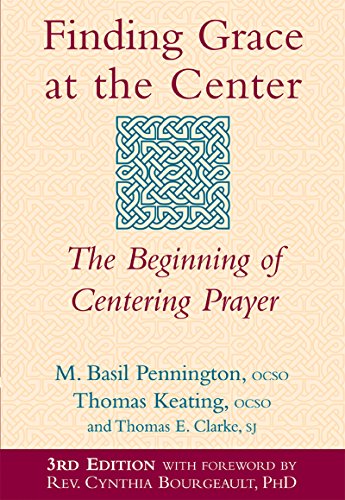
finding-grace-at-centerIn Finding Grace at the Center: the Beginning of Centering Prayer, a collection of essays by M. Basil Pennington, Thomas Keating, and Thomas E. Clarke, Thomas Keating provides an extremely helpful introduction to centering prayer based on The Cloud of Unknowing, a Carthusian monk’s prayer guide for novices dated to around the 14th century.

Keating is especially careful to avoid overselling what “happens” during centering prayer. One may not expect incredible revelations or to even be fully in control of what happens during this prayer. Rather, intention becomes essential as we enter this form of prayer.

Keating writes:


*****

“[Centering prayer] is not an end in itself, but a beginning. It is not to be done for the sake of an experience, but for the sake of its fruits in one’s life.”

*****

“The presence of God is like the atmosphere we breathe. You can have all you want of it as long as you do not try to take possession of it and hang on to it.”

*****

“Accept each period of centering prayer as it comes, without asking for anything, having no expectations. In that way its fruits will grow faster.”

*****

“We always want to possess. That is why it is so hard to leg go–why we want to reflect on moments of deep peace or union in order to remember how we got there and thus how to get back. But charity is non-possessive. It gives all back to God as fast as it comes. It keeps nothing for itself.”

*****

“Take everything that happens during the periods of centering prayer peacefully and gratefully, without putting a judgment on anything, and just let the thoughts go by. It does not matter where they come from, as long as you let them go by. Don’t worry about them.”

*****

Read more…


Contemplative Profiles: Evelyn Underhill

Contemplative profiles are back with the help of author and historian Lisa Deam. This month we’re featuring Evelyn Underhill:

Lately I’ve enjoyed getting to know some of the modern contemplatives and mystics. One of these is the Anglo-Catholic writer Evelyn Underhill (1875-1941). Underhill offered scholarly studies on great mystics from the past — she called them giants and heroes. At the same time, she insisted that the life of prayer and contemplation belongs to every ordinary person. No heroism necessary.

Underhill also believed that contemplation belongs to every era — eras of conflict and eras of peace. One of her early books, Practical Mysticism (free on Kindle!), was released at the beginning of World War I. Underhill almost postponed its publication out of concern that its subject matter would seem inapplicable or, even worse, selfish and otherworldly. But she decided that there was no better time to nourish the spiritual life.

We, too, live in times of turmoil and conflict. As Christians, we’re acutely aware of the world’s brokenness. This month we’ll explore what, according to Underhill, Christian contemplation offers us in troubled (as well as more peaceful) times.

I’ll leave you with some quotes from Practical Mysticism on the applicability of contemplation for every Christian.

For those who embrace it, the contemplative life “will teach them to see the world in a truer proportion, discerning eternal beauty beyond and beneath apparent ruthlessness. It will educate them in a charity free from all taint of sentimentalism; it will confer on them an unconquerable hope . . .”

*****

“Though it is likely that the accusation will annoy you, you are already in fact a potential contemplative: for this act, as St. Thomas Aquinas taught, is proper to all . . .  is, indeed, the characteristic human activity.”

Read more about Underhill in the Fuller Studio.


About Lisa Deam

Lisa Deam writes and speaks about Christian spiritual formation from a historical perspective. She’s the author of A World Transformed: Exploring the Spirituality of Medieval Maps. Visit her on Twitter @LisaKDeam and at lisadeam.com.

Friday Favorites for Prayer and Writing

Each Friday I share some of my favorite finds related to praying or writing. If I think it could help you pray or write better, then I’ll include it below.

Do you have someone else’s article or post to share? Join the Contemplative Writers Facebook group, comment on today’s post on my Facebook page, or follow me on Twitter (@edcyzewski) to nominate your favorite articles, blog posts, and books by Thursday at noon each week.

Seasons of the Soul via Adam McHugh

How Gratitude Made Ann Voskamp a Contemplative Activist

Tips for Handling a Toxic Co-Worker (The contemplative response? compassion)

Thoughts on Contemplative SilenceThoughts on Contemplative Silence

Sleepy Wasps and Ecclesiastes via Tanya Marlow

10 Predictions for the Days After November 8 (Deep breaths folks…)


Keep the Contemplative Writer Sustainable

The Contemplative writer is ad-free and never shares sponsored content, but it is a lot of work to maintain. We rely on affiliate links from the books we share and the generous donations of our readers. An automated monthly gift as low as $1 per month or a one-time gift of $5 goes a long way to sustaining our mission to provide contemplative prayer resources for our readers.

Learn how your support, through a one-time gift or small monthly gifts can keep this website running: Support Us Today