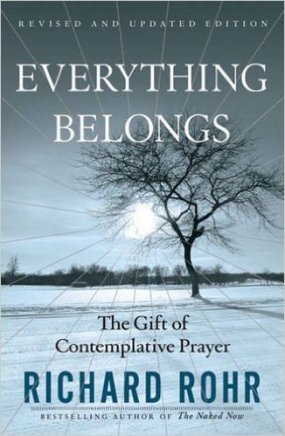
Book of the Month: Everything Belongs

everything-belongs-rohrWeek Three: Real Freedom… from Ourselves…


What gets in the way of our freedom? Most of the time, we do!

In Everything Belongs, Richard Rohr writes about the way the ego, our desire to uphold our self images, and the ways that we judge others all can lead us away from our true selves, union with God, and union with others.

This week’s quotes include the following:


*****

“When we live out of the ego, we impose our demands on reality. But when we live in God’s presence, we await reality’s demands on us. “

*****

“As long as we are comparing and differentiating from the other, we can’t love the other. We judge it.”

*****

“Most don’t know how to surrender to God. How can we surrender unless we believe there is someone trustworthy out there to surrender to?”

*****

“We don’t live in our bodies where we can feel our own feelings and trust our own experience. Instead, through commercials and advertisements and jingles we live in images and appearances.”

*****

“I’ve seen far too many activists who are not the answer. Their head answer is largely correct but the energy, the style, and the soul are not.”

*****

Read more…


For Reflection

featured-book-october-19

Book of the Month: Everything Belongs

everything-belongs-rohrWeek Two: Replacing Illusion with Reality

In his book Everything Belongs, Richard Rohr writes about the great surrender that must take place before we can find God and our true selves in prayer.

He is quick to note that God is already present. In fact, we cannot escape God’s presence but we can obscure it or overlook it. Our illusions about ourselves or about God can get in the way.

Therefore the great goal of every spiritual practice is to help us move past our illusions, distractions, and oversimplified answers so that we can be truly present for God.


*****

“We have no real access to who we really are except in God. Only when we rest in God can we find the safety, the spaciousness, and the scary freedom to be who we are, all that we are, more than we are, and less than we are. Only when we live and see through God can ‘everything belong.’ All other systems exclude, expel, punish, and protect to find identity for their members in ideological perfection or some kind of ‘purity.’”

*****

“We cannot attain the presence of God because we’re already totally in the presence of God. What’s absent is awareness. Little do we realize that God is maintaining us in every breath we take.”

*****

“All spiritual disciplines have one purpose: to get rid of illusions so we can be present.”

*****

“When we look at the questions, we look for the opening to transformation. Fixing something doesn’t usually transform us. We try to change events in order to avoid changing ourselves. We must learn to stay with the pain of life, without answers, without conclusions, and some days without meaning. That is the path, the perilous dark path of true prayer.”

*****

“When we avoid darkness, we avoid tension, spiritual creativity, and finally transformation. We avoid God, who works in the darkness—where we are not in control! Maybe that is the secret: relinquishing control.”

*****

Read more in Everything Belongs


For Reflection

featured-book-october-10

Book of the Month: Everything Belongs

Week One: Surrender to God’s Mercy

everything-belongs-rohrIf everything belongs in our contemplative practice, then we must give up the charade of denial or wearing a mask to hide our flaws and pain. Our only hope will be completely surrendering to God’s mercy.

Once we face our pain, struggles, and failures, we remove ourselves from religious systems that gain their power from setting moral standards that cannot be violated by their members or call for simplistic answers. This is why those who have faced their own dark sides and found God’s mercy are so able to share mercy with others.

This month we’ll look at Richard Rohr’s book Everything Belongs: The Gift of Contemplative Prayer, with quotes this week about the process of exposing and moving beyond the obstacles that keep us from intimacy with God:


*****

“In God’s reign ‘everything belongs,’ even the broken and poor parts. Until we have admitted this in our own soul, we will usually perpetuate expelling systems in the outer world of politics and class. Dualistic thinking begins in the soul and moves to the mind and eventually moves to the streets. True prayer, however, nips the lie in the bud. It is usually experienced as tears, surrender, or forgiveness.”

*****

“In terms of soul work, we dare not get rid of the pain before we have learned what it has to teach us.”

*****

“We do not find our own center; it finds us… We do not think ourselves into new ways of living. We live ourselves into new ways of thinking.”

*****

“It seems that we Christians have been worshipping Jesus’ journey instead of doing his journey.”

*****

“It is much easier to belong to a group than it is to know that you belong to God. Those who firm up their own edges and identity too quickly without finding their center in God and in themselves will normally be the enemies of ecumenism, forgiveness, vulnerability, and basic human dialogue.”

*****

Read more in Everything Belongs


For Reflection

featured-book-october-3

Book of the Month: The Way of the Heart

Week Four: Finding God in Silence…

way-of-the-heartPerhaps you’ve hoped, prayed, and waited for God to speak or you’ve spoken many words in your pursuit of God. Henrí Nouwen writes that God is present in the silence and that our pursuit of silence may be one of the surest paths to God.

While acknowledging the place of speaking and teaching, Nouwen reminds us that our words can often get us in trouble. James assured us that the tongue is a restless evil that the Desert Fathers and Mothers sought to overcome by “fleeing” the use of many words.

Out of this pursuit of silence, they found freedom to speak less but with greater insight and awareness of God.


*****

“Silence is the way to make solitude a reality. The Desert Fathers praise silence as the safest way to God.”

*****

“The Word of God is born out of the eternal silence of God, and it is to this Word out of silence that we want to be witnesses.”

*****

“Speaking gets us involved in the affairs of the world, and it is very hard to be involved without becoming entangled in and polluted by the world.”

*****

“Sometimes it seems that our many words are more an expression of doubt than of our faith. It is as if we are not sure that God’s Spirit can touch the hearts of people: we have to help him out and, with man words, convince others of his power.”

*****

“In order to be a ministry in the Name of Jesus, our ministry must also point beyond our words to the unspeakable mystery of God.”

*****

Read more in The Way of the Heart.


Reflection

featured-book-september-26


Book of the Month: The Way of the Heart

Week Three: The Roots of Compassion

way-of-the-heartAccording to Henrí Nouwen, judgment prevents us from ministering to others, while compassion makes all ministry possible. Compassion comes from the practice of solitude where God can ministry to us with mercy.

Once we have experienced God’s compassion and mercy for us, we’ll be able to share the same with others. Here are Nouwen’s thoughts on solitude from his book, The Way of the Heart:


*****

“Compassion is the fruit of solitude and the basis of all ministry.”

*****

“We have to give up measuring our meaning and value with the yardstick of others. To die to our neighbors means to stop judging them, to stop evaluating them, and thus to become free to be compassionate.”

*****

“Solitude molds self-righteous people into gentle, caring, forgiving persons who are so deeply convinced of their own great sinfulness and so fully aware of God’s even greater mercy that their life itself becomes ministry.”

*****

“When we are filled with God’s merciful presence, we can do nothing other than minister because our whole being witnesses to the light that has come into the darkness.”

*****

Read more in The Way of the Heart.


For Reflection

featured-book-september-19


Featured Book: The Way of the Heart

Week Two: The Struggle of Solitude

way-of-the-heartSolitude is good for us, but that doesn’t mean it will be an easy or tranquil time. In fact, Nouwen assures us in The Way of the Heart, that solitude is where we struggle to find our identity.

Each day we are hit with new expectations, desires, and compulsions that could pull is in so many different directions. The voice of God can be drowned out if we don’t pull back, face the worst parts of our false selves, and quietly wait on the Lord.

This week Nouwen describes some of what we can expect in solitude:

*****

“Solitude is not a private therapeutic place. Rather, it is the place of conversion, the place where the old self dies and the new self is born, the place where the emergence of the new man and the new woman occurs.”

*****


“This struggle is far, far beyond our own strength. Anyone who wants to fight his demons with his own weapons is a fool. The wisdom of the desert is that the confrontation with our own frightening nothingness forces us to surrender ourselves totally and unconditionally to the Lord Jesus Christ. Alone, we cannot face the ‘mystery of iniquity’ with impunity.”

*****

“We are responsible for our own solitude. Precisely because our secular milieu offers us so few spiritual disciplines, we have to develop our own. We have, indeed, to fashion our own desert where we can withdraw every day, shake off our compulsions, and dwell in the gentle healing presence of our Lord.”

*****

“Solitude is not simply a means to an end. Solitude is its own end. It is the place where Christ remodels us in his own image and frees us from the victimizing compulsions of the world.”

*****

Read more in The Way of the Heart.

For Reflection

featured-book-september-12

Featured Book: The Way of the Heart

Week One: Head for the Hills

Henrí Nouwen distills the teachings of the desert fathers and mothers into a brief but incredibly useful book on silence, solitude, and prayer called The Way of the Heart. Grounded in the experience of ministry, Nouwen’s insights are refreshingly accessible and practical.

Readers need not be involved in ministry. If anything, ministers face heightened or exacerbated situations that call all the more for the wisdom in this slender book. This week we’re looking at why we need to head for the hills.

*****

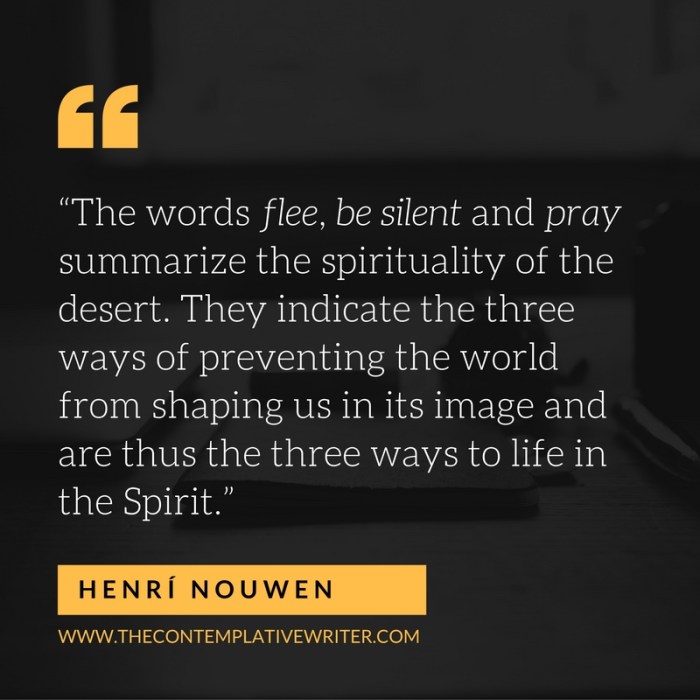
“The words flee, be silent and pray summarize the spirituality of the desert. They indicate the three ways of preventing the world from shaping us in its image and are thus the three ways to life in the Spirit.”

*****

“Our calendars are filled with appointments, our days and weeks filled with engagements, and our years filled with plans and projects. There is seldom a period in which we do not know what to do, and we move through life in such a distracted way that we do not even take the time and rest to wonder if any of the things we think, say, or do are worth thinking, saying or doing.”

*****

“Solitude is the furnace of transformation. Without solitude we remain victims of our society and continue to be entangled in the illusions of the false self. Jesus himself entered into this furnace. There he was tempted with the three compulsions of the world: to be relevant (‘turn stones into loaves’), to be spectacular (‘throw yourself down’), and to be powerful (‘I will give you all these kingdoms’). There he affirmed God as the only source of his identity (‘You must worship the Lord your God and serve him alone’). Solitude is the place of the great struggle and the great encounter – the struggle against the compulsions of the false self, and the encounter with the loving God who offers himself as the substance of the new self.”

*****


For Reflection

Featured Book for September 5

Featured Book: Thoughts in Solitude

Week Five: Silence and Solitude for the Anxious

thoughts in solitude-mertonThomas Merton was well aware of the anxiousness and fragmentation of our wold. Perhaps he saw these trends with particular clarity because he had given so much time to solitude.

Solitude can be learned and developed, just as anxiety can be exposed and then replaced. These aren’t quick fixes or processes that happen over night. They take practice, with the word practice indicated a lot of imperfection and failure as we continue. However, the rewards are invaluable.

Thomas Merton writes in Thoughts in Solitude:

*****

“Ours is a time of anxiety because we have willed it to be so. Our anxiety is not imposed on us by force from outside. We impose it on our world and upon one another from within ourselves.”

*****

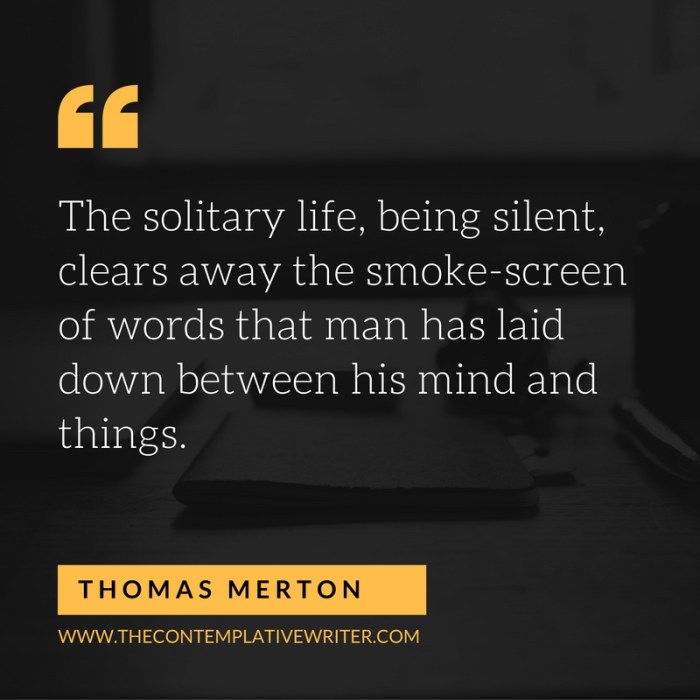
“The solitary life, being silent, clears away the smoke-screen of words that man has laid down between his mind and things.”

*****

“When we are not living up to our true vocation, thought deadens our life, or substitutes itself for life, or gives in to life so that our life drowns out our thinking and stifles the voice of conscience. When we find our vocation—thought and life are one.”

*****

“As soon as a man is fully disposed to be alone with God, he is alone with God no matter where he may be—in the country, the monastery, the woods or the city.”

*****

Read more in Thoughts in Solitude


For Reflection

Featured Book for August 29 (1)


Featured Book: Thoughts in Solitude

thoughts in solitude-mertonWeek Four: Contemplation Is a Gift

Contemplation is a gift from God that we could not even attempt in the first place if God hadn’t given it to us. This approach to prayer reminds us that we truly do rely completely on the grace and kindness of God.

However it’s also all too easy to turn the pursuit of contemplation into it’s own end. Merton warns us against seeking mountain top experiences or assurances of God’s love because these pursuits can overtake our greater pursuit of God’s loving presence. He writes in Thoughts in Solitude:


*****

“The only thing to seek in contemplative prayer is God; and we seek Him successfully when we realize that we cannot find Him unless He shows Himself to us, and yet at the same time that He would not have inspired us to seek Him unless we had already found Him.”

*****

“There is a stage in the spiritual life in which we find God in ourselves—this presence is a created effect of His love. It is a gift of His, to us. It remains in us. All the gifts of God are good. But if we rest in them, rather than in Him, they lose their goodness for us.”

*****

“If you want to have a spiritual life you must unify your life. A life is either all spiritual or not spiritual at all. No man can serve two masters. Your life is shaped by the end you live for. You are made in the image of what you desire.”

*****

Learn more about Thoughts in Solitude…


For Reflection

If you want to have a spiritual life you must unify your life. A life is either all spiritual or not spiritual at all. No man can serve two masters. Your life is shaped by the end you live for. You are made in the image of what you desire.

Featured Book: Thoughts in Solitude

thoughts in solitude-mertonWeek Three: Prayer as Slow Conversion

This week’s readings from Thoughts in Solitude remind us that even when it seems that nothing is happening while we pray, God is present and working in us even as we struggle to break free from our worries and routines.

If you’re new to contemplative prayer, it’s tempting to start measuring and observing yourself as if something big and momentous is about to happen. However, Thomas Merton assures us that our work is to turn away from our cares and to trust ourselves to God’s care:

*****

“One cannot then enter into meditation, in this sense, without a kind of inner upheaval. By upheaval I do not mean a disturbance, but a breaking out of routine, a liberation of the heart from the cares and preoccupations of one’s daily business.”

*****

“There is no such thing as a prayer in which ‘nothing is done’ or ‘nothing happens,’ although there may well be a prayer in which nothing is perceived or felt or thought.”

*****

“All real interior prayer, no matter how simple it may be, requires the conversion of our whole self to God.”

*****

Learn more about Thoughts in Solitude…


For Reflection

Featured Book August 16, 2016