Blog

FEATURED ARTICLE: IMAGINING YOUR FUTURE SELF

We’re often told, these days, to try to live in the present. We know we shouldn’t dwell on the past or fret about the future. In fact, so much of contemplative prayer is about being present in the moment, in the now.

But as people of faith, there is a way in which we should also be future-minded. We’re aware that our best self lies ahead, in the person God is creating us to be. To look to the future is to keep hope alive.

This applies to other areas of our life, too. Leadership coach Peter Bregman says that for the sake of the work and the projects we really care about, we need to practice being our future selves. We should move toward what we’re becoming, even if it doesn’t feel very productive right now.

So . . . what is it that you see in your future? Do you want to write? Keep writing, even if you don’t think you’re very good. Don’t put if off! Walk toward your future writerly self.

*****

If you want to be productive, the first question you need to ask yourself is: Who do I want to be? Another question is: Where do I want to go? Chances are that the answers to these questions represent growth in some direction. And while you can’t spend all your time pursuing those objectives, you definitely won’t get there if you don’t spend any of your time pursuing them.

*****

Here’s the key: You need to spend time on the future even when there are more important things to do in the present and even when there is no immediately apparent return to your efforts. In other words — and this is the hard part — if you want to be productive, you need to spend time doing things that feel ridiculously unproductive.

*****

Sometimes you need to be irresponsible with your current challenges in order to make real progress on your future self. You have to let the present just sit there, untended. It’s not going away and will never end.

*****

Read more.

WEEKLY PRAYER

A prayer for Holy Week by Origen (c. 185–254):

Jesus, my feet are dirty. Come even as a slave to me, pour water into your bowl, come and wash my feet. In asking such a thing I know I am overbold, but I dread what was threatened when you said to me, “If I do not wash your feet I have no fellowship with you.” Wash my feet then, because I long for your companionship.

Source

BOOK OF THE MONTH: THE CLOUD OF UNKNOWING

Week Two: A Short Prayer Penetrates Heaven

Cloud of Unknowing cover

The modern Centering Prayer movement teaches practitioners to choose one word to say and focus on during prayer. This technique has its origins in The Cloud of Unknowing (among other historical works) — our featured book of the month.

I grew up listening to long and wordy prayers in church. But the Cloud‘s 14th-century author explains why short prayers can be better prayers. I especially like his colorful example of a person who uses one word to cry for help in the midst of a fire. Aren’t we all crying out for help when we pray?

*****

Contemplatives seldom use words when they pray, but if they do, they choose only a few, and the fewer the better. They prefer a short one-syllable word over a word with two syllables, because the spirit can best assimilate it.

*****

[I]f we pray intently to get anything good, we should cry out in word, thought, or longing nothing but this word—God, nothing else. No other words are needed; for God’s very nature is goodness, and he’s the source of everything good.

*****

Why does this short little prayer of one small syllable penetrate heaven? Because you pray it with all that you are and all that you can be . . . the deepest wisdom of your soul is contained in this single tiny word, which is long in feeling . . .

*****

When a person is terrified by a fiery catastrophe . . . they cry out for help. That’s obvious. But what do they say? I can promise you a person in danger won’t pray a long string of words or even a word of two syllables. Why not? When desperate, you’ve got no time to waste . . . you’ll scream ‘Fire!’ or ‘Help!’ and this one-word outburst works best.

*****

I’ve been enjoying the Cloud of Unknowing in a newer translation that renders the text in a modern English idiom. Read more here.

For Reflection

Cloud quote - week 2

FRIDAY FAVORITES FOR PRAYER AND WRITING

Each Friday I share some of my favorite finds related to praying or writing. If I think it could help you pray or write better, then I’ll include it below.

Do you have someone else’s article or post to share? Join the Contemplative Writers Facebook group, comment on today’s post on my Facebook page, or follow me on Twitter (@LisaKDeam) to nominate your favorite articles, blog posts, and books by Thursday at noon each week.

CONTEMPLATIVE PROFILE: GREGORY THE GREAT ON “RESTING IN GOD”

You may have heard that St. Gregory the Great (c. 540 – 604) defined contemplation as “resting in God.” Indeed, this quote is posted on the home page of The Contemplative Writer! This snippet is a condensed version of what St. Gregory really said, and I thought we should take a look at the full statement. It’s a wonderfully nuanced description of just what “resting in God” really means:

But the contemplative life is: to retain indeed with all one’s mind the love of God and neighbor, but to rest from all exterior action, and cleave only to the desire of the Maker, that the mind may now take no pleasure in doing anything, but having spurned all cares, may be aglow to see the face of its Creator; so that it already knows how to bear with sorrow the burden of the corruptible flesh, and with all its desires to seek to join the hymn-singing choirs of angels, to mingle with the heavenly citizens, and to rejoice at its everlasting incorruption in the sight of God. (Source)

Note that for Gregory, resting in God means:

  • Cleaving to our Maker
  • Being aglow to see the Creator
  • Bearing the burdens of the flesh
  • Desiring heaven

*****

Gregory the Great (c. 540 – 604) was pope of the Catholic Church from 590 to 604. He was a contemplative, a missionary, a reformer, and a physician of souls. Read more here.

Reflection: How are prayer and contemplation like rest for you?

FEATURED ARTICLE: WHY IT’S RIGHT TO GET THINGS WRONG

Do you ever feel like you always get it wrong – in your writing, art, or another area of your life? If so, you may be on the right track. A number of artists and scientists believe that a willingness to make mistakes is essential to the creative personality. As painful as it is, going backwards can help move us forward.

Maria Popova of Brain Pickings offers a host of quotes from noted scientists and artists about the role of error in the creative process. These thoughts certainly encourage me as I hit the delete button again and again and again . . .

*****

‘If one wants to be active, one mustn’t be afraid to do something wrong sometimes, not afraid to lapse into some mistakes,’ Van Gogh wrote in a magnificent letter to his brother about how taking risks and making inspired mistakes moves us forward.

*****

Discovery is made with tears and sweat … by people who are constantly getting the wrong answer. And it is not possible to eliminate it because that is the nature of looking for imaginative likenesses.

*****

Progress is the exploration of our own error.

*****

Read more.

WEEKLY PRAYER

A prayer before writing from Thomas Aquinas (1225-1274):

O Creator of the universe, who has set the stars in the heavens and causes the sun to rise and set, shed the light of your wisdom into the darkness of my mind. Fill my thoughts with the loving knowledge of you, that I may bring your light to others. Just as you can make even babies speak your truth, instruct my tongue and guide my pen to convey the wonderful glory of the Gospel. Make my intellect sharp, my memory clear, and my words eloquent, so that I may faithfully interpret the mysteries which you have revealed.

Source

BOOK OF THE MONTH: THE CLOUD OF UNKNOWING

Week One:Cloud of Unknowing cover
Prayer as Rest

The Cloud of Unknowing is a contemplative treatise written in the late 14th century. It forms the basis (along with a few other historical texts) of the modern Centering Prayer movement.

The Cloud‘s anonymous author was a monk or priest who addressed his treatise to a young disciple just setting out in a religious vocation. Although written in a monastic context, the Cloud (and its “sequel,” the Book of Privy Counsel), has advice for anyone who wants to pursue a life of prayer.

Reading the Cloud of Unknowing, I’m especially drawn to the author’s description of contemplative prayer as rest and even akin to sleep. I don’t know about you, but I think rest is something most of us need in a culture characterized by a lot of striving. Are you tired and anxious? The Cloud author writes:

*****

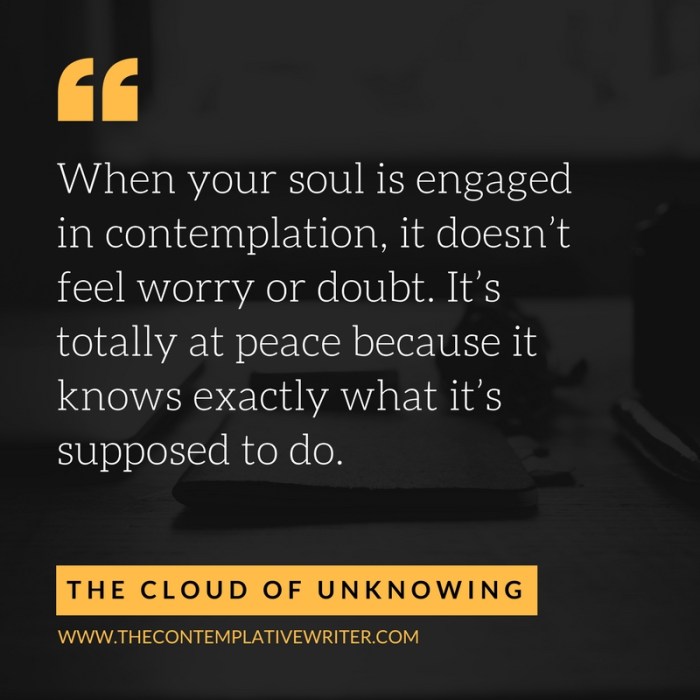
I . . . call [contemplative prayer] ‘rest’ for two reasons: When your soul is engaged in contemplation, it doesn’t feel worry or doubt. It’s totally at peace because it knows exactly what it’s supposed to do.

*****

It makes sense to compare the work of contemplation to sleep. When we’re asleep, the functions of our physical faculties are suspended so that our bodies can get complete rest. Sleep nourishes and strengthens our bodies in every way. The same is true of the spiritual ‘sleep’ of contemplative prayer. The stubborn questions of our restless spirituality and all our creative and rational thoughts are firmly bound and totally emptied, so the happy soul can sleep soundly, resting profoundly in the loving awareness of God as he is, completely nourished and strengthened in spirit.

*****

When you are seeking God, you won’t rest until you rest in him . . .

*****

I’ve been enjoying the Cloud of Unknowing in a newer translation that renders the text in a modern English idiom. Read more here.

For Reflection

Featured Book Cloud - week 1

Contemplative Profiles: Thomas Merton on Advent

This month’s contemplative profile by historian Lisa Deam is Thomas Merton:

In addition to writing a best-selling autobiography (The Seven Storey Mountain) and numerous books on the spiritual life, Thomas Merton was also a poet. He saw a link between contemplation and poetry and once said, “No Christian poetry worthy of the name has been written by anyone who was not in some degree a contemplative.”

Among Merton’s poetry are some beautiful verses for Advent and Christmas. Enjoy the poem below as you journey through the season.

Advent

Charm with your stainlessness these winter nights,
Skies, and be perfect!

Fly, vivider in the fiery dark, you quiet meteors,
And disappear.
You moon, be slow to go down,
This is your full!

The four white roads make off in silence
Towards the four parts of the starry universe.
Time falls like manna at the corners of the wintry earth.
We have become more humble than the rocks,
More wakeful than the patient hills.

Charm with your stainlessness these nights in Advent,
holy spheres,
While minds, as meek as beasts,
Stay close at home in the sweet hay;
And intellects are quieter than the flocks that feed by starlight.

Oh pour your darkness and your brightness over all our
solemn valleys,
You skies: and travel like the gentle Virgin,
Toward the planets’ stately setting,

Oh white full moon as quiet as Bethlehem!

Read this and other verses in The Collected Poems of Thomas Merton.


About Lisa Deam

Lisa Deam writes and speaks about Christian spiritual formation from a historical perspective. She’s the author of A World Transformed: Exploring the Spirituality of Medieval Maps. Visit her on Twitter @LisaKDeam and at lisadeam.com.


Contemplative Profiles: Thomas Merton

This month’s contemplative profile by historian Lisa Deam is Thomas Merton:

In several of his written works, Thomas Merton explores the idea of the spiritual life as a journey. While we may like to envision our path as being clearly laid out and free of obstruction, Merton realizes that in reality we’re often groping in the dark. He highlights one of the great paradoxes of the Christian faith—we travel, sometimes blindly, to a destination that we already possess. His reflections on life’s journey offer hope as we take the road to Bethlehem this Advent season.

*****

“In one sense we are always traveling, and traveling as if we did not know where we were going. In another sense we have already arrived. We cannot arrive at the perfect possession of God in this life, and that is why we are traveling and in darkness. But we already possess Him by grace, and therefore, in that sense, we have arrived and are dwelling in the light. But oh! How far have I to go to find You in Whom I have already arrived!” (The Seven Storey Mountain)

*****

“My Lord God, I have no idea where I am going. I do not see the road ahead of me. I cannot know for certain where it will end. Nor do I really know myself, and the fact that I think that I am following your will does not mean that I am actually doing so. But I believe that the desire to please you does in fact please you. And I hope I have that desire in all that I am doing. I hope that I will never do anything apart from that desire. And I know that if I do this you will lead me by the right road though I may know nothing about it. Therefore will I trust you always though I may seem to be lost and in the shadow of death. I will not fear, for you are ever with me, and you will never leave me to face my perils alone.” (Thoughts in Solitude)

*****

Reflection: Where am I on my journey with God today?


About Lisa Deam

Lisa Deam writes and speaks about Christian spiritual formation from a historical perspective. She’s the author of A World Transformed: Exploring the Spirituality of Medieval Maps. Visit her on Twitter @LisaKDeam and at lisadeam.com.