Blog

BOOK OF THE MONTH: THE ILLUMINED HEART

Week 3: Fasting
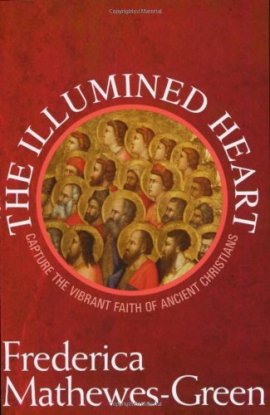
Illumined Heart cover

In The Illumined Heart, Frederica Mathewes-Green explores the wisdom and practices of the early Church.

Fasting is one such ancient practice. Mathewes-Green discusses details of how and when early Christians fasted. Just as important is her exploration of Christian attitudes toward the body:

Our bodies are a part of the creation God pronounced “very good,” and Jesus demonstrated God’s blessing on the human body when he became incarnate. He made the blessing more emphatic when he was resurrected, not as a mere spirit, but in a scar-marked body capable of eating fish. He sealed the blessing in the Ascension, taking that body into the very courts of heaven.

*****

So why do we need to fast?

Our bodies are blessed, but we don’t know how to live harmoniously in them. We drive them like vehicles, use them like tools to dig pleasure, and in the process damage them and distort our capacity to understand them. Fasting disciplines help us quiet these impulsive demands, so that we can better hear what they need and how they are meant to work. It is a turning toward health, a way of honoring creation and preparing for eternity.

*****

Read more.

For reflection:

Mathewes-Green week 3

FRIDAY FAVORITES FOR PRAYER AND WRITING

Each Friday I share some of my favorite finds related to praying or writing. If I think it could help you pray or write better, or just “be” better, I’ll include it below.

Do you have someone else’s article or post to share? Join the Contemplative Writers Facebook group, comment on today’s post on my Facebook page, or follow me on Twitter (@LisaKDeam) to nominate your favorite articles, blog posts, and books by Thursday at noon each week.

*****

Exit Through the Wilderness via Zach Hoag (a guest post on grace and giving up at Shawn Smucker’s website)

Daily Riches: The Practice of Waiting via William Britton (we all have to wait sometimes- how can we wait well?)

What You Can Learn From Declaring a Mystery via Tania Lombrozo (on learning from unexplainability)

Before you can be with others, first learn to be alone via Jennifer Stitt (in case you’re still not convinced of the benefits of solitude!)

7 Slippery-Slope Reasons Writers Shouldn’t Blog via Leslie Leyland Fields (so interesting considering just about everyone I know still has a blog)

*****

Hey y’all, I wanted to let you know that Friday Favorites will be taking a break next week. We’ll see you on July 28!


CONTEMPLATIVE PROFILE: TWO SOURCES ON THE JESUS PRAYER

Most of you are probably familiar with the words of the Jesus Prayer:

Lord Jesus Christ, Son of God, have mercy on me, a sinner.

This prayer originated with the Desert Fathers and Mothers as a form of unceasing prayer, as Paul urges in 1 Thess 5:17.

How does one pray the Jesus Prayer? Have you ever tried it? St Gregory of Sinai (1260s-1346), an Eastern Orthodox monk, gives many instructions, including these:

Sitting in your cell, remain patiently in prayer, according to the precept of the Apostle Paul. Collect your mind into your heart and send out thence your mental cry to our Lord Jesus, calling for His help and saying: ‘Lord Jesus Christ, have mercy upon me’ until you are tired. When tired, transfer your mind to the second half and say: ‘Jesus, Son of God, have mercy upon me!’ Having many times repeated this appeal, pass once more to the first half.

Centuries earlier, the Church Father John Chrysostom (c. 349 – 407) indicated that this prayer was to be said not just while sitting quietly but also while going about the many tasks of monastic and daily life. It is to be repeated until it becomes part of one’s very being:

I implore you, brethren, never to break or despise the rule of this prayer… A monk when he eats, drinks, sits, officiates, travels or does any other thing must continually cry: ‘Lord Jesus Christ, son of God, have mercy upon me!’ so that the name of the Lord Jesus, descending into the depths of the heart, should subdue the serpent ruling over the inner pastures and bring life and salvation to the soul. He should always live with the name of the Lord Jesus, so that the heart absorbs the Lord and the Lord the heart, and the two become one…

Read more about the Jesus Prayer at orthodoxytoday.org and Orthodox Mysticism.

Reflection: Do you pray the Jesus Prayer? How has it shaped your spiritual life?

WEEKLY PRAYER

A prayer from St. Augustine:

Great are you, O Lord, and greatly to be praised. Great is your power; your wisdom is infinite. All people, as part of your creation, desire to praise you; all people, who carry the signs of mortality and sin, desire to praise you still. You provoke us toward that delight, for you have created us for yourself, and our hearts cannot be quieted until they find rest in you . . . You will I seek, O Lord, calling upon you; you will I call, believing in you.

Source

BOOK OF THE MONTH: THE ILLUMINED HEART

Week Two: The Joy of Repentance

Illumined Heart cover

In The Illumined Heart, Frederica Mathewes-Green explores spiritual wisdom and practices from the ancient Christians. Chapters five and six tackle the unpopular subject of repentance.

Mathewes-Green shifts the discussion of repentance from condemnationwhere it usually sitsto joy. I also like her emphasis that repentance unlocks our compassion for others:

Repentance is the doorway to the spiritual life, the only way to begin. It is also the path itself, the only way to continue. Anything else is foolishness and self-delusion. Only repentance is both brute-honest enough, and joyous enough, to bring us all the way home.

*****

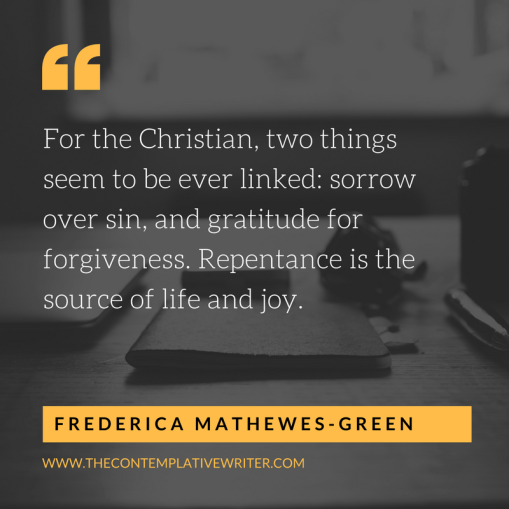
For the Christian, two things seem to be ever linked: sorrow over sin, and gratitude for forgiveness. Repentance is the source of life and joy.

*****

What’s more, repentance enlarges the heart until it encompasses all earthly life, and the sorrow tendered to God is no longer for ourselves alone. Knowing our own sin, we pray in solidarity with all other sinners, even those who hurt us. With all creation we groan, crying out to God for his healing and mercy.

*****

Read more.

For reflection:

Mathewes-Green week 2


FRIDAY FAVORITES FOR PRAYER AND WRITING

Each Friday I share some of my favorite finds related to praying or writing. If I think it could help you pray or write better, or just “be” better, I’ll include it below.

Do you have someone else’s article or post to share? Join the Contemplative Writers Facebook group, comment on today’s post on my Facebook page, or follow me on Twitter (@LisaKDeam) to nominate your favorite articles, blog posts, and books by Thursday at noon each week.

*****

Keep Not Quitting via Sarah Bessey (perhaps you, like me, really need to hear this message)

When You Don’t Have It All Together: How to Live a Flourishing Life via Jamin Goggin and Kyle Strobel (a guest post for Ann Voskamp)

3-Minute Retreat: Living in Freedom via Loyola Press (take a 3-minute guided online retreat)

The Spirituality of Imperfection via Clint Sabom (this is a spirituality I can wholeheartedly embrace!)

What the Enneagram Can Teach Us About Beloved Community via David Potter

7 Things to Do When You Want To Give Up (Instead of Giving Up) via Brian A. Klems (practical advice from Writer’s Digest)

11 Brutal Truths About Creativity that No One Wants to Talk About via Benjamin Earl Evans (very thought-provoking and myth-busting)

Books by Christian Authors of Color via Deidra Riggs (check out this awesome reading list!)


BOOK OF THE MONTH: THE ILLUMINED HEART

Week One: Tough Questions

Illumined Heart coverIn The Illumined Heat: Capture the Vibrant Faith of Ancient Christians, Frederica Mathewes-Green shares spiritual practices and wisdom from the ancient Church. I first read this book several years ago, and I thought it was time to revisit it and share some of my favorite parts with you.

As she discusses the early Christians, Mathewes-Green gives us a peek into the life of a fictional fifth-century couple, Anna and Theodore. This is one of my favorite pats of the book, especially when Anna struggles to show love and grace to her mother-in-law.

Mathewes-Green begins with a statement of what we know (intellectually) to be true: in God is life.

Here is communion. In God’s presence we discover ourselves able to love one another, to be vessels of heroic love, even toward our enemies, even unto death. We find all creation in harmony around us, as responsive and fruitful as the Garden was to Adam and Eve. The peace that passes understanding informs our every thought.

*****

If we know that God’s presence is life and love, why don’t we look like we know it? Mathewes-Green asks a whole series of tough questions I find it really good (and uncomfortable) to consider:

Why are we modern Christians so indistinguishable from the world?

*****

How come Christians who lived in times of bloody persecution were so heroic, while we who live in safety are fretful and pudgy?

*****

How could the earlier saints “pray constantly,” while our minds dawdle over trivialities?

*****

How could the martyrs forgive their torturers, but my friend’s success makes me pouty?

*****

In the rest of the book, Mathewes-Green considers how the spiritual practices of ancient Christians might help us as we struggle with our faith. For this week, I invite you to wrestle with the tough questions she asks in the first chapter. What might you answer to some of these questions?

Read more.

For Reflection:

Mathewes-Green week 1 corrected

FRIDAY FAVORITES FOR PRAYER AND WRITING

Each Friday I share some of my favorite finds related to praying or writing. If I think it could help you pray or write better, or just “be” better, I’ll include it below.

Do you have someone else’s article or post to share? Join the Contemplative Writers Facebook group, comment on today’s post on my Facebook page, or follow me on Twitter (@LisaKDeam) to nominate your favorite articles, blog posts, and books by Thursday at noon each week.

*****

Prayer Made Sense When Henri Nouwen Told Me To Give Up via Ed Cyzewski

Martin Sheen: Spirituality of Imagination via Krista Tippett

The Contemplative Way as a Practice in Death via Drew Jackson

101 Books to Dive into this Summer: A Massive Reading List via Rebekah Barnett and Chelsea Catlett (TED-speaker recommended books – just in case you don’t have enough piled on your nightstand right now)

7 Prayers I Pray for People I Love via Judy Douglass

Nothing and Everything (Reflections on a Retreat) via Lisa Bartelt

CONTEMPLATIVE PROFILE: FLANNERY O’CONNOR ON WRITING

I don’t know whether the American writer and essayist Flannery O’Connor (1925-1964) can really be called a contemplative — although she did ask God to make her a mystic. She has been described as a devout believer and also as a “turbocharged Catholic.”

Reading O’Connor’s Prayer Journal, which she wrote in 1946-1947, I was interested in what she says about the intersection of faith and writing. She wrote the journal while studying writing and working on her first novel. In the journal, she begs to know and want God and also to become a “fine writer.” Where do these two desires intersect? In radical dependence on God. O’Connor writes:

My dear God, how stupid we people are until You give us something. Even in praying it is You who have to pray in us. I would like to write a beautiful prayer but I have nothing to do it from.

*****

Dear God, tonight it is not disappointing because you have given me a story. Don’t let me ever think, dear God, that I was anything but the instrument for Your story — just like the typewriter was mine.

*****

If I ever do get to be a fine writer, it will not be because I am a fine writer but because God has given me credit for a few of the things He kindly wrote for me. Right at present this does not seem to be His policy. I can’t write a thing. But I’ll continue to try — that is the point. And at every dry point, I will be reminded Who is doing the work when it is done & Who is not doing it at that moment.

Read more about Flannery O’Connor here. Read her Prayer Journal here.

For reflection: Where do faith and writing intersect for you?