Blog

Friday Favorites for Prayer and Writing

Thank you for joining us for Friday Favorites! Each week, Prasanta Verma and I round up our favorite links related to prayer, spirituality, and writing. We hope it will enrich your life and help you to find the best the web has to offer.

Read, enjoy, and be blessed.

***

The Lord is My Everything: Psalm 23 in the Letter E via April Yamasaki (a paraphrase of a beloved psalm focused on the letter E… and other versions with different letters of the alphabet; what a neat exercise!)

How do we say goodbye? via The Red Hand Files (on regret, the past, and the privilege of saying goodbye)

Place and Pilgrimage via Lisa Colón DeLay (on this Spark My Muse podcast episode, Lisa and I talk about the resurgence of pilgrimage and a special event we’re planning for June 2020)

The Wonder Years Gathering (heads-up on two conferences in 2020 focusing on Christian spiritual formation for midlife women)

Self-Help for Fellow Refugees via Li-Young Lee (heart-stopping poetry)

The Hyphen Affair via Seth Maxon (why grammar nerds keep getting so furious with the Associated Press)

7 Common Mistakes in First-Time Memoir via Jessi Rita Hoffman (writing advice from a developmental book editor)


WEEKLY PRAYER: FRANCIS OF ASSISI

Our prayer this week is The Canticle of the Sun by St. Francis of Assisi (1181 – 1226). Francis’s Feast Day is October 4.

Francis’s hymn celebrates all of God’s creation. In Franciscan theology, contemplation and worship frequently begin with the goodness of the material world before delving inward, on the path of the spirit.


Giovanni_Bellini_-_Saint_Francis_in_the_Desert_-_Google_Art_Project


Most high, all powerful, sweet Lord,
yours is the praise, the glory, and the honor
and every blessing.

Be praised, my Lord,
for all your creatures,
and first for brother sun,
who makes the day bright and luminous.

And he is beautiful and radiant with great splendor,
he is the image of you, Most High.

Be praised, my Lord,
for sister moon and the stars,
in the sky you have made them brilliant and precious and beautiful.

Be praised, my Lord, for brother wind,
and for the air both cloudy and serene and every kind of weather,
through which you give nourishment to your creatures.

Be praised, my Lord, for sister water,
who is very useful and humble and precious and chaste.

Be praised, my Lord, for brother fire,
through whom you illuminate the night.
And he is beautiful, and joyous, and robust, and strong.

Be praised, my Lord, for our sister, mother earth,
who nourishes us and watches over us,
and brings forth various fruits with colored flowers and herbs.

Be praised, my Lord, for those who forgive through Your love,
and bear sickness and tribulation;
blessed are those who endure in peace,
for they will be crowned by you, Most High.

Be praised, my Lord, for our sister, bodily death,
from whom no living thing can escape.

Blessed are those whom she finds doing your holy will,
for the second death cannot harm them.

Praise and bless my Lord,
and give thanks to Him and serve Him with great humility.

(Source)

Friday Favorites for Prayer and Writing

Welcome to Friday Favorites! Each week, Prasanta Verma and I round up links that really struck us and that we’d like to share with you. We hope they will add to your writing and spiritual life. Without further ado…

Prasanta’s picks —

Postmarked via Shawn Smucker and Jen Pollock Michel (it began as a Twitter conversation but developed into a series of letters between two writers, navigating the terrain of creative work and family life)

How to Write Compelling Articles That Get Read and Shared via Nicole Bianchi (5 steps to crafting compelling articles)

“Birthday Poem for Roma Cady MacPherson Wilson 2 January 2019, aetatis suae XV” via Anthony Madrid (a stunning poem in Curator Magazine)

***

Lisa’s picks —

Rhythms That Return Us to Ourselves via Marlena Graves (returning to “our senses,” or to the rhythms that once sustained and can still sustain us)

On Feeling Afraid and Finding the Edge via Kelly Chripczuk (on the subtle sway of fear)

Year of Pilgrimage – to be a pilgrim in Britain’s Green and Pleasant Land via Bess Twiston Davies (the year 2020 has been decreed the “Year of Cathedrals and Pilgrimages” by the Association of English Cathedrals. Read about the continuing popularity of the practice of pilgrimage!)


Long Night of Struggle: A Post via Prasanta Verma

Today’s post is by Prasanta Verma, a member of The Contemplative Writer team.

***

“It is clear we must embrace struggle. Every living thing conforms to it. Everything in nature grows and struggles in its own way, establishing its own identity, insisting on it at all cost, against all resistance. We can be sure of very little, but the need to court struggle is a surety that will not leave us.” – Rainer Marie Rilke, in Letters to a Young Poet

No one can see the internal dialogue while I sit at my desk and gaze out the window or while I sit at a coffee shop, quietly sipping a cup of coffee, while others bustle about, my laptop on the table with an empty screen facing me.

“I have this deadline—and the article isn’t coming together.”
“How should I rearrange these particular paragraphs?”
“I’m too distracted.”
“This is digging up too much emotion.”
“Can I even do this? Why did I say yes?”
“Why didn’t they accept my submission?”
“What do I even write about?”

Based on what I have read from other writers, I believe I am not the only one who has said the above; I am sure you could add your own statements to the list.

For many of us, we are sure to encounter a season of struggle in our writing at one time or another. Maybe we even find ourselves in longer seasons of dry spells, struggling to put something of value and beauty onto the page.

Perhaps the struggle is against a deadline. Perhaps a struggle ensues in seeking the exact word or phrase, or the overarching purpose and length of a particular piece. Perhaps the struggle arises from within—a struggle with ourselves—of willpower or motivation or something else.

If struggle is inevitable, how can the writer “embrace struggle” as Rilke describes it? Must we?

I came across something recently that gave me some hope in those times of struggling and digging.

In Luke 5, Jesus was speaking to a crowd of people near the Sea of Galilee. He spotted two boats on the shore, climbed into Simon’s boat, and continued speaking to the crowd from the boat. After he finished speaking to the crowd, Jesus told Simon to go into the lake and do some fishing.

Trouble was, Simon had been fishing all night long, and had come up empty, and was even cleaning his nets. He says, “Master, we’ve worked hard all night and haven’t caught anything.” (Luke 5:5, NIV). He pretty much says, “Been there, done that, Jesus.”Furthermore, it is not just any place in the water that Jesus is asking Simon to fish: he tells him to fish in a deep part of the lake (Luke 5:4).

Jesus asks Simon to take the nets he’d just cleaned, and go out try again. I don’t know about you, but I’m usually tired after I’ve been out fishing all night! (I’m joking, of course; I have never been fishing all night.)

Presumably, experienced fishermen already know where the fish bite, when to fish, what parts of the lake are best, etc. I wonder if it felt somewhat insulting to be told where to fish and to go out again.

I can’t say I blame Simon. When Jesus, a carpenter and not a fisherman, tells them to go out again and drop their nets in the deep part of a lake, it must have sounded like a strange, fruitless, and unnecessary request.

Sometimes, writing (or service, or a job, or ministry, or some other activity requiring long-term diligent focus and attention) can feel like a long night of fishing with no catch. Maybe it can feel fruitless.

Yet, Simon and the others, already tired from the long night of fishing, do what Jesus asked: “But because you say so, I will let down the nets.” (Luke 5:5).

When they pulled up their nets, the nets were overflowing with such an abundance of fish they had to summon the other boat to come and assist them.

I do not know how long the particular obedience has been for each one of us. I do not know how many times we have dipped down our nets and come up empty-handed.

Rilke says, “embrace struggle”, and “everything in nature grows and struggles…establishing its own identity.” If the need for struggle is a “surety”, instead of fighting these seasons, viewing them as blockages, perhaps we are meant to embrace them. Perhaps the struggle is part of the formula needed to forge our own identity, the part that takes us to a deeper, truer level while also resulting in an astonishingly abundant net. Perhaps the growth occurs as we struggle; that one cannot occur without the other.

This little passage reminds me that no matter how many long nights have yielded nothing, that words and hope-filled stories are swimming and breathing underneath. A treasure is stirring in the deep, waiting for its time to surface. The next net pulled up may contain tender morsels of light and love for a reader who needs them.

***

Prasanta Verma is a writer, poet, and artist. Born under an Asian sun, raised in the Appalachian foothills, Prasanta currently lives in the Midwest, is a mom of three, and also coaches high school debate. You can find her on Twitter @ pathoftreasure, Instagram prasanta_v_writer, and at her website: https://pathoftreasure.wordpress.com/.

WEEKLY PRAYER

Today’s prayer is adapted from a passage in Walter Hilton’s spiritual treatise, The Scale of Perfection. Hilton (ca. 1340 – 1396) was an English Augustinian canon and mystic. Hilton is not a saint, but the Episcopal Church (USA) honors him this week, on September 28.

*****

Lord, thou art in me and shalt never be lost out of me,
but I am not near thee till I have found thee.
Nowhere need I run to seek thee,
but within me where already thou art.
Thou art the treasure hidden within me:
draw me therefore to thee that I may find thee
and serve and possess thee forever.

(Source)

FRIDAY FAVORITES FOR PRAYER AND WRITING

Thank you for joining us for Friday Favorites! Each week, Prasanta Verma and I round up our favorite links related to prayer, spirituality, and writing. We hope it will enrich your life and help you to find the best the web has to offer.

Read, enjoy, and be blessed.

***

Lisa’s picks–

Breaking My Podcast Addiction via Julia Roller (social media addiction? who…me?)

Why We Must Seek God’s Presence in the Ordinary via Catherine McNeil (an invitation to see God in the ordinary moments of our days)

8 Prayers from John Chrysostom that get right to God’s heart via Kathleen N. Hattrup (little reminders that we are always in the presence of the Father)


Prasanta’s picks–

Recognizing Eternal Moments in Narrative Nonfiction via Kent Meyers (a craft essay on tracking down eternal moments in our writing)

The 2019 Madeleine L’Engle Conference — Walking on Water (coming up on Saturday, November 16)

Poetry from Kristin George Bagdanov (inspiring poetry from a finalist in the Omnidawn Chapbook Contest)


We All Wander – But Do We Return?

Perhaps it’s no wonder that I’m drawn to the medieval mystics. Having spent the better part of my life researching and studying, the mystics teach something I need to hear: we come to know and love God not through our intellect, but through our heart.

One of the most popular mystical texts was written by my favorite author — Anonymous. In the late 14th century, this man (probably an English monk) penned a guide to contemplative prayer called the Cloud of Unknowing.

These days, the Cloud of Unknowing is one of the main texts used in the practice of centering prayer. It has many techniques and words of wisdom. I’m especially drawn to the section in which the author talks about failing at prayer. Because we all do. Our monk says:

No sooner has a man turned toward God in love when through human frailty he finds himself distracted by the remembrance of some created thing or some daily care. But no matter. No harm is done; for such a person quickly returns to deep recollection.

I like this monk’s down-to-earth approach. When our mind wanders, we return to God. We don’t worry about it; we don’t dwell on it. We simply return. I find such grace in this message!

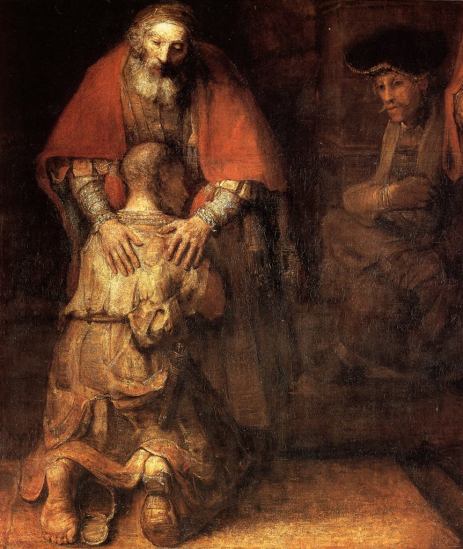
One of the most beautiful stories in Scripture, and one of the most familiar, is about returning to God. It’s the story of the Prodigal Son (reference). I love the way Rembrandt paints the moment of the wandering son’s return. The tender embrace between father and son captures, for me, the way God longs for each of his children to come home — no matter what we’ve done, no matter how far away we’ve gone.

Prodigan Son

We often think of the Prodigal Son as a parable about returning to God after a long time spent away. Might it also be about the way we return to God each day? I’ve come to see the Prodigal Son as a metaphor for my everyday prayer life. When I pray, I begin strong. I’m ready to take hold of the riches. Then, despite my best intentions, I begin to wander. Before I know it, my treacherous mind is far from the place it began — I end up, alongside the prodigal son, in a metaphorical pig sty of my own making. But God is always waiting, arms outspread, for me to return.

I hear the reassurance of God’s untiring welcome when I read the Cloud of Unknowing. I can return. We can all return to God.

It’s also nice to hear this assurance from people I know and trust. One day, after “failing” an exercise in contemplative prayer, I told a friend about my problem.

“I had to restart my prayer about thirty times,” I complained.

“Thirty times? That’s great! You actually thought about Jesus thirty times!” my friend exclaimed.

She sounded, in her own way, a lot like the Cloud of Unknowing. And I realized she was right. During my prayer exercise, I’d drifted away. There’s no question about it — I’m full of what our 14th-century monk calls “human frailty.” But when I wandered, I came back. And each time I did, Jesus was there. It’s reassuring to know that I may drift away, but he never will.

We all wander. But do we return? That is the real question.

Weekly Prayer: Hildegard of Bingen

Today is the Feast Day of Hildegard of Bingen (1098-1179), the “singing nun.” Hildegard was a German Benedictine abbess, writer, composer, and mystic who left us many beautiful words. Today, we’re praying one of her songs of praise.

You’re the Word of our Father,
the light of the first sunrise,
God’s omnipotent thought.
Before anything was made,
You saw it,
You designed it, and
You tucked Your all-seeing nature in the middle of Your sinew,
like a spinning wheel
with no beginning and no end,
still encircling everything.

Amen.

Source

FRIDAY FAVORITES FOR PRAYER AND WRITING

Welcome back to Friday Favorites. Each week, Prasanta Verma and I share our favorite links on prayer, writing, and spirituality.

Do you have someone else’s article or post to share? Join the Contemplative Writers Facebook group, comment on today’s post on my Facebook page, or follow me on Twitter (@LisaKDeam) to nominate your favorite articles, blog posts, and books by Thursday at noon each week.

***

Lisa’s picks —

Rewriting and Renaming the Silence via Cara Meredith (finding God–and oneself–in silence)

Pastoral prayer for the anniversay of 9/11 via Jill Duffield (a prayer to help us as we remember a difficult time)

Thought For the Day via Pádraig Ó Tuama  (a short and lovely audio about sleeplessness, prayer, and welcoming the dark)

***

Prasanta’s picks —

Curiosity, Creativity, Productivity: Three Pillars to Building Your Best Writing Life via Ann Kroeker (part one of a series)

The Business of Being a Spiritual Writer via Writing for Your Life and Patricia Raybon (a helpful video webinar on writers, agents, priorities, and more)

Arise, Stone via Christopher Warner (a poem in Image Journal)


What I Wish St. Augustine Had Said

When I read Marilynne Robinson’s novel Gilead several years ago, I was struck by something the character of John Ames proclaimss towards the end of the story: Augustine says the Lord loves each of us as an only child, and that has to be true.” (2004, pp. 245-46)

It certainly rang true to me. It’s hard for me to wrap my mind around the idea that God loves the whole world. Doesn’t he play favorites like the rest of us do? When I read that line in Gilead, I immediately took to the idea of being God’s only child. One of a kind. Special. Uniquely loved.

Historian that I am, I went to look up this quote in Augustine’s works. I was pretty sure it came from the Confessions. But try as I might, I couldn’t find it. As I searched, I came across the same loosely quoted phrase, with no citation, in a nonfiction book. And I’ve seen it other places on the web.

Finally, after consulting a friend who specializes in the early Christian tradition, I discovered what Augustine really said:

You are good and all-powerful, caring for each one of us as though the only one in your care.*

Here’s the context. Before his conversion to Christianity, Augustine’s mother, Monica, wept for his soul. God comforted Monica in a vision. Augustine writes:

How could this vision come to her unless ‘your ears were close to her heart?’ You are good and all-powerful, caring for each one of us as though the only one in your care, and yet for all as for each individual.

In this statement, Augustine paints a vivid picture of God’s overwhelming love. God rests his ear on Monica’s chest and listens to her heartbeat, her tears, her pain. In Monica’s moment of need, everything and everyone else fades from God’s view, and Monica becomes his only care and concern.

But Augustine did NOT say, “God loves each of us as an only child.” He does not explicitly cast God as a parent. Augustine might have been thinking about God as a father, but maybe not. Perhaps he was thinking of God as a pastor, a doctor, a mentor, or a teacher — someone who has another in his or her care.

I have to admit that I was disappointed. How I long to be told that I’m God’s only child! I yearn for the undivided attention of a beloved parent; to climb up on God’s knee and know that I am his only one. He’s not going to get distracted by the other children out there. He’s not going to run out of time or energy for me.

I’m not above acting like a child desperate for attention, either. “Look at me!” I cry out to God. “I bet those other kids can’t do a one-handed cartwheel!” Do you do that, too? (I mean the showing off, not the cartwheel.)

We look to the greats of the Church to tell us about our deepest longings. Augustine didn’t tell me what I wanted to hear, but he did teach me something about myself. My search for Augustine’s quotation, and my subsequent disappointment, reveals the state of my heart: a heart that longs to be someone’s one and only.

I know I’m not alone in feeling this way, since this passage from the Confessions has been misquoted (perhaps a better word is paraphrased) more than once, even by the likes of Marilynne Robinson! I think it points to one of the tensions of the Christian faith — we have a God who stretches his arms around the whole world yet loves each of us as the one perfect and beloved child he’s always longed for. It’s a tension I’ll wrestle with for a long time, since I’ll always be a child at heart.

*****

*Augustine, Confessions, trans. Henry Chadwick (Oxford: Oxford University Press, 2009), 3.11.19, p. 50.

This post was originally published on my website, lisadeam.com.