
Featured Contemplative Book: Immortal Diamond

Week Three: Transformation
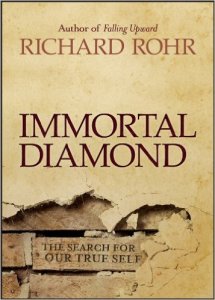
Immortal Diamond: the search for our true selfIt’s one thing to realize that we have been living out of a false self, but it’s quite another matter to allow God to transform us with the affirmation of his love. Too much of our unhealthy religious practice focuses on what we should not do or not be rather than what we should become.

Healthy religious practices detect and remove the obstacles and distractions that keep us from God’s loving and affirming presence. Our tools are spare and simple with practices such as:

  • Bracing honesty
  • A quiet mind
  • A heart turned toward God

Spiritual masters such as Jeanne Guyon often noted that we enter into prayer by simply turning our attention toward God. That act alone is a prayer, and it is a prayer that we can gradually build on.

As we learn to turn toward God, we’ll find our identities gradually transformed by God’s love and presence. Richard Rohr shares some particularly helpful quotes and insights in Immortal Diamond.


*****

“Our ongoing curiosity about our True Self seems to lessen if we settle into any successful role. We have then allowed others to define us from the outside, although we do not realize it… Thomas Merton said, ‘If I had a message to my contemporaries it is surely this: Be anything you like, be madmen, drunks, and bastards of every shape and form, but at all costs avoid one thing: success. If you are too obsessed with success, you will forget to live. If you have learned only how to be a success, your life has probably been wasted.’ Success is hardly ever your True Self, only your early window dressing.”

*****

On incarnational religion and Spirit-based morality: “You do things because they are true, not because you have to or you are afraid of punishment. Henceforth you are not so much driven from without (the False Self method) as you are drawn from within (the True Self method). The generating motor is inside of you now instead of a whip or a threat outside.”

*****

“God tries to first create a joyous yes inside of you, far more than any kind of no . . . Just saying no is resentful dieting, whereas finding your deeper yes, and eating from that table, is always a spiritual banquet.”

*****


Keep in Touch

Get our latest blog posts delivered to your inbox or sign up for the weekly contemplative email and receive a free eBook: The Contemplative Writer.


For Reflection or Sharing

Week 3 Featured book April 20 2016

Saturday Prayer: The Prayer of St. Patrick

Today’s prayer comes from the anonymous prayer that some have attributed to St. Patrick:

I arise today
Through the strength of heaven;
Light of the sun,
Splendor of fire,
Speed of lightning,
Swiftness of the wind,
Depth of the sea,
Stability of the earth,
Firmness of the rock.

I arise today
Through God’s strength to pilot me;
God’s might to uphold me,
God’s wisdom to guide me,
God’s eye to look before me,
God’s ear to hear me,
God’s word to speak for me,
God’s hand to guard me,
God’s way to lie before me,
God’s shield to protect me,
God’s hosts to save me
Afar and anear,
Alone or in a mulitude.

Christ shield me today
Against wounding
Christ with me, Christ before me, Christ behind me,
Christ in me, Christ beneath me, Christ above me,
Christ on my right, Christ on my left,
Christ when I lie down, Christ when I sit down,
Christ in the heart of everyone who thinks of me,
Christ in the mouth of everyone who speaks of me,
Christ in the eye that sees me,
Christ in the ear that hears me.

I arise today
Through the mighty strength
Of the Lord of creation.

Source: BeliefNet

Friday Favorites on Prayer and Writing

Each Friday I share some of my favorite finds related to praying or writing. If I think it could help you pray or write better, then I’ll include it below. Do you have someone else’s article or post to share? Join the Contemplative Writers Facebook group, comment on today’s post on my Facebook page, or follow me on Twitter (@edcyzewski) to nominate your favorite articles, blog posts, and books by Thursday at noon each week.

Seven Reasons to Pray the Divine Office via Carl McColman

The Unbusy Pastor (but not just for pastors!) via Eugene Peterson

How the Examen Empowers Us to Pray and Write via Micha Boyett (my guest post for her)

Ruthlessly Eliminate Hurry via John Ortberg

How I Became a Morning Person via Medium

How to Stick with Good Habits via Business Insider

The Desert Fathers (a parody) via Mallory Ortberg

Looking for more recommendations? Check out our Prayer Resources page.


Contemplative Profiles: Julian of Norwich

We best know Julian of Norwich for saying: “All shall be well, and all shall be well, and all manner of things shall be well.” 

Despite her optimism in this statement, Julian lived in the late 1300’s in England, facing plague and violent warfare, to say nothing of a church hierarchy that could turn on her in light of her visions of Christ.

At the age of 13 in May 1373, Julian suffered a severe illness and experienced a series of sixteen “showings” or visions of Christ. These visions revealed the love of God in ways seemed to run counter to the assumptions about God during her time, but she managed to both live a quiet life as a female hermit and to put her experiences down on paper. Julian was the first woman to publish a book in English: Revelations of Divine Love.

41ckwwd378l-_sx331_bo1204203200_


She is remembered by biographer Amy Frykholm as a mystic who embraced suffering–almost to the point that one would raise an eyebrow. However, the depth of her compassion for others cannot be separated from her embracing of the sufferings of Christ and the suffering of others.

Reviewer Jonathan Wilson-Hartgrove writes,

Julian’s compassion grows out of her passion—a suffering both in and of the church, but a suffering that nevertheless reveals the love at the heart of the church. Julian gets God’s love not because she retreated from the world and focused on spiritual things, but because “she chose Jesus over the bliss of heaven.”

Contemplating a crucifix that began to drip blood onto what she thought would be her deathbed, Julian saw and later wrote about a vision of God that was revolutionary to the church authorities of her day—indeed, to many church leaders in our own time.

May we have eyes to see the suffering of others around us.

May we remember that the cross wasn’t just the means of our salvation. It was the way of life that Jesus modeled and expected us to follow.


I want to know Christ and the power of his resurrection and the sharing of his sufferings by becoming like him in his death…

Philippians 3:10, NRSV


Reflection

Remain open to the ways you can share in the suffering of Christ today.


Where to Start with Christian Meditation

There are many Christians who are either unfamiliar with meditation or concerned that it’s inappropriate to practice. However, a brief look at the actual substance of meditation should put any concerns at rest and demonstrate the value of meditation for followers of Jesus today.

Meditation is a way to become mindful of the present, creating space to hear what God is speaking in the present moment rather than allowing our minds to run unchecked. We’re surrounded by noise, choose to add more noise, and may not even realize how much negative noise is coming from our own heads.

Christian meditation is a way to become mindful of what we are thinking so that our thoughts can be open to direction from God.

Stephanie Vozza writes about the basics of meditation for Fast Company:

Mindful people—those who live in the present—can step back and stay on the riverbank, watching their current of thoughts and not getting swept away by their content.


Meditation fosters mindfulness, but the practice seems difficult in today’s world of constant stimulation: “People think the goal of meditation is to empty the mind,” says Brooks. “It’s not about clearing the mind; it’s about focusing on one thing. When the mind wanders, the meditation isn’t a failure. Our brain is like a wayward puppy, out of control. Catching it and putting it back to the object of focus is the mediation.”


Brooks says meditating is like exercise; a full workout is preferred, but there is value in short bursts.

“Research shows that a total of 15 minutes of meditating each day for several weeks produces detectable, positive changes in the brain as well as corresponding reductions in stress, anxiety, and an enhanced sense of well-being,” says Brooks. “You can get the benefits of a formal meditation practice by weaving mini-meditations into your daily life.”

Source: Fast Company

Vozza adds a few simple prompts for meditation that you can incorporate throughout your day:

  • Walking Meditation
  • Red Light Meditation (turn off your radio while waiting at red lights)
  • Exercise Meditation
  • Eating/Drinking Meditation
  • Waiting Meditation
  • Task-Oriented Meditation

For instance, if you’re waiting in line or doing the dishes, turn off the radio or a podcast in order to become aware of God’s presence. I’ve often turned to a prayer word such as “mercy” or “beloved.” I also use the Jesus prayer: “Jesus Christ, only Son of God, have mercy on me, a sinner.”

I have incorporated all of these practices into my life at one point or another and have discovered that left to my own devices I am constantly reliving the past or fearing the future. By practicing these simple meditation practices I’m no longer at the mercy of my guilt or fears. I’m learning to live by faith and trust God in new, deeper ways.


Keep the Contemplative Writer Sustainable

The Contemplative writer is ad-free and never shares sponsored content, but it is a lot of work to maintain. We rely on affiliate links from the books we share and the generous gifts of our readers. An automated monthly gift as low as $1 per month or a one-time gift of $5 goes a long way to sustaining our mission to provide contemplative prayer resources for our readers. Thank you!

Choose a recurring monthly donation:

support-patreon-orange

Make a one-time gift via PayPal (credit cards accepted!)


Donate Now Button

Learn more about how to support us.


Scripture Meditation: Trusting God to Care for Our Souls


“To you, O LORD, I lift up my soul; my God I put my trust in you; . . .”
Psalm 25:1

Meditation

I bible-1440953-1279x852have long wondered what it means to “lift up my soul” to God, but I recently read one suggestion that “lifting up” our souls to God is a surrender. Lifting up my soul is a handing over of control to God.

A weary soul is consumed with the cares of this world, distracted by entertainment and greed, or caught up in pleasing others. Perhaps we “lift up” our souls to others each day as we hope they’ll notice us, affirm us, or meet a deep need.

Trust is no small matter. Is God worthy of our trust? Will God show up if we lift up our souls to him?

The practice of contemplation opens our souls to the presence of God. It’s a lifting of our souls to God, inviting him to care for us and our souls. Over time, we will learn to place greater trust in God, but we must begin by lifting up our souls in faith and expectation.


Reflection

How is your soul today?

Are you lifting up your soul to something or someone other than God?

What does it look like to trust God with your soul


Featured Contemplative Book: Immortal Diamond

Immortal Diamond by RohrWeek Two: The Struggle with the False Self

Who am I?

This is a foundational question that we’ll forever struggle with in prayer and writing until we finally confront it. There may be no better tool for answering this question than Richard Rohr’s Immortal Diamond: The Search for our True Self.

This is the book that saved my soul, or at least saved me from myself.

The false self won’t be silenced easily. In fact, I have found that the false self is so hard to fight because living into your true self in God’s love requires doing LESS. So much of religion is about doing more or doing something differently. Rohr’s wisdom about the true self appears to be counterintuitive at first.


“Your True Self is who you are, and always have been in God . . . The great surprise and irony is that “you,” or who you think you are, have nothing to do with its original creation or its demise. It’s sort of disempowering and utterly empowering at the same time, isn’t it? All you can do is nurture it.”

* * * * *

“The soul, the True Self, has everything, and so it does not require any particular thing. When you have all things, you do not have to protect any one thing. True Self can love and let go. The False Self cannot do this.”

* * * * *

“Remember, please remember, you do not (you must not!) fear, attack, or hate the False Self. That would only continue a negative and arrogant death energy, and it is delusional and counterproductive anyway. It would be trying to “drive out the devil by the prince of devils,” as Jesus puts it. In the great economy of grace, all is used and transformed, and nothing is wasted. God uses your various False Selves to lead you beyond them.”

* * * * *

“What the ego (the False Self) hates and fears more than anything else is change. It will think up a thousand other things to be concerned about or be moralistic about—anything rather than giving up “who I think I am” and “who I need to be to look good.”


Finding your true self in God’s love is largely a matter of practicing the presence of God rather than trying to do any one thing better. If we let God define who we are, we’ll start to recognize the times when the false sense begins to whisper lies to us.

Once we learn to rest in Christ, we’ll begin to recognize when the imposter of the false self emerges.

Learn more about Immortal Diamond today.


Keep in Touch

Get our latest blog posts delivered to your inbox or sign up for the weekly contemplative email and receive a free eBook: The Contemplative Writer.


For Reflection or Sharing

Do less Contemplative Writer


Saturday Prayer

Today’s prayer comes from the Divine Hours as compiled by Phyllis Tickle. It is a prayer from the 7th century that has been translated from Latin: 

The Word whom earth and sea and sky adore and laud and magnify, whose might they show, whose praise they tell, in Mary’s body deigned to dwell. Blessed is the message Gabriel brought, blessed is the work the Spirit wrought, most blessed to bring to human birth the long-desired of all the earth. Lord Jesus, Virgin born, to thee eternal praise and glory be, whom with the Father we adore and Holy Spirit evermore.
Latin, 7th C.

Friday Favorites–How to Pray and Write More

Each Friday I share some of my favorite finds related to praying or writing. If I think it could help you pray or write better, then I’ll include it below. Do you have someone else’s article or post to share? Join the Contemplative Writers Facebook group, comment on today’s post on my Facebook page, or follow me on Twitter (@edcyzewski) to nominate your favorite articles, blog posts, and books by Thursday at noon each week.

Productivity 101: A Primer on the Pomodoro Technique via LifeHacker

Why You Should Walk More if You’re a Writer via The Publication Coach

You Were Never Made to Be Productive via Christianity Today

7 Essential Thomas Merton Books via Carl McColman

Lessons from Weakness: Elizabeth Maxon Interview via Scott Savage


Looking for more recommendations? Check out our Prayer Resources page.


Contemplative Profiles: St. Ignatius of Loyola

Ignatius of Loyola was a former soldier who was known for extraordinary bravery and discipline. After a serious injury left him alone for a long and painful time of recovery, Ignatius read about the life of Jesus and the stories of the saints. He found a new calling for his life and dedicated up to seven hours of his day to prayer.

While praying in solitude, he developed his Spiritual Exercises which formed the foundation of the Jesuits, a spiritual order he founded later in his life along with a group of friends.

The legacy of Ignatius is difficult to untangle. Was he a Catholic mystic on the brink of heresy? Was he a zealous counter-reformer who opposed the Reformation? Where does his legacy of spiritual direction and spiritual practices fit into how we remember him?

Even the Jesuits, whom Ignatius founded, remain divided over his legacy. However, as more Catholics and Protestants discover his work, there’s no doubt that many have benefitted from his emphasis on meditation and awareness throughout the day, such as his use of the Examen. One writer sums up his influence in this way:

“The Spiritual Exercises focus not only on our intellect, but also on our feelings and emotions. It is through all of our senses that we can come to know and experience God in our daily lives.”

Whatever Ignatius would have thought about a Protestant writer leaning so heavily on his spiritual practices today, Christians from every background and denomination can enter into prayer with greater awareness and freedom because of the practices he passed on to us.

Learn more about Ignatian spirituality here.


Paraphrase of the First Foundation of the Spiritual Exercises

The Goal of our life is to live with God forever.
God, who loves us, gave us life.
Our own response of love allows God’s life
to flow into us without limit.

All the things in this world are gifts from God,
Presented to us so that we can know God more easily
and make a return of love more readily.
As a result, we appreciate and use all these gifts of God
Insofar as they help us to develop as loving persons.
But if any of these gifts become the center of our lives,
They displace God
And so hinder our growth toward our goal.

In everyday life, then, we must hold ourselves in balance
Before all of these created gifts insofar as we have a choice
And are not bound by some obligation.
We should not fix our desires on health or sickness,
Wealth or poverty, success or failure, a long life or a short one.
For everything has the potential of calling forth in us
A deeper response to our life in God.

Our only desire and our one choice should be this:
I want and I choose what better leads
To God’s deepening his life in me.

Source: Ignatian Solidarity Network


Reflection

Ask God to deepen his life in you today.
