A prayer from St. Patrick (c. 389 – 461):
Lord, be with us this day,
Within us to purify us;
Above us to draw us up;
Beneath us to sustain us;
Before us to lead us;
Behind us to restrain us;
Around us to protect us.

Lord, be with us this day,
Within us to purify us;
Above us to draw us up;
Beneath us to sustain us;
Before us to lead us;
Behind us to restrain us;
Around us to protect us.


The Cloud of Unknowing is a 14th-century treatise that offers instruction to beginners in contemplative prayer. Throughout the book, the anonymous author reminds us that God gives us the gift of prayer.
How heartening this is! When we remember that God’s in charge, we don’t have to think we’re going to master prayer or even be very good at it. Even when we’re bumbling through it, maybe our desire is enough, or at least a start. Maybe we’re always beginners.
Without God’s intervention, no saint or angel would even think to desire contemplative love. I also believe our Lord deliberately chooses lifelong sinners to do this work, perhaps even more often than he selects others who have not grieved him as much.
*****
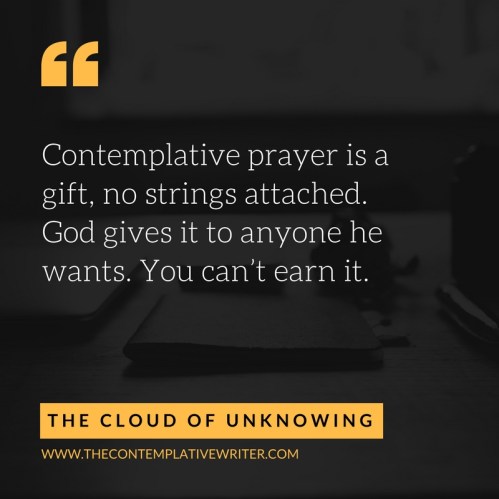
Contemplative prayer is a gift, no strings attached. God gives it to anyone he wants. You can’t earn it.
*****
When understood properly, prayer is nothing but an intense longing for God, nurturing everything good and removing everything evil.
*****
[K]now that God is the one who stirs your will and longing, all by himself, with no middle man. Nor does he need your help to do this. Don’t be afraid of the devil, either; he can’t come near you.
*****
I’ve been enjoying the Cloud of Unknowing in a newer translation that renders the text in a modern English idiom. Read more here.
Each Friday I share some of my favorite finds related to praying or writing. If I think it could help you pray or write better, or just “be” better, I’ll include it below.
Do you have someone else’s article or post to share? Join the Contemplative Writers Facebook group, comment on today’s post on my Facebook page, or follow me on Twitter (@LisaKDeam) to nominate your favorite articles, blog posts, and books by Thursday at noon each week.
*****
Monday Merton: Is the Church Redemptive or Self-Serving? via Ed Cyzewski (when the mission of the Church becomes distorted)
Daily Lectio Divina: Hildegard of Bingen via Laura Cavanaugh (a guided lectio divina podcast)
Only One Platform Will Last via Karen Swallow Prior (it’s time to reimagine the p-word)
The Long View on a Writer’s Work via Andi Cumbo-Floyd (are you writing for now or for the long-view, or both?)
Why I’m Committing to the Work-Ahead Advantage via Ann Kroeker (try writing ahead for the busy or dry times that will come)

Almighty and everlasting God, who in the Paschal mystery established the new covenant of reconciliation: Grant that all who have been reborn in this fellowship of Christ’s Body may show forth in their lives what they profess by their faith; through Jesus Christ our Lord, who lives and reigns with you and the Holy Spirit, one God, for ever and ever.

The Cloud of Unknowing, a 14th-century treatise on contemplative prayer, introduces a subject that plagues us all — distractions. Medieval mystics and other giants of the Church speak of distractions a great deal — obviously it’s a prayer problem that’s always been around.
The 13th-century Dominican theologian St. Thomas Aquinas said, “a man can scarcely say the ‘Our Father’ without his mind wandering to other things.” The same is true, perhaps even truer, of contemplative prayer. So if you have trouble with distraction, take heart! You (and I) are not alone. The Cloud author gives us these tips for dealing with those pesky stray thoughts:
*****
When distracting thoughts press down on you, when they stand between you and God and stubbornly demand your attention, pretend you don’t even notice them. Try looking over their shoulders, as if you’re searching for something else, and you are. That something else is God, hidden in a cloud of unknowing.
*****
When exhausted from fighting your thoughts, when you’re unable to put them down, fall down before them and cower like a captive or a coward overcome in battle. Give up. Accept that it’s foolish for you to fight them any longer. Do this, and you’ll find that in the hands of your enemies, you are surrendering to God.
*****
I also believe that when this attitude is genuine, it’s nothing but seeing who you really are . . . This is humility. The good news is that humility gets God’s attention. He’ll descend to avenge you against your enemies. Swooping in, he will snatch you up and then gently dry your spiritual eyes . . .
*****
I’ve been enjoying the Cloud of Unknowing in a newer translation that renders the text in a modern English idiom. Read more here.

Each Friday I share some of my favorite finds related to praying or writing. If I think it could help you pray or write better, then I’ll include it below.
Do you have someone else’s article or post to share? Tag me on the Contemplative Writers Facebook group, comment on today’s post on my Facebook page, or follow me on Twitter (@LisaKDeam) to nominate your favorite articles, blog posts, and books by Thursday at noon each week.
To Experience Resurrection (a Poem for Holy Week) via Kelly Chripczuk
Journeying with Jesus Through Holy Week via April Yamasaki
Monday Merton: Why We Wish to Destroy Our Enemies via Ed Cyzewski
The Disciplines Aren’t The Point via Nathan & Richard Foster (Renovaré podcast)
5 Reasons Fellow Writers Are Essential to Your Writing Life via Brian Klems
8 Writers on How to Face Writer’s Block and the Blank Page via Open Culture (a 5-minute video)
Jesus, my feet are dirty. Come even as a slave to me, pour water into your bowl, come and wash my feet. In asking such a thing I know I am overbold, but I dread what was threatened when you said to me, “If I do not wash your feet I have no fellowship with you.” Wash my feet then, because I long for your companionship.


The modern Centering Prayer movement teaches practitioners to choose one word to say and focus on during prayer. This technique has its origins in The Cloud of Unknowing (among other historical works) — our featured book of the month.
I grew up listening to long and wordy prayers in church. But the Cloud‘s 14th-century author explains why short prayers can be better prayers. I especially like his colorful example of a person who uses one word to cry for help in the midst of a fire. Aren’t we all crying out for help when we pray?
*****
Contemplatives seldom use words when they pray, but if they do, they choose only a few, and the fewer the better. They prefer a short one-syllable word over a word with two syllables, because the spirit can best assimilate it.
*****
[I]f we pray intently to get anything good, we should cry out in word, thought, or longing nothing but this word—God, nothing else. No other words are needed; for God’s very nature is goodness, and he’s the source of everything good.
*****
Why does this short little prayer of one small syllable penetrate heaven? Because you pray it with all that you are and all that you can be . . . the deepest wisdom of your soul is contained in this single tiny word, which is long in feeling . . .
*****
When a person is terrified by a fiery catastrophe . . . they cry out for help. That’s obvious. But what do they say? I can promise you a person in danger won’t pray a long string of words or even a word of two syllables. Why not? When desperate, you’ve got no time to waste . . . you’ll scream ‘Fire!’ or ‘Help!’ and this one-word outburst works best.
*****
I’ve been enjoying the Cloud of Unknowing in a newer translation that renders the text in a modern English idiom. Read more here.

A prayer before writing from Thomas Aquinas (1225-1274):
O Creator of the universe, who has set the stars in the heavens and causes the sun to rise and set, shed the light of your wisdom into the darkness of my mind. Fill my thoughts with the loving knowledge of you, that I may bring your light to others. Just as you can make even babies speak your truth, instruct my tongue and guide my pen to convey the wonderful glory of the Gospel. Make my intellect sharp, my memory clear, and my words eloquent, so that I may faithfully interpret the mysteries which you have revealed.

The Cloud of Unknowing is a contemplative treatise written in the late 14th century. It forms the basis (along with a few other historical texts) of the modern Centering Prayer movement.
The Cloud‘s anonymous author was a monk or priest who addressed his treatise to a young disciple just setting out in a religious vocation. Although written in a monastic context, the Cloud (and its “sequel,” the Book of Privy Counsel), has advice for anyone who wants to pursue a life of prayer.
Reading the Cloud of Unknowing, I’m especially drawn to the author’s description of contemplative prayer as rest and even akin to sleep. I don’t know about you, but I think rest is something most of us need in a culture characterized by a lot of striving. Are you tired and anxious? The Cloud author writes:
*****
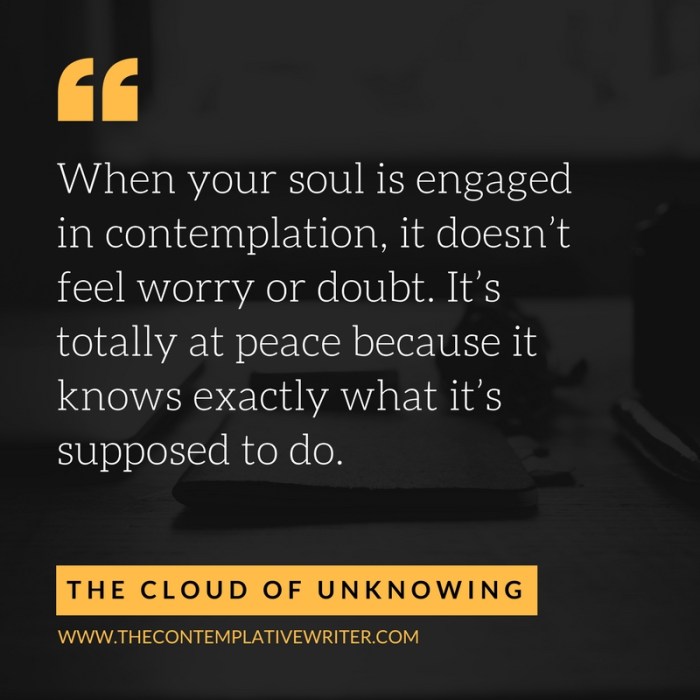
I . . . call [contemplative prayer] ‘rest’ for two reasons: When your soul is engaged in contemplation, it doesn’t feel worry or doubt. It’s totally at peace because it knows exactly what it’s supposed to do.
*****
It makes sense to compare the work of contemplation to sleep. When we’re asleep, the functions of our physical faculties are suspended so that our bodies can get complete rest. Sleep nourishes and strengthens our bodies in every way. The same is true of the spiritual ‘sleep’ of contemplative prayer. The stubborn questions of our restless spirituality and all our creative and rational thoughts are firmly bound and totally emptied, so the happy soul can sleep soundly, resting profoundly in the loving awareness of God as he is, completely nourished and strengthened in spirit.
*****
When you are seeking God, you won’t rest until you rest in him . . .
*****
I’ve been enjoying the Cloud of Unknowing in a newer translation that renders the text in a modern English idiom. Read more here.
 The Contemplative Writer