WEEKLY PRAYER

A prayer before writing or teaching from Christina Rossetti (1830-1894):

Lord Jesus Merciful and Patient, grant us grace, I beseech Thee, ever to teach in a teachable spirit; learning along with those we teach, and learning from them whenever Thou so pleasest. Word of God, speak to us, speak by us, what Thou wilt. Wisdom of God, instruct us, instruct by us if and whom Thou wilt. Eternal Truth, reveal Thyself to us, reveal Thyself by us, in whatsoever measure Thou wilt.

Source

BOOK OF THE MONTH: BEFRIENDING SILENCE

Week 3: Letting Go
Befriending Silence

In Befriending Silence, Carl McColman explores three kinds of monastic prayer that can help us today. In previous posts, we looked at the gifts of lectio divina and the Divine Office. We now turn our attention to contemplative (silent) prayer.

Contemplative prayer gives us much-needed peace and inner rest. When we pray in silence before God, McColman says, “The Holy Spirit invites us to gently set aside our attachments to our interior drama so that we might rest in God’s unchanging stability.”

Since it is mostly without words or particular agendas, contemplative prayer offers an additional benefit that can also be a challenge: letting go of our all-pervasive need for control.

*****

Contemplation challenges us not only as individuals but as a society because ours is a society that rewards assertive, take-charge, type A behavior, and we want to do spirituality in the same way.

*****

Think of it this way: every conversation requires both speaking and listening, otherwise it is one-sided. The Divine Office and other verbal prayers invite us to speak to God, while contemplation gives us the space to listen.

*****

Contemplative prayer fosters an inner spirit of acceptance and receptivity. It reminds us that we are not in the driver’s seat when it comes to prayer (or indeed any aspect of spiritual living). When we pray in silence, we actually embody humility in our prayer. We make ourselves available to God but without presuming to tell God what we want to have happen or what we think should happen. Rather, we shut up and let God take the lead.

Read more.

For reflection:

McColman - week 3

FRIDAY FAVORITES FOR PRAYER AND WRITING

Each Friday I share some of my favorite finds related to praying or writing. If I think it could help you pray or write better, or just “be” better, I’ll include it below.

Do you have someone else’s article or post to share? Join the Contemplative Writers Facebook group, comment on today’s post on my Facebook page, or follow me on Twitter (@LisaKDeam) to nominate your favorite articles, blog posts, and books by Thursday at noon each week.

*****

Author Tuesday: The Divine Dance (Mike Morrell), via Cara Meredith (an interview with Mike Morrell, co-author with Richard Rohr of The Divine Dance)

Tuesday Tip with Rich: A Mystic Love via Rich Lewis  (with a quote to encourage you as you pray)

Jesus Is King, America Is in Chaos, Now What? via Ed Cyzewski (no matter what your politics are, read this post about turning to prayer in times of chaos and crisis)

Returning to a Ritual: Reading a Writing Book Each Day via Andi Cumbo-Floyd (with suggestions to get you started)

Why Reading Fiction Is Good for the Soul via Ashley Hales (I agree with everything in this essay because — true confession — fiction is what I love to read the most!)

Practicing From the Inside Out: Balancing Our Working Life via Greg Richardson (how’s your work-life balance right now?)

CONTEMPLATIVE PROFILE: PERSEVERING IN PRAYER WITH CATHERINE OF SIENA

In last week’s Contemplative Profile, we looked at a letter of St. Catherine, the 14th-century mystic, in which she describes three kinds of prayer. In that same letter, Catherine encourages her niece, a nun, to persevere when faced with difficulties praying. Let’s take her words to heart when we have our own struggles. Catherine writes:

*****

If you encounter different kinds of struggle in your prayer, or if you experience confusing darkness of mind (this is the devil making the soul feel that her prayer is not pleasing to God), you ought, nevertheless, never give up on account of struggles and darkness, but rather to stand firm with courage and perseverance, remembering that the devil does this to draw you away from your mother, prayer, and that God permits it to test the courage and constancy of your soul.

*****

God allows this also so that in your struggle and darkness you may know that of yourself you are nothing, and may know, through the good intention in which you remain, the goodness of God who is the giver and the preserver of a good and holy will.

*****

Catherine of Siena (1347-1380) was a member of the Dominican Order of Penance. She was a mystic, a reformer, and an adviser to popes. Her written work includes over 300 letters and a contemplative treatise, The Dialogue. Read more here.

Read Catherine’s letters here.

.

WEEKLY PRAYER

A prayer from Clement of Rome (1st century):

We beseech thee, Master, to be our helper and protector.
Save the afflicted among us; have mercy on the lowly;
raise up the fallen; appear to the needy; heal the ungodly;
restore the wanderers of thy people;
feed the hungry; ransom our prisoners;
raise up the sick; comfort the faint-hearted.

Source

BOOK OF THE MONTH: BEFRIENDING SILENCE

Week 2: Baby Steps Toward a Life of Prayer

Befriending SilenceIn Befriending Silence, author and Lay Cistercian Carl McColman shares with us the gifts of Cistercian spirituality. Not surprisingly, many of these gifts center on prayer. “Artists paint, doctors heal, businessmen sell, and Cistercians pray,” McColman writes.

The monastic commitment to a life of prayer can inspire those of us “in the world” to make this gift an important part of our spiritual life.

[P]art of the gift of Cistercian spirituality becoming available to people outside the cloister is a challenge to pray, to seek intimacy with God every day–not in just a perfunctory way but as a meaningful part of each day.

*****

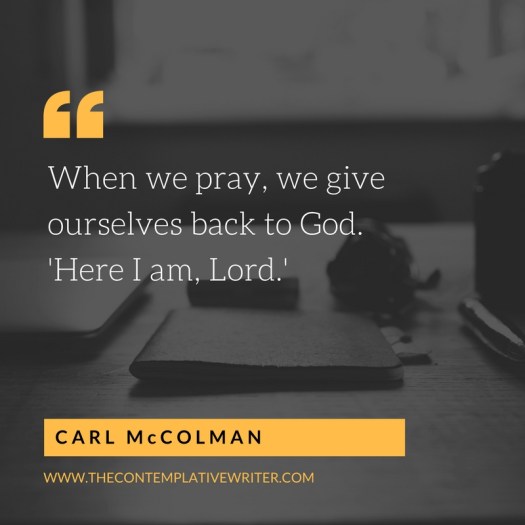
With prayer we express love of Christ, and it is also a gift, in a very mutual way; for prayer, like all spiritual blessings, is a gift from God. Yet when we pray, we give ourselves back to God. ‘Here I am, Lord.’

*****

There are several different kinds of prayer. Last week’s post touched on lectio divina, a way of praying with the Bible. Also important in monastic life is the Divine Office, the prayers and other readings marking the hours of each day. McColman believes that this liturgy offers a poetic and insightful prayer structure for everyone. Because the Divine Office can be complicated, McColman advocates starting small. He suggests the following practice based on the psalms, which form the heart of the Divine Office:

*****

Here is a simple, yet effective, way to begin a practice of daily prayer. Every day for the next five months, pray one psalm a day. That’s it. Each individual psalm can easily be prayed in a single sitting.

*****

Keep in mind that Jesus prayed the psalms. Jews and Christians of every generation have found inspiration, solace, hope, comfort, and challenge in this biblical prayer book. When you pray the psalms, you are truly partaking in a prayer tradition that spans the globe and the centuries.

*****

Don’t worry if you don’t ‘feel’ the particular emotion that is expressed in any one particular psalm. Your prayer is meant to operate on a deeper level than mere feeling.

*****

Read more.

For reflection:

McColman - week 2 (alt)

FRIDAY FAVORITES FOR PRAYER AND WRITING

Each Friday I share some of my favorite finds related to praying or writing. If I think it could help you pray or write better, or just “be” better, I’ll include it below.

Do you have someone else’s article or post to share? Join the Contemplative Writers Facebook group, comment on today’s post on my Facebook page, or follow me on Twitter (@LisaKDeam) to nominate your favorite articles, blog posts, and books by Thursday at noon each week.

*****

Why I Write via Anna Gissing (part of a series on writing as a spiritual discipline)

How Significant Books Become Good Friends via Richard J. Foster (I love the idea of books as friends!)

Tesser Well via Amanda Cleary Eastep (can you guess the book that served as an impetus for this essay on faith and writing?)

5 Things I Learned From My Six-Week Social Media Fast via Michelle DeRusha (don’t worry – social media’s not all bad)

The Art and Practice of Spiritual Discernment via The Transforming Center (part of a leadership podcast but good for all of us!)

CONTEMPLATIVE PROFILE: PRAYING WITH CATHERINE OF SIENA

St. Catherine of Siena (1347-1380) was a compassionate spiritual adviser and encourager. Interestingly, she dispensed much of her advise in writing, in the form of letters. Sometimes she wrote to popes and other rulers, sometimes to simple religious folk like herself.

In a letter to her niece, who was a nun, Catherine describes three kinds of prayer. It’s helpful to take a look at her taxonomy. Note: what Catherine calls “mental prayer” (below) appears to be akin to contemplative or silent prayer:

*****

Prayer is of three kinds. The first is unceasing: it is a holy constant desire which prays in the sight of God, no matter what you are doing . . . The glorious saint Paul seemed to be referring to this when he urged: “Pray constantly” (1 Thes 5:17).

*****

The second kind is vocal prayer: you engage in this when you say the office or other prayers aloud.

*****

This is meant to bring you to the third kind, namely, mental prayer. Your soul reaches this kind of prayer through the use of vocal prayer with prudence and humility, so that while the tongue speaks, the heart is not far from God. And when you perceive that God is visiting your mind so that it is drawn in any way to think of its Creator, you ought to abandon vocal prayer and to fix your mind with great love on God’s visitation.

*****

A bit more on mental prayer:

*****

[The soul] rises above herself, that is, above the gross impulse of the senses, and with angelic mind is united with God in intense love. By the light of her intellect she sees and knows, and she clothes herself with truth, becoming the sister of the angels.

*****

Catherine of Siena (1347-1380) was a member of the Dominican Order of Penance. She was a mystic, a reformer, and an adviser to popes. Her written work includes over 300 letters and a contemplative treatise, The Dialogue. Read more here.

Read Catherine’s letters here.

Reflection: Do you practice all three kinds of prayer mentioned by Catherine of Siena?

WEEKLY PRAYER

A prayer from Thomas à Kempis (1380-1471):

Grant me most sweet and loving Jesus, to rest in You above every other creature, above all health and beauty, above all glory and honor, above all power and dignity, above all knowledge and precise thought, above all wealth and talent, above all joy and exultation, above all fame and praise, above all sweetness and consolation, above all hope and promise, above all merit and desire, above all gifts and favors You give and shower upon me, above all happiness and joy that the mind can understand and feel, and finally, above all angels and archangels, above all the hosts of heaven, above all things visible and invisible, and above all that is not You, my God.

Source

FRIDAY FAVORITES FOR PRAYER AND WRITING

Each Friday I share some of my favorite finds related to praying or writing. If I think it could help you pray or write better, or just “be” better, then I’ll include it below.

Do you have someone else’s article or post to share? Join the Contemplative Writers Facebook group, comment on today’s post on my Facebook page, or follow me on Twitter (@LisaKDeam) to nominate your favorite articles, blog posts, and books by Thursday at noon each week.

*****

Warming Up to Prayer via Tammy Perlmutter (in which Buffy the Vampire Slayer makes an appearance)

A Contemplative Faith – With a Gaelic Accent! via Carl McColman

The Books That Made Your Favorite Writers Want to Write via Emily Temple (some surprising choices here!)

When Writing Is Actually About Waiting via Joe Fassler

Why I Said Yes to a Part-Time Job (Or, Let’s Talk Real About the Creative Life) via Michelle DeRusha