Friday Favorites for Prayer and Writing

Each Friday I share some of my favorite finds related to praying or writing. If I think it could help you pray or write better, then I’ll include it below.

Do you have someone else’s article or post to share? Join the Contemplative Writers Facebook group, comment on today’s post on my Facebook page, or follow me on Twitter (@edcyzewski) to nominate your favorite articles, blog posts, and books by Thursday at noon each week.

Benedictine Stability: When the Going Gets Tough, Stay

Change Is Not for the Faint of Heart

John Wesley on Conversion and Spiritual Formation

Facebook Has 50 Minutes of Your Time… It Wants More

Doctors Explain How Hiking Changes Our Brains

Looking for more recommendations? Check out our Prayer Resources page.


Keep the Contemplative Writer Sustainable

The Contemplative writer is ad-free and never shares sponsored content, but it is a lot of work to maintain. We rely on affiliate links from the books we share and the generous gifts of our readers. An automated monthly gift as low as $1 per month or a one-time gift of $5 goes a long way to sustaining our mission to provide contemplative prayer resources for our readers. Thank you!

Choose a recurring monthly donation:

support-patreon-orange

Make a one-time gift via PayPal (credit cards accepted!)


Donate Now Button

Learn more about how to support us.


How Exercising Helps Us Pray and Write

Don’t let today’s featured article about running and writing turn you away if you can’t fathom the practice of running daily. Nick Ripatrazone writes in The Atlantic about the benefits of running for writers and the ways that the flow of running connects with the flow of writing.

I have personally found that most of this article also applies to contemplative prayer. Both writing and prayer can thrive when we immerse ourselves in a simple, repetitive practice that allows our minds to be clear and our imaginations to wander.

Whether you walk, swim, bike ride, run, or do something else to exercise, your writing and your prayer will benefit over the long term. It may take a while to train your mind alongside your body, but I was personally shocked at all of the benefits I saw after only three months of running four days a week. Here are a few key quotes from Ripatrazone’s article:

*****

“In many ways running is a natural extension of writing. The steady accumulation of miles mirrors the accumulation of pages, and both forms of regimented exertion can yield a sense of completion and joy. Through running, writers deepen their ability to focus on a single, engrossing task and enter a new state of mind entirely—word after word, mile after mile.”

*****

“Once I built a tolerance for distance my runs became incubators for writing ideas. The steady, repetitive movement of distance running triggers one’s intellectual autopilot, freeing room for creative thought. Neuroscientists describe this experience as a feeling of timelessness, where attention drifts and imagination thrives.”

*****

“Writing exists in that odd mental space between imagination and intellect, between the organic and the planned. Runners must learn to accept the same paradoxes, to realize that each individual run has its own narrative, with twists and turns and strains.”

*****

Read more at The Atlantic.


Keep the Contemplative Writer Sustainable

The Contemplative writer is ad-free and never shares sponsored content, but it is a lot of work to maintain. We rely on affiliate links from the books we share and the generous gifts of our readers. An automated monthly gift as low as $1 per month or a one-time gift of $5 goes a long way to sustaining our mission to provide contemplative prayer resources for our readers. Thank you!

Choose a recurring monthly donation:

support-patreon-orange

Make a one-time gift via PayPal (credit cards accepted!)


Donate Now Button

Learn more about how to support us.


Why We Need the Restoration of Silence

I’m somewhere in the middle of the Highly Sensitive spectrum, so I’m very aware of how noise impacts my anxiety levels and ability to concentrate. However, some of the most recent research in neuroscience is finding that we don’t just need silence as a break from the noise. We need silence in order for our brains to process information and to more or less “recover” from the noise of life.

Studies are finding that children who grow up near airports, highways, and other noisy environments have higher levels of stress and tend to struggle to concentrate in school. Without down time, our brains become overloaded.

One of the most important benefits of practicing contemplative prayer has been a greater awareness of my mental state and when I need to take a break. Prayer is much easier when my brain isn’t spinning out of control! Here are a few helpful quotes from a LifeHacker article on the importance of silence:

*****

When the brain rests it is able to integrate internal and external information into “a conscious workspace,” said Moran and colleagues.

When you are not distracted by noise or goal-orientated tasks, there appears to be a quiet time that allows your conscious workspace to process things. During these periods of silence, your brain has the freedom it needs to discover its place in your internal and external world.

*****

It has been found that noise can have a pronounced physical effect on our brains resulting in elevated levels of stress hormones. The sound waves reach the brain as electrical signals via the ear. The body reacts to these signals even if it is sleeping. It is thought that the amygdalae (located in the temporal lobes of the brain) which is associated with memory formation and emotion is activated and this causes a release of stress hormones. If you live in a consistently noisy environment that you are likely to experience chronically elevated levels of stress hormones.

*****

According to the attention restoration theory when you are in an environment with lower levels of sensory input the brain can ‘recover’ some of its cognitive abilities. In silence the brain is able to let down its sensory guard and restore some of what has been ‘lost’ through excess noise.

*****

Read the rest of the LifeHacker article here.


Keep the Contemplative Writer Sustainable

The Contemplative writer is ad-free and never shares sponsored content, but it is a lot of work to maintain. We rely on affiliate links from the books we share and the generous gifts of our readers. An automated monthly gift as low as $1 per month or a one-time gift of $5 goes a long way to sustaining our mission to provide contemplative prayer resources for our readers. Thank you!

Choose a recurring monthly donation:

support-patreon-orange

Make a one-time gift via PayPal (credit cards accepted!)


Donate Now Button

Learn more about how to support us.


Featured Contemplative Book: 100 Days in the Secret Place

Week 1: Healing through Our Suffering

100-days-secret-placeIf you’re looking for a book that will offer a challenge to seek the deeper spiritual life with God and to make prayer a higher priority, 100 Days in the Secret Place is at the top of my list.

Gene Edwards, author of Divine Romance, has gathered together key writings from three notable Christian mystics from the seventeenth century: Miguel de Molinos, Madame Jeanne Guyon, and Francois Fenelon: 100 Days in the Secret Place: Classic Writings from Madame Guyon, Francois Fenelon, and Michael Molinos on the Deeper Christian Life by Gene Edwards.

This week I’m highlighting a series of quotes on the ways that God works with us in the midst of suffering, failure, and disappointment.

*****

Do you want to experience true happiness? Submit yourself peacefully and simply to the will of God, and bear your sufferings without struggle. Nothing so shortens and soothes your pain as the spirit of nonresistance to your Lord.

*****

Let God use trials to help you grow. Do not try to measure your progress, your strength, or what God is doing. His work is not less efficient because what He is doing is invisible.

*****

With people you love you do not need to continually say, “I love you with all my heart.” Even if you do not think about how much you love Him, you still love God every bit as much. True love is deep down in the spirit—simple, peaceful, and silent.

*****

Do not disturb yourself by trying to manufacture an artificial sense of God’s presence. Slowly you will learn that all the troubles in your life—your job, your health, your inward failings—are really cures to the poison of your old nature. Learn to bear these sufferings in patience and meekness.

*****

God wants to build a relationship with you that is based on faith and trust and not on glamorous miracles.

*****

These mystics don’t suggest that God intentionally brings suffering to us. Rather, God remains with us in the midst of our sufferings, bears our burdens, and ministers to and through us as we bear hardships.

Keep in Touch

Get our latest blog posts delivered to your inbox or sign up for the weekly contemplative email and receive a free eBook: The Contemplative Writer.


For Reflection or Sharing

How is God reaching out to you today?

Week 1 Featured book May 2, 2016.jpg

Friday Favorites for Prayer and Writing

Each Friday I share some of my favorite finds related to praying or writing. If I think it could help you pray or write better, then I’ll include it below.

Do you have someone else’s article or post to share? Join the Contemplative Writers Facebook group, comment on today’s post on my Facebook page, or follow me on Twitter (@edcyzewski) to nominate your favorite articles, blog posts, and books by Thursday at noon each week.

When the Darkness Lifts by Kelly J. Youngblood

The Liturgists Podcast: An Interview of Richard Rohr

How Our Salvation Begins by Kelly Chripczuk

Rest Easy, You’re Loved No Matter What by Aundi Kolber

Keep Showing Up and Finishing Stuff by Me (Read the comments!)

13 Powerful Women Mystics Who Helped Shape Christianity

Looking for more recommendations? Check out our Prayer Resources page.

Scripture Meditation: How to Restore Your Soul


“He makes me lie down in green pastures; he leads me beside still waters; he restores my soul.”
Psalm 23:2-3a

bible-1440953-1279x852

Meditation

Seasons of weariness are coming. There’s no guarantee that God will shield us from hard times, from weakness, and from souls that desperately need restoration. While we can anticipate draining, difficult seasons, we are assured that God will restore us.

Are we prepared to receive the restoration that comes from God?

Restoration may look like stopping, lying down, and seeking places of peace and stillness. Perhaps we will resist God’s restoration to the point that he will “make” us lie down.

Finding God’s rest takes faith, trusting that God can lead us and sustain us, especially when we stop trying to maintain control. May we have eyes to see the gentle hand of God leading us to restoration.


Reflection

Why have you resisted restoration?

When has your soul grown weary lately?

What does it look like to trust God with restoring your soul today?


Featured Contemplative Book: Immortal Diamond

Week Four: Love

Immortal Diamond by RohrI used to speak of God being apart from myself, but Richard Rohr has helped me look at scripture with new eyes. For instance, Paul writes:

“Set your minds on things that are above, not on things that are on earth, for you have died, and your life is hidden with Christ in God.”
Colossians 3:2-3, NRSV

Our lives are hidden in Christ? In other words, after all of the times I’ve asked God to “show up,” I’ve missed the fact that I’m hidden in Christ. This divine union forms the backbone of Rohr’s writing.

The presence of God we seek and even fear losing because of our imperfections has been among us all along. Even as we reach out for God, God is already holding us. When we fear we are falling away, we are already being held.

May we find comfort today in the loving embrace of God.

Here is the final list of quotes from Immortal Diamond this month.

*****

“It is almost impossible to fall in love with majesty, power, or perfection. These make us fearful and codependent, but seldom truly loving. On some level, love can only happen between equals, and vulnerability levels the playing field. What Christians believe is that God somehow became our equal when he became the human “Jesus,” a name that is, without doubt, the vulnerable name for God.”

*****

“Your False Self is how you define yourself outside of love, relationship, or divine union. After you have spent many years laboriously building this separate self, with all its labels and preoccupations, you are very attached to it. And why wouldn’t you be? It’s what you know and all you know. To move beyond it will always feel like losing or dying…”

*****

“Longing for God and longing for our True Self are the same longing. And the mystics would say that it is God who is even doing the longing in us and through us…”

*****

“The Risen Christ is the standing icon of humanity in its final and full destiny. He is the pledge and guarantee of what God will do with all of our crucifixions. At last, we can meaningfully live with hope. It is no longer an absurd or tragic universe. Our hurts now become the home for our greatest hopes.”

*****


Keep in Touch

Get our latest blog posts delivered to your inbox or sign up for the weekly contemplative email and receive a free eBook: The Contemplative Writer.


For Reflection or Sharing

Even as we reach out for God, God is already holding us.

Week 4 Featured book April 25 2016


Contemplative Profiles: The Female Mystics of the Middle Ages

In the past I have made the mistake of ignoring the spiritual teachings of the Middle Ages, missing out on the rich contemplative practices that were documented at great personal cost. Dr. Elizabeth Alvilda Petroff notes in an article in Christianity Today that women were often denied educations in the Middle Ages, so their religious communities took on a more contemplative, creative, and spiritual shape, while many religious men leaned toward theological reflection.

This resulted in a unique spirituality from women who experienced the love of God in rich and vibrant encounters. Perhaps the simplicity of their spirituality became their greatest strength. While some female mystics from this time were supported by the church hierarchy, many wrote down their accounts and visions despite heated opposition, risking persecution and even death at the hands of controlling church leaders.

Dr. Elizabeth Alvilda Petroff writes about female mystics for Christianity Today:

*****

We think of the Middle Ages as the age of faith, and so it was, but it was also an age of crisis. In such a context, mysticism was not a retreat from the negative aspects of reality, but a creative marshaling of energy in order to transform reality and one’s perception of it.

Mystics were the teachers of the age, inspired leaders who synthesized Christian tradition and proposed new models for the Christian community. We know some of the men—Bernard of Clairvaux, Francis of Assisi, Thomas Aquinas—but we are not as familiar with the women, although they were actually more numerous. Hildegard of Bingen, Clare of Assisi, Beatrijs of Nazareth, Angela of Foligno, Julian of Norwich, and other women mystics drew on their experience of the divine to provide spiritual guidance for others. Such women became highly respected leaders of the faithful. Their role as prophets and healers was the one exception to women’s presumed inferiority in medieval society.

*****

She goes on to write:

*****

Dame Julian of Norwich said in her Showings: “ … God forbid that you should say or assume that I am a teacher … for I am a woman, ignorant, weak and frail. But I know very well that what I am saying I have received by the revelation of him who is the sovereign teacher … because I am a woman, ought I therefore to believe that I should not tell you of the goodness of God, when I saw at that same time that it is his will that it be known?”

*****

As we honor their legacy, learn from their wisdom, and embody their practices, may we have the courage to share with others the ways God has spoken to us.


Reflection

Take 5 minutes to ask God what you need to receive today.

Remain open to sharing that with someone else if appropriate.


Can Mindfulness Training Help You Pray?

How can I focus better when I pray?

Try practicing mindfulness.

Bookshelf-BarnImages.com-1

Mindfulness has long been practiced by Christian contemplatives from their days in the desert caves to the monasteries of Europe to John Wesley’s holiness club. You can find mindfulness in just about every religion, no one can claim this practice exclusively, and it’s even back by solid science. It’s also becoming increasingly popular in non-religious settings.

Those who teach mindfulness training in elementary schools note that simple meditation practices help our brains settle down so that we can focus on the present moment and the tasks before us. Perhaps Christians make the mistake of associating “mindfulness” practices with “Eastern” religions (I won’t get into whether Christianity is actually an Eastern religion or not… Ha.). The truth is that mindfulness can prove extremely useful for prayer.

Let’s begin with a look at what researchers have to say:

First we have to practice things deliberately, and then what happens — just like learning to play the piano or something like that — we practice and then with enough practice it becomes a habit. And the habits become character traits after a while.”

The most common complaint he hears from teachers (who are choosing MindUP as their professional development) is that they don’t have time for an extra program, the curriculum is already too big and hard to cover. Weresch sympathizes with that argument, but tells them that in his own experience the time spent on the front end tremendously improved the quality of learning throughout the day…

Teachers noticed benefits within a few weeks of practicing mindfulness in the classroom:

The real shifts in school culture came when they started implementing the program school-wide. Teachers now start class in the morning with a few breaths to help students feel present. The middle school has breathing exercises after passing periods. Penley described how kindergarteners used to come into their classroom for free breakfast while their teacher was already directing them to look at what she’d written on the board. Students were having a hard time learning that way because they didn’t feel settled or safe.

Now, teachers greet kids at the door and play soft music with the lights down; they talk about the practices the whole school is working on at that moment. In this low key environment, the teacher is taking roll and checking in on students.

Our environments matter. What we think about matters. The emotions we are feeling need to be detected and acknowledged.

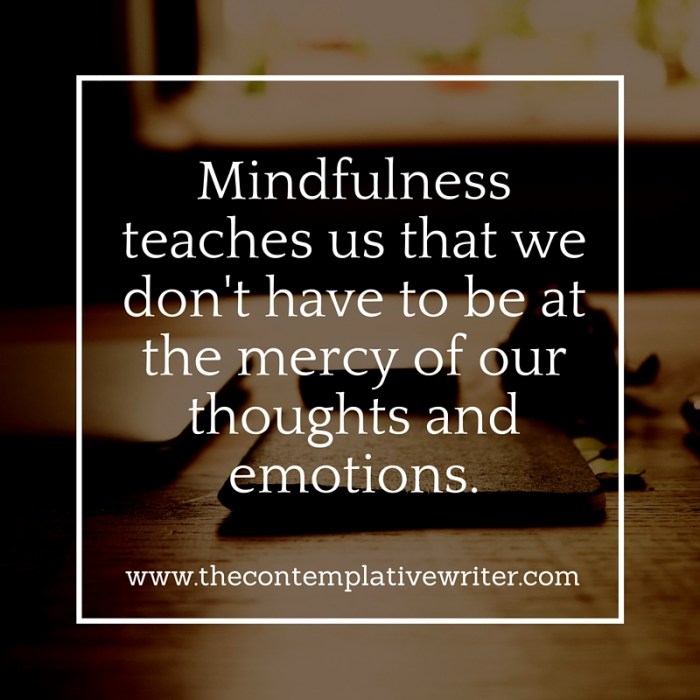
Mindfulness teaches us that we don’t have to be at the mercy of our thoughts and emotions. We can become aware of what we are thinking and feeling. We can take deep breaths and focus on the immediate moment rather than the future or the past.

Most importantly, in the context of prayer and contemplation, we become aware of our thoughts and emotions in order to pray with greater clarity. Paul writes about taking every thought captive to obey Christ (2 Corinthians 10:5), and the simple practice of mindfulness helps us become aware of our thoughts and how they impact us. How else can we take thoughts captive if we don’t see them with complete clarity?

* * * * *

For Reflection
Copy of Meditation April 20 2016


* * * * *

Keep the Contemplative Writer Sustainable

The Contemplative writer is ad-free and never shares sponsored content, but it is a lot of work to maintain. We rely on affiliate links from the books we share and the generous gifts of our readers. An automated monthly gift as low as $1 per month or a one-time gift of $5 goes a long way to sustaining our mission to provide contemplative prayer resources for our readers. Thank you!

Choose a recurring monthly donation:

support-patreon-orange

Make a one-time gift via PayPal (credit cards accepted!)


Donate Now Button

Learn more about how to support us.


Friday Favorites on Prayer and Writing

Each Friday I share some of my favorite finds related to praying or writing. If I think it could help you pray or write better, then I’ll include it below. Do you have someone else’s article or post to share? Join the Contemplative Writers Facebook group, comment on today’s post on my Facebook page, or follow me on Twitter (@edcyzewski) to nominate your favorite articles, blog posts, and books by Thursday at noon each week.

Seven Reasons to Pray the Divine Office via Carl McColman

The Unbusy Pastor (but not just for pastors!) via Eugene Peterson

How the Examen Empowers Us to Pray and Write via Micha Boyett (my guest post for her)

Ruthlessly Eliminate Hurry via John Ortberg

How I Became a Morning Person via Medium

How to Stick with Good Habits via Business Insider

The Desert Fathers (a parody) via Mallory Ortberg

Looking for more recommendations? Check out our Prayer Resources page.