CONTEMPLATIVE PROFILE: TWO SOURCES ON THE JESUS PRAYER

Most of you are probably familiar with the words of the Jesus Prayer:

Lord Jesus Christ, Son of God, have mercy on me, a sinner.

This prayer originated with the Desert Fathers and Mothers as a form of unceasing prayer, as Paul urges in 1 Thess 5:17.

How does one pray the Jesus Prayer? Have you ever tried it? St Gregory of Sinai (1260s-1346), an Eastern Orthodox monk, gives many instructions, including these:

Sitting in your cell, remain patiently in prayer, according to the precept of the Apostle Paul. Collect your mind into your heart and send out thence your mental cry to our Lord Jesus, calling for His help and saying: ‘Lord Jesus Christ, have mercy upon me’ until you are tired. When tired, transfer your mind to the second half and say: ‘Jesus, Son of God, have mercy upon me!’ Having many times repeated this appeal, pass once more to the first half.

Centuries earlier, the Church Father John Chrysostom (c. 349 – 407) indicated that this prayer was to be said not just while sitting quietly but also while going about the many tasks of monastic and daily life. It is to be repeated until it becomes part of one’s very being:

I implore you, brethren, never to break or despise the rule of this prayer… A monk when he eats, drinks, sits, officiates, travels or does any other thing must continually cry: ‘Lord Jesus Christ, son of God, have mercy upon me!’ so that the name of the Lord Jesus, descending into the depths of the heart, should subdue the serpent ruling over the inner pastures and bring life and salvation to the soul. He should always live with the name of the Lord Jesus, so that the heart absorbs the Lord and the Lord the heart, and the two become one…

Read more about the Jesus Prayer at orthodoxytoday.org and Orthodox Mysticism.

Reflection: Do you pray the Jesus Prayer? How has it shaped your spiritual life?
WEEKLY PRAYER

A prayer from St. Augustine:

Great are you, O Lord, and greatly to be praised. Great is your power; your wisdom is infinite. All people, as part of your creation, desire to praise you; all people, who carry the signs of mortality and sin, desire to praise you still. You provoke us toward that delight, for you have created us for yourself, and our hearts cannot be quieted until they find rest in you . . . You will I seek, O Lord, calling upon you; you will I call, believing in you.

Source

BOOK OF THE MONTH: THE ILLUMINED HEART

Week Two: The Joy of Repentance

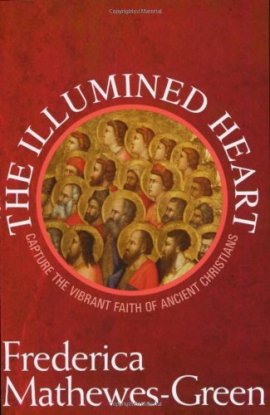
Illumined Heart cover

In The Illumined Heart, Frederica Mathewes-Green explores spiritual wisdom and practices from the ancient Christians. Chapters five and six tackle the unpopular subject of repentance.

Mathewes-Green shifts the discussion of repentance from condemnationwhere it usually sitsto joy. I also like her emphasis that repentance unlocks our compassion for others:

Repentance is the doorway to the spiritual life, the only way to begin. It is also the path itself, the only way to continue. Anything else is foolishness and self-delusion. Only repentance is both brute-honest enough, and joyous enough, to bring us all the way home.

*****

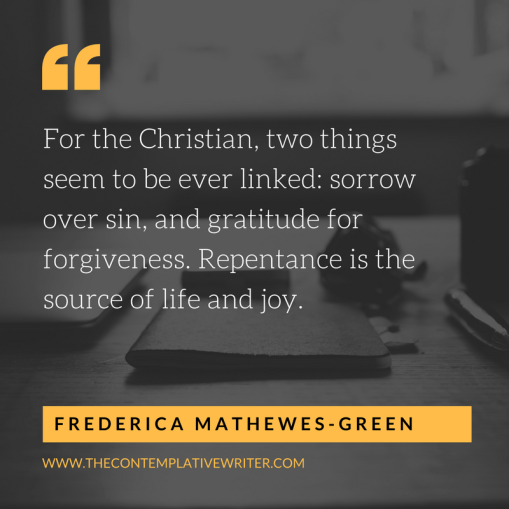
For the Christian, two things seem to be ever linked: sorrow over sin, and gratitude for forgiveness. Repentance is the source of life and joy.

*****

What’s more, repentance enlarges the heart until it encompasses all earthly life, and the sorrow tendered to God is no longer for ourselves alone. Knowing our own sin, we pray in solidarity with all other sinners, even those who hurt us. With all creation we groan, crying out to God for his healing and mercy.

*****

Read more.

For reflection:

Mathewes-Green week 2


BOOK OF THE MONTH: THE ILLUMINED HEART

Week One: Tough Questions

Illumined Heart coverIn The Illumined Heat: Capture the Vibrant Faith of Ancient Christians, Frederica Mathewes-Green shares spiritual practices and wisdom from the ancient Church. I first read this book several years ago, and I thought it was time to revisit it and share some of my favorite parts with you.

As she discusses the early Christians, Mathewes-Green gives us a peek into the life of a fictional fifth-century couple, Anna and Theodore. This is one of my favorite pats of the book, especially when Anna struggles to show love and grace to her mother-in-law.

Mathewes-Green begins with a statement of what we know (intellectually) to be true: in God is life.

Here is communion. In God’s presence we discover ourselves able to love one another, to be vessels of heroic love, even toward our enemies, even unto death. We find all creation in harmony around us, as responsive and fruitful as the Garden was to Adam and Eve. The peace that passes understanding informs our every thought.

*****

If we know that God’s presence is life and love, why don’t we look like we know it? Mathewes-Green asks a whole series of tough questions I find it really good (and uncomfortable) to consider:

Why are we modern Christians so indistinguishable from the world?

*****

How come Christians who lived in times of bloody persecution were so heroic, while we who live in safety are fretful and pudgy?

*****

How could the earlier saints “pray constantly,” while our minds dawdle over trivialities?

*****

How could the martyrs forgive their torturers, but my friend’s success makes me pouty?

*****

In the rest of the book, Mathewes-Green considers how the spiritual practices of ancient Christians might help us as we struggle with our faith. For this week, I invite you to wrestle with the tough questions she asks in the first chapter. What might you answer to some of these questions?

Read more.

For Reflection:

Mathewes-Green week 1 corrected

CONTEMPLATIVE PROFILE: FLANNERY O’CONNOR ON WRITING

I don’t know whether the American writer and essayist Flannery O’Connor (1925-1964) can really be called a contemplative — although she did ask God to make her a mystic. She has been described as a devout believer and also as a “turbocharged Catholic.”

Reading O’Connor’s Prayer Journal, which she wrote in 1946-1947, I was interested in what she says about the intersection of faith and writing. She wrote the journal while studying writing and working on her first novel. In the journal, she begs to know and want God and also to become a “fine writer.” Where do these two desires intersect? In radical dependence on God. O’Connor writes:

My dear God, how stupid we people are until You give us something. Even in praying it is You who have to pray in us. I would like to write a beautiful prayer but I have nothing to do it from.

*****

Dear God, tonight it is not disappointing because you have given me a story. Don’t let me ever think, dear God, that I was anything but the instrument for Your story — just like the typewriter was mine.

*****

If I ever do get to be a fine writer, it will not be because I am a fine writer but because God has given me credit for a few of the things He kindly wrote for me. Right at present this does not seem to be His policy. I can’t write a thing. But I’ll continue to try — that is the point. And at every dry point, I will be reminded Who is doing the work when it is done & Who is not doing it at that moment.

Read more about Flannery O’Connor here. Read her Prayer Journal here.

For reflection: Where do faith and writing intersect for you?

BOOK OF THE MONTH: THE REVELATIONS OF DIVINE LOVE

Week Four: Desire and Divine Will

All Shall Be Well

In The Revelations of Divine Love, Julian of Norwich describes our desires and the divine will as these relate to prayer. God gives us what he wills us to have, and then he makes us yearn for it.

I’m pretty blown away by the idea that in prayer, we ask for what God already plans to give us. It’s hard to wrap my mind around that concept! Here’s what Julian says:

Christ told me from whom our prayers come when He said, “I am the Ground.” And we see how they come to life in the centers of our being when He said, “It is my will first that you have whatever it is, and then I make you yearn for it.” The second thing God wants us to understand about prayer is how we should carry it out. The answer to this is that we choose with all our mental powers to align our desires with the Divine Will; this is what He meant when He said, “Then I make you yearn for it.”

*****

No one sincerely asks for grace and mercy without already having been given grace and mercy.

*****

[T]he greatest acts of God have already been accomplished (just as the Church teaches), and as we meditate on this, we pray for the action that is already being accomplished: that God directs us while we live on Earth, so that God is enriched by our lives, and that we be brought to Divine Joy in Heaven. And then God will have accomplished everything.

*****

Our Protector wants us to pray for everything, whether in general or in particular, that God has laid out to happen. As far as I can see, the thanks, joy, delight, and worth that God grants us in return is beyond our ability to comprehend!

*****

Julian of Norwich (1342 – c. 1416) was an English visionary, mystic, anchoress, and writer. Read about her here.

I’ve been enjoying the Divine Revelations in a modern translation entitled All Shall Be Well.

For reflection:

Julian of Norwich Week 4

FRIDAY FAVORITES FOR PRAYER AND WRITING

Each Friday I share some of my favorite finds related to praying or writing. If I think it could help you pray or write better, or just “be” better, I’ll include it below.

Do you have someone else’s article or post to share? Join the Contemplative Writers Facebook group, comment on today’s post on my Facebook page, or follow me on Twitter (@LisaKDeam) to nominate your favorite articles, blog posts, and books by Thursday at noon each week.

*****

Of Killer Whales and Killers via Leslie Leyland Fields (on not giving up on despair, longing, our country, and God)

Why Do We Bother? via Emily Polis Gibson (“We get up to see just what might happen…”)

The Skeptic’s Guide to Spiritual Practices: Prayer via Stina Cook (in which Marilla Cuthbert helps us learn the value of structured prayer)

Many Ways to Pray: Walking A Labyrinth via Jodi Gehr (discover how to pray using this ancient practice)

To discover one’s heart is an act of reintegration . . . via Fr Aidan (Alvin) Kimel (linking our breath to the Jesus Prayer)

You know you’re a Serious Reader when . . . via Anne Bogel (Anne dishes with Shawn Smucker on favorite books and summer reading)

WEEKLY PRAYER

This week’s prayer is from St. Anselm (1033 – 1109):

Lord, because you have made me, I owe you the whole of my love; because you have redeemed me, I owe you the whole of myself; because you have promised so much, I owe you my whole being. Moreover, I owe you as much more love than myself as you are greater than I, for whom you gave yourself and to whom you promised yourself. I pray you, Lord, make me taste by love what I taste by knowledge; let me know by love what I know by understanding. I owe you more than my whole self, but I have no more, and by myself I cannot render the whole of it to you. Draw me to you, Lord, in the fullness of your love. I am wholly yours by creation; make me all yours, too, in love.

Source