Friday Favorites for Prayer and Writing

Each Friday I share some of my favorite finds related to praying or writing. If I think it could help you pray or write better, then I’ll include it below.

Do you have someone else’s article or post to share? Join the Contemplative Writers Facebook group, comment on today’s post on my Facebook page, or follow me on Twitter (@edcyzewski) to nominate your favorite articles, blog posts, and books by Thursday at noon each week.

One Small Square [On justice and contemplation]

How to Create an Internal Mindset Conducive to Writing

Are You the Listener You Think You Are?

Why Does Running Appeal to Writers?

Experience God’s Presence: Five First Steps

From my blog: Creating a Contemplative-Friendly Smartphone


Keep the Contemplative Writer Sustainable

The Contemplative writer is ad-free and never shares sponsored content, but it is a lot of work to maintain. We rely on affiliate links from the books we share and the generous gifts of our readers. An automated monthly gift as low as $1 per month or a one-time gift of $5 goes a long way to sustaining our mission to provide contemplative prayer resources for our readers. Thank you!

Choose a recurring monthly donation:

support-patreon-orange

Make a one-time gift via PayPal (credit cards accepted!)


Donate Now Button

Learn more about how to support us.


Contemplative Profiles: Brother Lawrence

We best know Brother Lawrence as an unassuming monk who worked hard in a monastery kitchen doing menial chores. It was hardly a step up from his previous occupation in the army, which he only joined because he had grown up in poverty. While serving as a soldier he had a spiritual experience that eventually sent him to a monastery.

Lawrence spent his days contemplating the love of God while washing pots and pan, running errands, and cleaning the kitchen. I have personally benefitted from his writings since I’m the person who washes the dishes in our home, but his example of inviting God to join him in the simplest of tasks is a powerful reminder of how to practice God’s presence today.

This profile in Christian History includes the following quotes from Brother Lawrence:

*****

Lawrence writes, “Men invent means and methods of coming at God’s love, they learn rules and set up devices to remind them of that love, and it seems like a world of trouble to bring oneself into the consciousness of God’s presence. Yet it might be so simple. Is it not quicker and easier just to do our common business wholly for the love of him?”

*****

“We can do little things for God; I turn the cake that is frying on the pan for love of him, and that done, if there is nothing else to call me, I prostrate myself in worship before him, who has given me grace to work; afterwards I rise happier than a king.”

*****

“As often as I could, I placed myself as a worshiper before him, fixing my mind upon his holy presence, recalling it when I found it wandering from him. This proved to be an exercise frequently painful, yet I persisted through all difficulties.”

*****

Read more…


Featured Article: Christian Contemplation Leads Us to Community

There are many misconceptions surrounding contemplative prayer, and perhaps one of the most damaging has been the belief that contemplative prayer is self-centered or self-emptying, disconnecting us from others. However, the Christian contemplative tradition aims to make us more aware of God’s loving presence.

For Christians, God is a loving trinitarian relationship that we participate in because of our adoption by Jesus. Contemplative prayer helps us clear away distractions in order to be more fully present for God’s love, and once we have been impacted by God’s love, we are in a better position to love and serve others. In fact, the desert fathers and mothers were often sought out for their wisdom and advice. Their greatest ministry followed their solitude and contemplation!

In this featured blog post, Carl McColman shares how contemplation has become distorted in some circles as a purely individual pursuit and then offers helpful clarification:

*****

“Christian mysticism actually involves relationship in its most intense form — because it is a trinitarian expression of relationship: relationship with God, relationship with self, relationship with others. All three are necessary for Christian mysticism. For Christians, all three forms of love are necessary for contemplation.”

*****

“It’s a paradox: we retreat into the inner room (including the solitude of silent prayer) not to escape from relationships, but rather to deepen relationships: all relationships (with God, self, and others). When we directly cultivate our relationship with God (as we do during contemplative prayer), we are simultaneously cultivating our capacity for authentic care of self and compassionate love of others. We are called into the silence but then led out of the silence, a rhythm similar to all the great rhythms of life: breathing in/breathing out, the heart beating/resting; work and Sabbath, day and night, summer and winter. Life is an alternating current: and so is the mystical life. We sink into solitude only to be sent forth into relationship.”

*****

Read more…


Keep the Contemplative Writer Sustainable

The Contemplative writer is ad-free and never shares sponsored content, but it is a lot of work to maintain. We rely on affiliate links from the books we share and the generous gifts of our readers. An automated monthly gift as low as $1 per month or a one-time gift of $5 goes a long way to sustaining our mission to provide contemplative prayer resources for our readers. Thank you!

Choose a recurring monthly donation:

support-patreon-orange

Make a one-time gift via PayPal (credit cards accepted!)


Donate Now Button

Learn more about how to support us.

 

Friday Favorites

Each Friday I share some of my favorite finds related to praying or writing. If I think it could help you pray or write better, then I’ll include it below.

Do you have someone else’s article or post to share? Join the Contemplative Writers Facebook group, comment on today’s post on my Facebook page, or follow me on Twitter (@edcyzewski) to nominate your favorite articles, blog posts, and books by Thursday at noon each week.

30 Must-Read Articles if You’re Becoming a Minimalist (We’re moving this week, so…)

Students of Jesus (Just read what Ray writes. The End.)

How to Work Alone

6 Ways the Most Productive People Send Emails

Through Hell and Back (A fascinating profile of Rob Bell)

How to Break Your Addiction to Work


Keep the Contemplative Writer Sustainable

The Contemplative writer is ad-free and never shares sponsored content, but it is a lot of work to maintain. We rely on affiliate links from the books we share and the generous gifts of our readers. An automated monthly gift as low as $1 per month or a one-time gift of $5 goes a long way to sustaining our mission to provide contemplative prayer resources for our readers. Thank you!

Choose a recurring monthly donation:

support-patreon-orange

Make a one-time gift via PayPal (credit cards accepted!)


Donate Now Button

Learn more about how to support us.

Contemplative Profiles: Pope Gregory I

The divide between the “professional” religious people and the lay people is nothing new for Christianity. In fact, Pope Gregory I struggled with the urgency of his ministry as Pope and his inner desire to make more time for contemplative prayer. He spent considerable time bridging the divide between the Christians who attempted to elevate the office of monk over the ministry of lay people.

His words remain helpful for us today as we seek to join our contemplation with action and to guide our action with contemplation.

Here are a few highlights from a recent profile:

*****

Gregory (ca. 540-604) was a contemplative mystic at heart who struggled all of his days with the conflict between busyness and intimacy with Christ. And this struggle gave him great pastoral sympathy for a group of people who had become “second-class citizens” in Christendom: married layfolk. His meditations on the busy life—the life he associated both with Jesus’ friend Martha and Jacob’s wife Leah—led him to formulate a spiritual theology that blasted monastic elitism and freed busy laypeople to enjoy the contemplative life.

*****

[While Pope] He wrote, “I am being smashed by many waves of affairs and afflicted by the storms of a life of tumults.” But whatever the dangers to his soul, the new pope felt obliged to spend himself in labor for his people, healing and calming whom he could among a populace battered by war, plague, and famine. His heart still aching for the contemplative life of the monastery, the shepherd devoted himself to his sheep.

*****

…The contemplative life equips us for the active life, and the active life grounds us in acts of love to our neighbors, to keep us from floating off into spiritual pride and irrelevance.

*****

Read more…


Featured Article: The Real Reason You Procrastinate

Whether we struggle with distractions during prayer or while trying to work, the same root cause is often at work: procrastinating. We procrastinate because of the lure of instant gratification and the emotional difficulty of digging into big or intimidating projects.

I found this analysis of the roots of procrastination and the ways to fight back truly helpful. Most importantly, this is a compassionate article that invites us to confront the emotions and impulses that drive many of our decisions and habits related to procrastination.

Thankfully, we can take some helpful steps forward today:

*****

Most psychologists see procrastination as a kind of avoidance behavior, a coping mechanism gone awry in which people “give in to feel good,” says Timothy Pychyl, a professor who studies procrastination at Carleton University, in Ottawa.

It usually happens when people fear or dread, or have anxiety about, the important task awaiting them. To get rid of this negative feeling, people procrastinate — they open up a video game or Pinterest instead. That makes them feel better temporarily, but unfortunately, reality comes back to bite them in the end

*****

Pychyl discusses the idea of the “monkey mind” — that our thoughts are constantly darting all over the place, preventing us from concentrating. And psychologists agree that the problem with procrastinators is that they are tempted to give in to instant gratification, which brings people the kind of instant relief psychologists call “hedonic pleasure,” rather than staying focused on the long-term goal.

*****

Interestingly, research suggests that one of the most effective things that procrastinators can do is to forgive themselves for procrastinating. In a study by Pychyl and others, students who reported forgiving themselves for procrastinating on studying for a first exam ended up procrastinating less for a second exam.

*****

Instead of focusing on feelings, we have to think about what the next action is, Pychyl says. He counsels people to break down their tasks into very small steps that can actually be accomplished. So if it’s something like writing a letter of reference, the first step is just opening the letterhead and writing the date.

*****

Read the rest…


Keep the Contemplative Writer Sustainable

The Contemplative writer is ad-free and never shares sponsored content, but it is a lot of work to maintain. We rely on affiliate links from the books we share and the generous gifts of our readers. An automated monthly gift as low as $1 per month or a one-time gift of $5 goes a long way to sustaining our mission to provide contemplative prayer resources for our readers. Thank you!

Choose a recurring monthly donation:

support-patreon-orange

Make a one-time gift via PayPal (credit cards accepted!)


Donate Now Button

Learn more about how to support us.

Saturday Prayer

Today’s prayer is taken from Brennan Manning’s Ragamuffin Gospel:

Let us ask God for the gift He gave to an unforgettable rabbi, Joshua Abraham Heschel:

“Dear Lord, grant me the grace of wonder. Surprise me, amaze me, awe me in every crevice of Your universe. Delight me to see how Your Christ plays in ten thousand places, lovely in limbs, and lovely in eyes not His, to the Father through the features of men’s faces. Each day enrapture me with Your marvelous things without number. I do not ask to see the reason for it all; I ask only to share the wonder of it all.”


Friday Favorites

Each Friday I share some of my favorite finds related to praying or writing. If I think it could help you pray or write better, then I’ll include it below.

Do you have someone else’s article or post to share? Join the Contemplative Writers Facebook group, comment on today’s post on my Facebook page, or follow me on Twitter (@edcyzewski) to nominate your favorite articles, blog posts, and books by Thursday at noon each week.

The Human Cost of Digital Technology

Confessions of a Media Protective Parent

Is Contemplation Dangerous?

I Once Was Lost and Now Am Lost Again…

Productivity Apps for Busy Writers

From Ed’s Blog: Evangelicals Need to Sit in a Room and Say Nothing for a Long Time


Keep the Contemplative Writer Sustainable

The Contemplative writer is ad-free and never shares sponsored content, but it is a lot of work to maintain. We rely on affiliate links from the books we share and the generous gifts of our readers. An automated monthly gift as low as $1 per month or a one-time gift of $5 goes a long way to sustaining our mission to provide contemplative prayer resources for our readers. Thank you!

Choose a recurring monthly donation:

support-patreon-orange

Make a one-time gift via PayPal (credit cards accepted!)


Donate Now Button

Learn more about how to support us.
 

Contemplative Profiles: 13 Female Mystics Who Shaped the Church

The women who led the contemplative movement in the church throughout history and influenced the loving search for God over the centuries often made tremendous sacrifices and suffered a great deal. Some gave up wealthy positions, some suffered significant loss, and many of them actively sought to alleviate the suffering of others, exposing themselves to plagues and misery.

They didn’t necessarily shape the theology that we believe, but they do show us steps we can take in the deeper work of abiding in Christ. Here’s an overview of 13 female mystics from church history, but I have included three highlights below:

*****

Catherine of Genoa wrote about a kind of internal purgatory: “The soul presents itself to God still bound to the desires and suffering that derive from sin and this makes it impossible for it to enjoy the beatific vision of God,” Catherine wrote in her book of revelations. She developed a deep relationship with God which Pope Benedict XVI described as a “unitive life.”

*****

Clare of Assissi worked alongside Francis of Assissi: “Clare’s piety was so profound that her sister, mother and several other female relatives eventually came to live with her and be her disciples in her convent outside Assisi. The group came to be known as the ‘Poor Clares.'”

*****

Angela of Foligno shares the common background of coming from a wealthy family or, in her case, losing family members to death: “Angela then sold her possessions and in 1291 enrolled in the Third Order of St Francis. At 43, Angela had a vision of God’s love while she was making a pilgrimage to the shrine of St. Francis of Assisi.”

*****

Read the rest here…


For Reflection

Consider if there are desires you may need to confess to God today in order to experience greater freedom.


Featured Contemplative Book: The Ragamuffin Gospel

ragamuffin Gospel coverWeek Two: What the Cross Tells Us

Brennan Manning writes that we can make the mistake of turning salvation into a process or transaction when the cross itself is God’s ultimate act of love for us. The cross tells us just how deeply God loves us.

As I’ve read the works of contemplative Christians, I’ve noticed that many of them had their most profound revelations while meditating on the cross. It’s on the cross that God demonstrated his commitment to saving us through a different kind of power that doesn’t resort to force or degrading others. The cross tells us just how far God’s love will go for us.

The cross tells us that God saw a violent, self-centered people and still preferred to sacrifice himself at the mercy of our religious and political institutions rather than demanding the love and honor that is his due.

We are continuing our feature of Manning’s The Ragamuffin Gospel this month where he reflects on the love of God and the meaning of the cross:

*****

“We need a new kind of relationship with the Father that drives out fear and mistrust and anxiety and guilt, that permits us to be hopeful and joyous, trusting and compassionate…

The gospel of grace calls us to sing of the everyday mystery of intimacy with God instead of always seeking for miracles or visions. It calls us to sing of the spiritual roots of such commonplace experiences as falling in love, telling the truth, raising a child, teaching a class, forgiving each other after we have hurt each other, standing together in the bad weather of life, of surprise and sexuality, and the radiance of existence.” Page 77-78

*****

“In his monumental work The Crucified God, Jürgen Moltmann writes, ‘We have made the bitterness of the cross, the revelation of God in the cross of Jesus Christ, tolerable to ourselves by learning to understand it as a necessity for the process of salvation.’” Page 108

*****

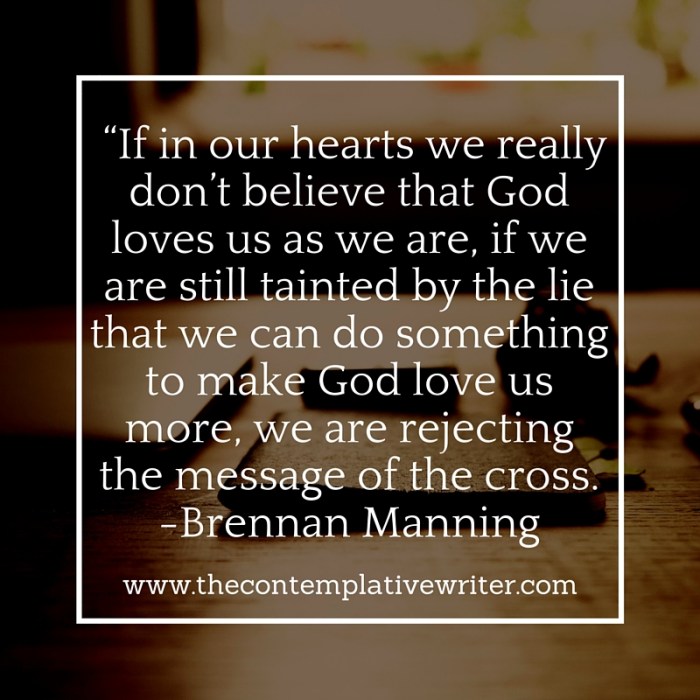
“Do you really accept the message that God is head over heels in love with you? I believe that this question is at the core of our ability to mature and grow spiritually. If in our hearts we really don’t believe that God loves us as we are, if we are still tainted by the lie that we can do something to make God love us more, we are rejecting the message of the cross.” Page 165

*****

Keep in Touch

Get our latest blog posts delivered to your inbox or sign up for the weekly contemplative email and receive a free eBook: The Contemplative Writer.


For Reflection

Featured Book June 6 2016 (1)