WEEKLY PRAYER

A prayer from Clement of Alexandria (c. 150 – 215):

O Educator, be gracious to thy children, O Educator, Father, Guide of Israel, Son and Father, both one, Lord. Give to us, who follow thy command, to fulfill the likeness of thy image, and to see, according to our strength, the God who is both a good God and a Judge who is not harsh. Do thou thyself bestow all things on us who dwell in thy peace, who have been placed in thy city, who sail the sea of sin unruffled, that we may be made tranquil and supported by the Holy Spirit, the unutterable Wisdom, by night and day, unto the perfect day, to sing eternal thanksgiving to the one only Father and Son, Son and Father, Educator and Teacher with the Holy Spirit.

Source

BOOK OF THE MONTH: THE ILLUMINED HEART

Week Four: The Jesus Prayer

Illumined Heart cover

This month we’ve been reading The Illumined Heart: Capture the Vibrant Faith of Ancient Christians. In this short book, Frederica Mathewes-Green explores the wisdom and practices of the early Church to guide us on our walk of faith today. Our previous posts looked at repentance and fasting. Today, we’ll examine the Jesus Prayer.

The Jesus Prayer arose in the early centuries of eastern Christianity. The prayer involves repeating a single phrase: “Lord Jesus Christ, Son of God, have mercy on me.”

Mathewes-Green explains the rationale behind this prayer:

The Jesus Prayer arose as a way to practice unceasing prayer. It offered a short and simple form that can be repeated in an unhurried way no matter what else a person is doing. Since the prayer is silent and interior, it can be kept going in all situations.

*****

Why ask Jesus for mercy?

We keep lapsing into ideas of self-sufficiency, or get impressed with our niceness, and so we lose our humility. Asking for mercy reminds us that we are still poor and needy, and fall short of the glory of God. Those who do not ask do not receive, because they don’t know their own need.

*****

What about when we just can’t do it?

Do not cease praying when prayer comes hard, for fear of doing it imperfectly. If you cease praying when you can’t do it right, the devil gets a victory. So keep offering a broken prayer, and remember that you are only an unworthy servant, and yet Jesus wants you.

*****

Read more.

For Reflection:

Mathewes-Green week 4

CONTEMPLATIVE PROFILE: ST. JOHN CHRYSOSTOM ON PRAYER

In last week’s contemplative profile, we looked at two sources on the Jesus Prayer: Lord Jesus Christ, have mercy on me, a sinner. Historically, this prayer has been thought to be a response to Paul’s instructions to “pray continually.”

St. John Chrysostom also advises the Christian to pray constantly because prayer vanquishes our enemy. The Jesus Prayer sounds so gentle; yet many of the Church Fathers speak of prayer as a weapon. In fact, they often use a violent imagery that has mostly fallen out of favor today. If nothing else, this imagery impresses on us the efficacy of prayer in our lives. Chrysostom says:

Prayer is the cause of salvation, the source of immortality, the indestructible wall of the Church, the unassailable fortress, which terrifies the demons and protects us in the work of righteousness… Prayer is a great weapon, a great protection. Zealous prayer is the light of mind and soul, a constant, inextinguishable light. Therefore during prayer our bitter enemy floods our mind and drenches our soul with a measureless filth of thoughts and collects together qualities of things which had never entered our heads…

And:

By this remembrance (the Jesus Prayer) a soul forcing itself to this practice can discover everything which is within, both good and bad. First it will see within, in the heart, what is bad — and later — what is good. This remembrance is for rousing the serpent, and this remembrance is for subduing it. This remembrance can reveal the sin living is us, and this remembrance can destroy it. This remembrance can arouse all the enemy hosts in the heart, and little by little this remembrance can conquer and uproot them. The name of the Lord Jesus Christ, descending into the depths of the heart, will subdue the serpent holding sway over the pastures of the heart, and will save our soul and bring it to life. Thus abide constantly with the name of our Lord Jesus Christ, so that the heart swallows the Lord and the Lord the heart, and the two become one.

Read more.

Reflection: Have you ever thought of prayer in the forceful and passionate terms of St. John Chrysostom?

WEEKLY PRAYER

A prayer from St. Augustine:

Great are you, O Lord, and greatly to be praised. Great is your power; your wisdom is infinite. All people, as part of your creation, desire to praise you; all people, who carry the signs of mortality and sin, desire to praise you still. You provoke us toward that delight, for you have created us for yourself, and our hearts cannot be quieted until they find rest in you . . . You will I seek, O Lord, calling upon you; you will I call, believing in you.

Source

BOOK OF THE MONTH: THE ILLUMINED HEART

Week Two: The Joy of Repentance

Illumined Heart cover

In The Illumined Heart, Frederica Mathewes-Green explores spiritual wisdom and practices from the ancient Christians. Chapters five and six tackle the unpopular subject of repentance.

Mathewes-Green shifts the discussion of repentance from condemnationwhere it usually sitsto joy. I also like her emphasis that repentance unlocks our compassion for others:

Repentance is the doorway to the spiritual life, the only way to begin. It is also the path itself, the only way to continue. Anything else is foolishness and self-delusion. Only repentance is both brute-honest enough, and joyous enough, to bring us all the way home.

*****

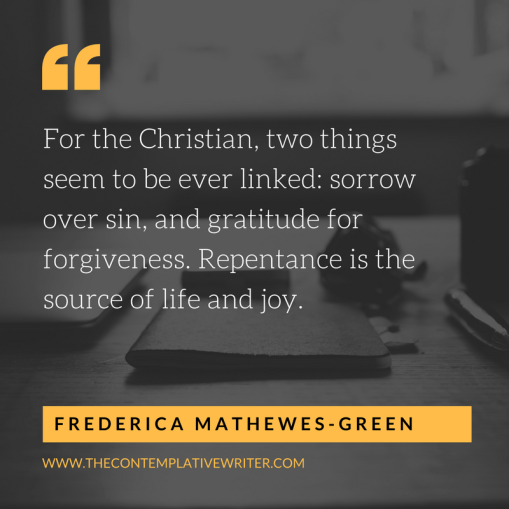
For the Christian, two things seem to be ever linked: sorrow over sin, and gratitude for forgiveness. Repentance is the source of life and joy.

*****

What’s more, repentance enlarges the heart until it encompasses all earthly life, and the sorrow tendered to God is no longer for ourselves alone. Knowing our own sin, we pray in solidarity with all other sinners, even those who hurt us. With all creation we groan, crying out to God for his healing and mercy.

*****

Read more.

For reflection:

Mathewes-Green week 2


BOOK OF THE MONTH: THE ILLUMINED HEART

Week One: Tough Questions

Illumined Heart coverIn The Illumined Heat: Capture the Vibrant Faith of Ancient Christians, Frederica Mathewes-Green shares spiritual practices and wisdom from the ancient Church. I first read this book several years ago, and I thought it was time to revisit it and share some of my favorite parts with you.

As she discusses the early Christians, Mathewes-Green gives us a peek into the life of a fictional fifth-century couple, Anna and Theodore. This is one of my favorite pats of the book, especially when Anna struggles to show love and grace to her mother-in-law.

Mathewes-Green begins with a statement of what we know (intellectually) to be true: in God is life.

Here is communion. In God’s presence we discover ourselves able to love one another, to be vessels of heroic love, even toward our enemies, even unto death. We find all creation in harmony around us, as responsive and fruitful as the Garden was to Adam and Eve. The peace that passes understanding informs our every thought.

*****

If we know that God’s presence is life and love, why don’t we look like we know it? Mathewes-Green asks a whole series of tough questions I find it really good (and uncomfortable) to consider:

Why are we modern Christians so indistinguishable from the world?

*****

How come Christians who lived in times of bloody persecution were so heroic, while we who live in safety are fretful and pudgy?

*****

How could the earlier saints “pray constantly,” while our minds dawdle over trivialities?

*****

How could the martyrs forgive their torturers, but my friend’s success makes me pouty?

*****

In the rest of the book, Mathewes-Green considers how the spiritual practices of ancient Christians might help us as we struggle with our faith. For this week, I invite you to wrestle with the tough questions she asks in the first chapter. What might you answer to some of these questions?

Read more.

For Reflection:

Mathewes-Green week 1 corrected

BOOK OF THE MONTH: THE REVELATIONS OF DIVINE LOVE

Week 3: Prayer as a Way of Life

All Shall Be WellThe Revelations of Divine Love by English anchoress Julian of Norwich is our book of the month. In this spiritual classic, Lady Julian explains why prayer is a good and necessary part of life.

I am drawn to the ways Julian speaks of prayer, always emphasizing our radical dependence on God. I also like the two metaphors she uses in the first passage below – prayer is like an arrow and prayer is like a shelter. These metaphors seem so different, yet they work together to describe the gift of communing with God.


For prayer is like an arrow shot straight toward joy’s completion in Heaven—and prayer is also like a shelter that covers us with the knowledge that we can trust God to grant all for which we yearn. When we fall short of the joy that has been laid out for us, we are filled with longing; but as we cover ourselves with the knowledge of God’s love and with sweet thoughts of our Rescuer, then we are granted the gift of confidence in God’s firm integrity.

*****

For our part, we must take care to always lovingly choose prayer as a way of life. We may still feel as though we have accomplished nothing—but in reality (whether we can see it or not), we have. And if we do what we can and ask with constancy and faithfulness for mercy and grace, then all that we lack we shall find in God.

*****

Prayer makes the soul one with God. Our souls are like God in their essence, and they are connected to God with bonds of kinship—yet because of sin, our way of being is often not much like God’s. That is why we need to use prayer as an affirmation that our souls are aligned with the Divine Will. What’s more, prayer comforts our uneasy consciences and becomes a conduit for grace to flow into us.

*****

 Julian of Norwich (1342 – c. 1416) was an English visionary, mystic, anchoress, and writer. Read about her here.

I’ve been enjoying the Divine Revelations in a modern translation entitled All Shall Be Well.

For reflection:


Julian of Norwich - week 3

BOOK OF THE MONTH: REVELATIONS OF DIVINE LOVE

Week One: Clinging to God’s Goodness

All Shall Be WellIn the late 14th century, the English anchoress Julian of Norwich wrote her influential book, The Revelations of Divine Love. The book is based on a series of visions Julian received, and its stated purpose is to reveal the divine will, which is to love and know God. The Revelations has become a Christian classic for its unique theological and spiritual insights into God’s love.

In her book, Julian has many things to say about prayer. In the first revelation, Julian writes that prayer is more of an attitude than a set of techniques. I find this encouraging, because it means that we don’t have to approach prayer with a lot of bells and whistles. Clinging to the fullness of God is, Julian says, the “truest form of prayer.”

*****

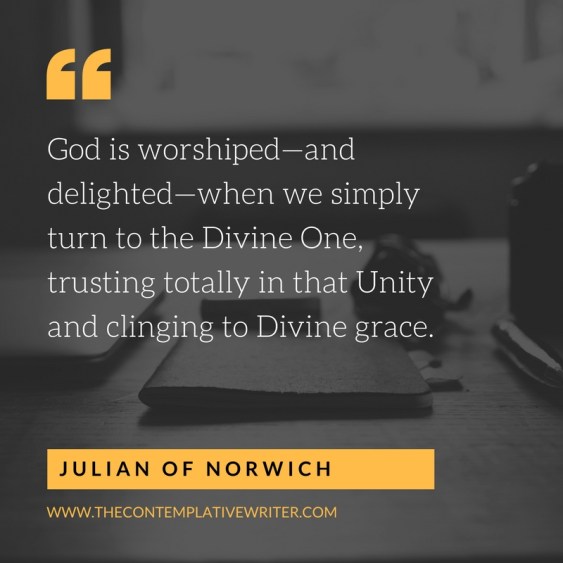
What came to mind next was the way we pray: in our ignorance and incomprehension of love, we use many methods for asking God what we want. But I realized now that God is worshiped—and delighted—when we simply turn to the Divine One, trusting totally in that Unity* and clinging to Divine grace.

*****

Even if we were to practice all the prayer techniques ever used, they would never be enough to connect our souls to God with utter wholeness and fullness, for God’s goodness is the entire whole of reality, a unity that lacks absolutely nothing. By focusing our attention here—on the absolute Unity that never fails—we achieve the truest form of prayer.

*****

Resting in this Unity is the highest prayer, and it reaches down to our deepest needs. It brings our souls to life; it brings us more of life’s fullness; and our lives expand with grace and strength.

*****

*Note: In this edition of the Revelations, Julian’s word “goodness” is translated as “unity” to express the idea of the fullness of God, the way he encompasses every part of creation.

*****

Julian of Norwich (1342 – c. 1416) was an English visionary, mystic, anchoress, and writer. Read about her here.

I’ve been enjoying the Divine Revelations in a modern translation entitled All Shall Be Well.

For reflection:
Julian of Norwich - week 1

CONTEMPLATIVE PROFILE: WRITING WITH HILDEGARD OF BINGEN

Have you ever thought of writing as a duty? The 12th-century German visionary Hildegard of Bingen introduced this idea to me. In the preface to her best-known work, the Scivias, Hildegard describes a series of visions God gave to her. One of these visions included the instruction to write down all that she had seen. But Hildegard hesitated. In the passages below, Hildegard recounts what happened when she refused the duty God gave her to write down her visions:

*****

But I, although I had seen and heard these things, nevertheless because of the doubt and bad opinion and divers remarks of men, refused for a long time the duty of writing, not in obstinacy but in humility, until I fell on a bed of sickness, cast down by the scourge of God, until at length I was compelled to write by many infirmities.

*****

When Hildegard didn’t write, she fell ill! Finally, she began setting down her visions:

*****

I said and wrote [these visions and words] not according to the curious invention of my heart, nor of any man, but as I saw, heard, and perceived them in a heavenly way, through the secret mysteries of God. And again I heard a voice from Heaven saying to me, “Cry aloud therefore, and write thus.”

*****

It took Hildegard of Bingen ten years to write down her visions, and they still inspire and challenge the Church today. Let that be an encouragement if you, like me, are a slow and sometimes reluctant writer.

*****

Hildegard of Bingen (1098-1179) was a Benedictine abbess, a visionary, and a writer. Read a selection of her visions here.

Reflection: Have you ever felt that God has given you the duty to “cry aloud” and write something? Have you ever hesitated or refused?


CONTEMPLATIVE PROFILE: CATHERINE OF SIENA ON CONTEMPLATION AND ACTION

This month we’ve been looking at the letters of the 14th-century mystic and reformer Catherine of Siena. In a letter to a Dominican laywoman, Catherine writes a wonderful passage on the melding of contemplation and action. She doesn’t mince words when describing how Christians are to behave. Loving our neighbor, Catherine says, is the only proper response to God’s love for us:

*****

You know that every virtue receives life from love, and love is gained in love, that is, by raising the eye of our intellect to consider how much we are loved by God . . . Loving God we embrace virtue out of love, and we despise vice out of hatred.

*****

So you see that it is in God that we conceive virtues and in our neighbors that we bring them to birth. You know indeed that you give birth to the child charity that is in your soul in order to answer your neighbor’s need; and that you give birth to patience when your neighbor does you harm. You offer prayer for all your neighbors, and particularly for the one who has wronged you. This is the way we ought to behave . . .

*****

Catherine of Siena (1347-1380) was a member of the Dominican Order of Penance. She was a mystic, a reformer, and an adviser to popes. Her written work includes over 300 letters and a contemplative treatise, The Dialogue. Read more here.

Read Catherine’s letters here.