Blog

How Boundaries Help Our Faith and Families Thrive

A spiritual director once told me that the concept of having “balance” in your life is often unhelpful. If anything, striving for balance creates false expectations and sets us up for failure.

I have personally found it far more helpful to think in terms of words like “intentional,” “boundary,” and “sustainability.” We can find healthy spirituality and healthy relationships by intentionally scheduling our time with clear boundaries. Our relationships and spiritual practices need to be the guarded non-negotiables that we make so easy to pursue that we eventually turn to them as a matter of habit.

That isn’t an easy place to arrive at. I know it’s a struggle each week for me. However, the more I get used to my schedule and the more I set boundaries around my day, the more I can settle into these daily habits.

While I don’t love the title of this Fast Company article about work-life balance, it offers some helpful tips for arranging your priorities and creating healthy habits for your spiritual life and relationships. Here are a few tips to consider:

*****

“People who have managed to carve out a work-life balance that works for them don’t just wait to see what time is left over after work. They make a point of planning and booking time off to spend outside of work and powerfully guard this time. While emergencies happen and situations come up that need their attention at work on occasion, they strongly resist any intrusion on this time.”

*****

“People who maintain balance are able to turn off their electronic devices to enjoy quality uninterrupted time doing matters they enjoy. They realize that multitasking is a myth and focus on the task at hand. Having developed the ability to compartmentalize their time, they seek out moments to simply enjoy the experience and savor life. Often they have discovered meditation, music, physical activity, or some other interest that allows them to get away from the pressures of everyday life…”

* * * * *

One other thing: If you asked me, most people could stand to get rid of their televisions, cancel cable, and see what happens for two months. I suspect you’ll end up having more conversations, reading more books, and having more time enjoyable activities. It’s so crazy that it just may work.

Keep the Contemplative Writer Sustainable

The Contemplative writer is ad-free and never shares sponsored content, but it is a lot of work to maintain. We rely on affiliate links from the books we share and the generous gifts of our readers. An automated monthly gift as low as $1 per month or a one-time gift of $5 goes a long way to sustaining our mission to provide contemplative prayer resources for our readers. Thank you!

Choose a recurring monthly donation:

support-patreon-orange

Make a one-time gift via PayPal (credit cards accepted!)


Donate Now Button

Learn more about how to support us.

Scripture Meditation: How to Restore Your Soul


“He makes me lie down in green pastures; he leads me beside still waters; he restores my soul.”
Psalm 23:2-3a

bible-1440953-1279x852

Meditation

Seasons of weariness are coming. There’s no guarantee that God will shield us from hard times, from weakness, and from souls that desperately need restoration. While we can anticipate draining, difficult seasons, we are assured that God will restore us.

Are we prepared to receive the restoration that comes from God?

Restoration may look like stopping, lying down, and seeking places of peace and stillness. Perhaps we will resist God’s restoration to the point that he will “make” us lie down.

Finding God’s rest takes faith, trusting that God can lead us and sustain us, especially when we stop trying to maintain control. May we have eyes to see the gentle hand of God leading us to restoration.


Reflection

Why have you resisted restoration?

When has your soul grown weary lately?

What does it look like to trust God with restoring your soul today?


Featured Contemplative Book: Immortal Diamond

Week Four: Love

Immortal Diamond by RohrI used to speak of God being apart from myself, but Richard Rohr has helped me look at scripture with new eyes. For instance, Paul writes:

“Set your minds on things that are above, not on things that are on earth, for you have died, and your life is hidden with Christ in God.”
Colossians 3:2-3, NRSV

Our lives are hidden in Christ? In other words, after all of the times I’ve asked God to “show up,” I’ve missed the fact that I’m hidden in Christ. This divine union forms the backbone of Rohr’s writing.

The presence of God we seek and even fear losing because of our imperfections has been among us all along. Even as we reach out for God, God is already holding us. When we fear we are falling away, we are already being held.

May we find comfort today in the loving embrace of God.

Here is the final list of quotes from Immortal Diamond this month.

*****

“It is almost impossible to fall in love with majesty, power, or perfection. These make us fearful and codependent, but seldom truly loving. On some level, love can only happen between equals, and vulnerability levels the playing field. What Christians believe is that God somehow became our equal when he became the human “Jesus,” a name that is, without doubt, the vulnerable name for God.”

*****

“Your False Self is how you define yourself outside of love, relationship, or divine union. After you have spent many years laboriously building this separate self, with all its labels and preoccupations, you are very attached to it. And why wouldn’t you be? It’s what you know and all you know. To move beyond it will always feel like losing or dying…”

*****

“Longing for God and longing for our True Self are the same longing. And the mystics would say that it is God who is even doing the longing in us and through us…”

*****

“The Risen Christ is the standing icon of humanity in its final and full destiny. He is the pledge and guarantee of what God will do with all of our crucifixions. At last, we can meaningfully live with hope. It is no longer an absurd or tragic universe. Our hurts now become the home for our greatest hopes.”

*****


Keep in Touch

Get our latest blog posts delivered to your inbox or sign up for the weekly contemplative email and receive a free eBook: The Contemplative Writer.


For Reflection or Sharing

Even as we reach out for God, God is already holding us.

Week 4 Featured book April 25 2016


Saturday Prayer: The Prayer for Spiritual Freedom

Today’s prayer comes from the Ignatian Spirituality website:

O Spirit of God, we ask you to help orient
all our actions by your inspirations,
carry them on by your gracious assistance,
that every prayer and work of ours
may always begin from you
and through you be happily ended.

This prayer is often shared before meetings and gatherings. Learn more about Ignatian spirituality here.

Friday Favorites for Prayer and Writing

Each Friday I share some of my favorite finds related to praying or writing. If I think it could help you pray or write better, then I’ll include it below.

Do you have someone else’s article or post to share? Join the Contemplative Writers Facebook group, comment on today’s post on my Facebook page, or follow me on Twitter (@edcyzewski) to nominate your favorite articles, blog posts, and books by Thursday at noon each week.

Letting Myself Be Known by Nicole Walters

How Even the Busiest People Find Time to Pray by Rev. James Martin

Community Lectio Divina via Abbey of the Arts (@abbeyofthearts)


Looking for more recommendations? Check out our Prayer Resources page.

Contemplative Profiles: The Female Mystics of the Middle Ages

In the past I have made the mistake of ignoring the spiritual teachings of the Middle Ages, missing out on the rich contemplative practices that were documented at great personal cost. Dr. Elizabeth Alvilda Petroff notes in an article in Christianity Today that women were often denied educations in the Middle Ages, so their religious communities took on a more contemplative, creative, and spiritual shape, while many religious men leaned toward theological reflection.

This resulted in a unique spirituality from women who experienced the love of God in rich and vibrant encounters. Perhaps the simplicity of their spirituality became their greatest strength. While some female mystics from this time were supported by the church hierarchy, many wrote down their accounts and visions despite heated opposition, risking persecution and even death at the hands of controlling church leaders.

Dr. Elizabeth Alvilda Petroff writes about female mystics for Christianity Today:

*****

We think of the Middle Ages as the age of faith, and so it was, but it was also an age of crisis. In such a context, mysticism was not a retreat from the negative aspects of reality, but a creative marshaling of energy in order to transform reality and one’s perception of it.

Mystics were the teachers of the age, inspired leaders who synthesized Christian tradition and proposed new models for the Christian community. We know some of the men—Bernard of Clairvaux, Francis of Assisi, Thomas Aquinas—but we are not as familiar with the women, although they were actually more numerous. Hildegard of Bingen, Clare of Assisi, Beatrijs of Nazareth, Angela of Foligno, Julian of Norwich, and other women mystics drew on their experience of the divine to provide spiritual guidance for others. Such women became highly respected leaders of the faithful. Their role as prophets and healers was the one exception to women’s presumed inferiority in medieval society.

*****

She goes on to write:

*****

Dame Julian of Norwich said in her Showings: “ … God forbid that you should say or assume that I am a teacher … for I am a woman, ignorant, weak and frail. But I know very well that what I am saying I have received by the revelation of him who is the sovereign teacher … because I am a woman, ought I therefore to believe that I should not tell you of the goodness of God, when I saw at that same time that it is his will that it be known?”

*****

As we honor their legacy, learn from their wisdom, and embody their practices, may we have the courage to share with others the ways God has spoken to us.


Reflection

Take 5 minutes to ask God what you need to receive today.

Remain open to sharing that with someone else if appropriate.


Can Mindfulness Training Help You Pray?

How can I focus better when I pray?

Try practicing mindfulness.

Bookshelf-BarnImages.com-1

Mindfulness has long been practiced by Christian contemplatives from their days in the desert caves to the monasteries of Europe to John Wesley’s holiness club. You can find mindfulness in just about every religion, no one can claim this practice exclusively, and it’s even back by solid science. It’s also becoming increasingly popular in non-religious settings.

Those who teach mindfulness training in elementary schools note that simple meditation practices help our brains settle down so that we can focus on the present moment and the tasks before us. Perhaps Christians make the mistake of associating “mindfulness” practices with “Eastern” religions (I won’t get into whether Christianity is actually an Eastern religion or not… Ha.). The truth is that mindfulness can prove extremely useful for prayer.

Let’s begin with a look at what researchers have to say:

First we have to practice things deliberately, and then what happens — just like learning to play the piano or something like that — we practice and then with enough practice it becomes a habit. And the habits become character traits after a while.”

The most common complaint he hears from teachers (who are choosing MindUP as their professional development) is that they don’t have time for an extra program, the curriculum is already too big and hard to cover. Weresch sympathizes with that argument, but tells them that in his own experience the time spent on the front end tremendously improved the quality of learning throughout the day…

Teachers noticed benefits within a few weeks of practicing mindfulness in the classroom:

The real shifts in school culture came when they started implementing the program school-wide. Teachers now start class in the morning with a few breaths to help students feel present. The middle school has breathing exercises after passing periods. Penley described how kindergarteners used to come into their classroom for free breakfast while their teacher was already directing them to look at what she’d written on the board. Students were having a hard time learning that way because they didn’t feel settled or safe.

Now, teachers greet kids at the door and play soft music with the lights down; they talk about the practices the whole school is working on at that moment. In this low key environment, the teacher is taking roll and checking in on students.

Our environments matter. What we think about matters. The emotions we are feeling need to be detected and acknowledged.

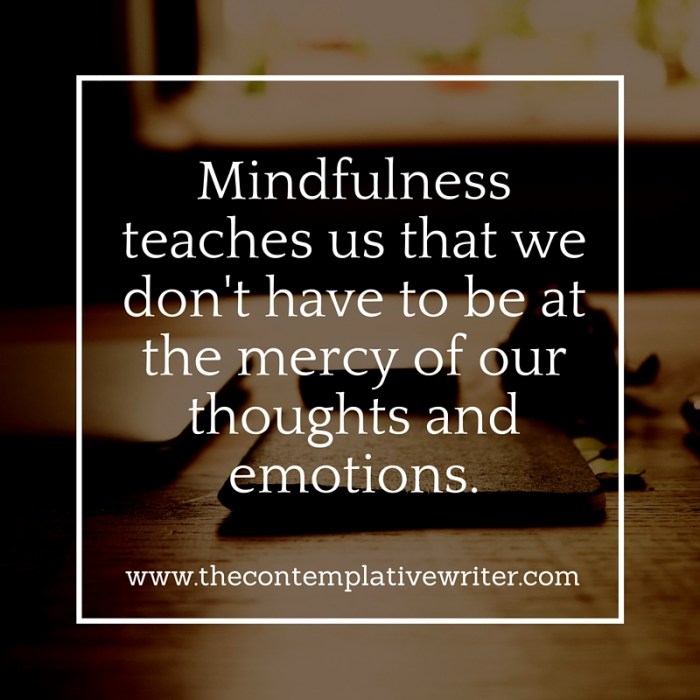
Mindfulness teaches us that we don’t have to be at the mercy of our thoughts and emotions. We can become aware of what we are thinking and feeling. We can take deep breaths and focus on the immediate moment rather than the future or the past.

Most importantly, in the context of prayer and contemplation, we become aware of our thoughts and emotions in order to pray with greater clarity. Paul writes about taking every thought captive to obey Christ (2 Corinthians 10:5), and the simple practice of mindfulness helps us become aware of our thoughts and how they impact us. How else can we take thoughts captive if we don’t see them with complete clarity?

* * * * *

For Reflection

Copy of Meditation April 20 2016


* * * * *

Keep the Contemplative Writer Sustainable

The Contemplative writer is ad-free and never shares sponsored content, but it is a lot of work to maintain. We rely on affiliate links from the books we share and the generous gifts of our readers. An automated monthly gift as low as $1 per month or a one-time gift of $5 goes a long way to sustaining our mission to provide contemplative prayer resources for our readers. Thank you!

Choose a recurring monthly donation:

support-patreon-orange

Make a one-time gift via PayPal (credit cards accepted!)


Donate Now Button

Learn more about how to support us.


Scripture Meditation: You Are a Beloved Gift from God


Create in me a clean heart, O God, and renew a right spirit within me.
Psalm 51:11


Meditation

bible-1440953-1279x852Spirituality and holiness are gifts from God. Existence alone is a gift. From the mud that shaped us to the breath that God breathed into our lungs, we are beloved creations of God. God isn’t done creating us either.

As we seek to live in the wholehearted freedom of God’s Kingdom, we can’t “create” our own clean hearts. Breaking us free from sin and guiding us into a life of love and service is a creative act of God.

The harder I work to create a clean heart, the more likely I am to judge others and, most importantly, to fail. A clean heart and right spirit received from God as a pure gift is humbling and effective.

Those who recognize the depths of God’s mercy live with gratitude and generosity, recognizing that all people are either in need of this gift. May God’s creativity reshape our lives and shape a right spirit for others.

Reflection

Do you imagine God giving you a gift of a clean heart or demanding a clean heart from you?

What does it look like to trust God to create a clean heart in you?

Meditate on this today: I am a beloved gift from God.


Featured Contemplative Book: Immortal Diamond

Week Three: Transformation

Immortal Diamond: the search for our true selfIt’s one thing to realize that we have been living out of a false self, but it’s quite another matter to allow God to transform us with the affirmation of his love. Too much of our unhealthy religious practice focuses on what we should not do or not be rather than what we should become.

Healthy religious practices detect and remove the obstacles and distractions that keep us from God’s loving and affirming presence. Our tools are spare and simple with practices such as:

  • Bracing honesty
  • A quiet mind
  • A heart turned toward God

Spiritual masters such as Jeanne Guyon often noted that we enter into prayer by simply turning our attention toward God. That act alone is a prayer, and it is a prayer that we can gradually build on.

As we learn to turn toward God, we’ll find our identities gradually transformed by God’s love and presence. Richard Rohr shares some particularly helpful quotes and insights in Immortal Diamond.


*****

“Our ongoing curiosity about our True Self seems to lessen if we settle into any successful role. We have then allowed others to define us from the outside, although we do not realize it… Thomas Merton said, ‘If I had a message to my contemporaries it is surely this: Be anything you like, be madmen, drunks, and bastards of every shape and form, but at all costs avoid one thing: success. If you are too obsessed with success, you will forget to live. If you have learned only how to be a success, your life has probably been wasted.’ Success is hardly ever your True Self, only your early window dressing.”

*****

On incarnational religion and Spirit-based morality: “You do things because they are true, not because you have to or you are afraid of punishment. Henceforth you are not so much driven from without (the False Self method) as you are drawn from within (the True Self method). The generating motor is inside of you now instead of a whip or a threat outside.”

*****

“God tries to first create a joyous yes inside of you, far more than any kind of no . . . Just saying no is resentful dieting, whereas finding your deeper yes, and eating from that table, is always a spiritual banquet.”

*****


Keep in Touch

Get our latest blog posts delivered to your inbox or sign up for the weekly contemplative email and receive a free eBook: The Contemplative Writer.


For Reflection or Sharing

Week 3 Featured book April 20 2016

Saturday Prayer: The Prayer of St. Patrick

Today’s prayer comes from the anonymous prayer that some have attributed to St. Patrick:

I arise today
Through the strength of heaven;
Light of the sun,
Splendor of fire,
Speed of lightning,
Swiftness of the wind,
Depth of the sea,
Stability of the earth,
Firmness of the rock.

I arise today
Through God’s strength to pilot me;
God’s might to uphold me,
God’s wisdom to guide me,
God’s eye to look before me,
God’s ear to hear me,
God’s word to speak for me,
God’s hand to guard me,
God’s way to lie before me,
God’s shield to protect me,
God’s hosts to save me
Afar and anear,
Alone or in a mulitude.

Christ shield me today
Against wounding
Christ with me, Christ before me, Christ behind me,
Christ in me, Christ beneath me, Christ above me,
Christ on my right, Christ on my left,
Christ when I lie down, Christ when I sit down,
Christ in the heart of everyone who thinks of me,
Christ in the mouth of everyone who speaks of me,
Christ in the eye that sees me,
Christ in the ear that hears me.

I arise today
Through the mighty strength
Of the Lord of creation.

Source: BeliefNet