Welcome to Friday Favorites! We’re happy to bring you these links by some wonderful writers and thinkers and hope they’ll add beauty and encouragement to your day.
Last week at the gas station, a man I didn’t know approached me at the pump and asked me if I could give him some change to help him fill up his car. “I’m running short on money this week,” he said.
At first I said no. I was startled… strangers don’t usually approach me at the gas pump. And I thought all the thoughts that often go through our mind in these situations. What if he’s not a good person? What will he really do with the money?
But then, as the fuel pumped into my car, the truth pumped into me. My response to this man wasn’t right. Maybe I didn’t know who he was, but I knew what he was. He was a pilgrim.
The Wife of Bath from Chaucer’s Canterbury Tales, ca. 1405
We might think of pilgrims as people from another time with a penchant for funny hats (I write about some of these people in my new book). Or perhaps as folks with backpacks walking the Camino de Santiago in Spain. Yet these images we have—that I have—can blind us to the fact that not all pilgrims are distant historical figures or travelers on faraway paths. Sometimes, they’re people like you and me; people on life’s journey who can’t make it alone.
In simple terms —
Pilgrims are strangers— That person you just met or who just asked you for help may be unknown to you, but their very “strangeness” makes them a pilgrim. In Roman times, a peregrinus, the Latin word from which we get “pilgrim,” was someone “not from these parts.” It was a legal term. The Bible teaches that Christians are pilgrims because we’re not from these parts, either. (Heb 11:13) We don’t belong to the world and its ways. We’re all strangers here.
Pilgrims are travelers — In the Middle Ages, peregrinus morphed to mean someone on a journey, usually one of sacred import. Have you encountered any travelers lately? Maybe someone fueling up at the pump next to yours? Or someone on a difficult path through life? Every person is on his way somewhere—or trying to be, if he gets a tank of gas.
Pilgrims are needy — Historically, pilgrims often traveled in desperate circumstances. Medieval pilgrims frequently were ill or were atoning for sin or crimes. Many arrived at their destination completely broke, relying on others to help them and even to keep them alive. That day at the gas station, I was charged to help a pilgrim in need. The next time, it might be me who needs help.
Although I hesitated at first, I walked over to the pilgrim after filling my tank. He was standing beside his car and running his fingers through his hair in a gesture of utter despair (he must have coasted in on fumes). I did what I could for him. It wasn’t much because I didn’t have much to give. But then another man walked over and also gave some money. I hope that enabled the pilgrim to get further down the road.
Having studied pilgrimage for so long, I’m chastened that I had to remind myself to help. What I needed, and what I got, was a lesson that brought my studies down to earth. Pilgrimage teaches us about our biblical identity as people on our way to the heavenly country. In practical terms, it means that we welcome the stranger and help one another on our long journey home.We are all pilgrims, and we need each other. No one walks – er, drives – alone.
Preparing for the season of Lent, we pray with Henri Houwen:
Help me, O Lord, to let my old self die, to let die the thousand big and small ways in which I am still building up my false self and trying to cling to my false desires. Let me be reborn in you and see through you the world in the right way, so that all my actions, words, thoughts can become a hymn of praise to you.
I need your loving grace to travel on this hard road that leads to the death of my old self and to a new life in and for you. I know and trust that this is the road to freedom.
Lord, dispel my mistrust and help me become a trusting friend.
I’m always hooked by articles about becoming a more efficient writer. Most of them don’t disappoint: they’re full of good practical tips – for example, stay focused, avoid negative self-talk, find your best time of day to work, and so on.
The other day, while thinking about this issue, I looked up the word “efficient” and read the following definition: maximum productivity with minimum wasted effort. I have to say that it made me shudder. It made me think I don’t want to be an efficient writer after all.
The fact is, I am not productive to the max in the sense of being prolific. I’m not able to churn out books and articles one after the other, no matter how often I write at my best time of day. It takes time for my ideas to steep, like tea leaves having a long soak to produce the richest flavor. Sometimes, I put a piece of writing aside for a while. I daydream a lot. I rest.
Here’s a confession: I just released a book, and I don’t have a new book proposal ready to go out. I don’t even have one in the works. I feel like I should, but I just don’t. I need a little time to lie fallow.
But in the end, I’m not too bothered by this because Ibelieve that steeping and daydreaming and waiting are key parts of the writing process. I’m going to go a step further and say that I’m being productive when I engage in these activities. Simply put, they help me produce. My writing will not go where I want it to go without them.
A few years ago, author Leslie Leyland Fields wrote a post entitled “The Slow-Writing Revolt.” Her words resonate with my thoughts about efficiency (or the lack thereof). She encourages writers to “slow down. M a r i n a t e. Wait. Sometimes even—stop. Sometimes even—say No.” Leyland Fields calls it “marinating” while I call it “steeping,” but the idea is the same. It takes time for the good stuff to come.
I recently talked with Jonathan Rogers of The Habit podcast, and during our conversation he said something very interesting: Being too efficient can stifle creativity. Going straight for that one source you’ve pinpointed for your project means that you may miss other sources and ideas along the way. One of the best ways to aid new discoveries is wandering the stacks in a library. I did this many times during my graduate studies at the University of Chicago. On my way to a particular book, I took the time to let my eye wander over nearby book titles and discovered valuable information I wouldn’t have found any other way. It was time consuming but completely worth it.
Fellow writers, be encouraged that inefficiency is a virtue. Steeping and daydreaming and resting are legitimate parts of the writing process. Even if words aren’t flowing from the pen (or marching across the computer screen), things are likely happening behind the scenes, in your heart and mind.
A couple caveats:
Please note that I’m distinguishing steeping from procrastination. They are very different things. Don’t procrastinate—even though I do it all the time.
I understand that the need for a paycheck may complicate my arguments. Sometimes a writer may have to be efficient to put bread on the table. But I still think all writers should take time to daydream and wander through their mind palaces.
I summarized my points in this list – The 7 Habits of Highly Inefficient Writers
Steep (your ideas) – let them develop a rich flavor
Wait – it’s ok to put your project aside for a better time
Daydream – get lost in your mind palace and dream up new ideas for your writing
Rest – fill the well by taking time off when you need it
Wander (the library stacks) – see what you discover by exploring with no particular goal in mind
Say no – feel free to decline a writing project if it’s not the right one or the right time
Live life – writing is intertwined with life, so don’t hesitate to enjoy your friends and loved ones, laugh, and be fully engaged in all the pleasures and responsibilities of daily life
A Prayer from Saint Thérèse of Lisieux (1873-1897):
I have no other means of showing you my love than by throwing flowers, that is, of not allowing one little sacrifice to escape, not one look, not one word, but by profiting from all the smallest things and doing them out of love . . .
I want to suffer for love and even to rejoice for love so that in this way I will throw flowers before your throne. I shall not come upon one without unpetalling it for you . . .
Then while I am throwing my flowers, I shall sing (for could one cry when doing such a joyous thing?). I will sing, even when I have to gather my flowers in the midst of thorns, and my song will be all the more melodious when the thorns are longest.
It’s time for Friday Favorites! Find prayer, hope, healing — and encouragement to keep writing and creating no matter your circumstances — in this week’s collection of posts and podcasts.
Whatever Tomb You’re In via Tammy Perlmutter (although all may seem lost, your rescue is already in play)
Making Christians Great Again via Leslie Leyland Fields (“This leader is like no other. He bent like a slave to wash His people’s feet. He chose our lashes instead of His power…”)
My book on pilgrimage releases next week! And because I have pilgrimage on the brain, I wanted to share an article I wrote a few years ago for Epikeia Magazine. The article shows how pilgrimage can become an intensely personal journey to the heart of our faith. I hope it opens the gate to a journey of your own.
***
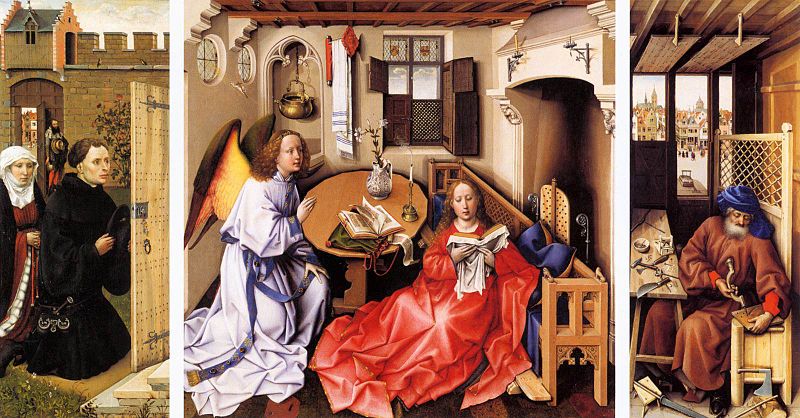
A few years ago, in New York for a conference, I made a pilgrimage to The Cloisters museum and gardens. I use the term “pilgrimage” advisedly. Like a medieval traveler going to a shrine, I went to see a sacred object—the painting known as the Merode Altarpiece by Flemish artist Robert Campin. From Midtown, the Cloisters was enough out of the way to make the journey a little difficult, the gratification a bit delayed. The museum’s medieval setting enhanced my sense of sacred purpose.
Once at the Cloisters, I discovered that Campin’s painting has its own gallery, called the Merode Room. I made straight for it. At the time of my visit, the altarpiece hung above a medieval bench opposite the gallery entrance. By some miracle, the room was empty. The painting beckoned me forward, and I walked toward it as to an altar…
Before writing, preaching, and perhaps even blogging, we all need to pray. So today, I’m featuring a prayer before writing from Saint Thomas Aquinas (1225 – 1274), a Dominican friar, theologian, and Doctor of the Church. Aquinas’s Feast Day is January 28.
***
O Creator of the universe, who has set the stars in the heavens and causes the sun to rise and set, shed the light of your wisdom into the darkness of my mind. Fill my thoughts with the loving knowledge of you, that I may bring your light to others. Just as you can make even babies speak your truth, instruct my tongue and guide my pen to convey the wonderful glory of the Gospel. Make my intellect sharp, my memory clear, and my words eloquent, so that I may faithfully interpret the mysteries which you have revealed.
Welcome to Friday Favorites! As we come to the end of another eventful week in an already eventful year, enjoy these posts that bring us poetry, the timelessness and constancy of God, and the pursuit of God’s voice.







 The Contemplative Writer