Blog

FRIDAY FAVORITES FOR PRAYER AND WRITING

Each Friday I share some of my favorite finds related to praying or writing. If I think it could help you pray or write better, or just “be” better, I’ll include it below. This week’s finds tend more toward spirituality than writing; some weeks are just like that.

Do you have someone else’s article or post to share? Join the Contemplative Writers Facebook group, comment on today’s post on my Facebook page, or follow me on Twitter (@LisaKDeam) to nominate your favorite articles, blog posts, and books by Thursday at noon each week.

*****

12 Best Practices for Finding Time, Energy, and Inspiration to Write + A Prayer for Writers via Sarah Bessey (notes from Sarah’s workshop at the Princeton Theological Seminary’s Frederick Buechner Writer’s Workshop)

Franciscan Spirituality: Week 1 via Richard Rohr (on St. Francis, a “second Christ”)

Putting on the Mind of Christ via Chuck DeGroat (what is “unknowing” and how does it relate to putting on the mind of Christ?)

The Wonder Of It All via Sharon Brani (finding God in the beauty of the cosmos; after you read this essay, check out the entire June issue of The Redbud Post on finding God in creation)

Meditation Monday: Rest In The Peace Beyond Understanding via Christine Sine (how to journey peacefully amidst life’s challenges)

Exploring Summer Sabbath via Whitney R. Simpson (soul care tips for your summer)

Books Can Keep You Stitched Together via Velynn Brown (on the power of story and books as friends)


CONTEMPLATIVE PROFILE: WALTER HILTON

In last week’s post, we saw that the English mystic Walter Hilton likened prayer to fire. He continues this analogy in a letter to a layperson. He writes a beautiful description of what he calls the “mixed life:” a life marked by a rhythm of labor and prayer.

[T]he will and desire you have toward God is like a little coal of fire in your soul. It gives you a certain amount of spiritual heat and even light, but it is quite little, and threatens to grow cold in idleness and want of fuel. At that point it is good that you should put against it some sticks of wood—good labors of the active life. And if it seems for a time that these duties shroud or overshadow the coal of your desire, that it does not burn as cleanly and fervently as you would want, then do not be fearful, but rather be patient awhile.


Then blow at the fire—after doing your proper duties and service, go alone to your prayer and meditation, and lift up your heart to God, praying him of his goodness that he will accept the work that you have done as unto his pleasure.

I’m encouraged by Hilton’s conviction that the active life is a way to serve God.

Source.

Walter Hilton (c. 1340 – 1396) was an Augustinian canon and a mystic. He was the first person to write a treatise on mysticism in the English language.

WEEKLY PRAYER

A prayer from St. Ignatius of Loyola (1491 – 1553)

Take, Lord, and receive all my liberty,
my memory, my understanding
and my entire will,
All I have and call my own.

You have given all to me.
To you, Lord, I return it.

Everything is yours; do with it what you will.
Give me only your love and your grace,
that is enough for me.

Source


BOOK OF THE MONTH: REVELATIONS OF DIVINE LOVE

Week One: Clinging to God’s Goodness

All Shall Be WellIn the late 14th century, the English anchoress Julian of Norwich wrote her influential book, The Revelations of Divine Love. The book is based on a series of visions Julian received, and its stated purpose is to reveal the divine will, which is to love and know God. The Revelations has become a Christian classic for its unique theological and spiritual insights into God’s love.

In her book, Julian has many things to say about prayer. In the first revelation, Julian writes that prayer is more of an attitude than a set of techniques. I find this encouraging, because it means that we don’t have to approach prayer with a lot of bells and whistles. Clinging to the fullness of God is, Julian says, the “truest form of prayer.”

*****

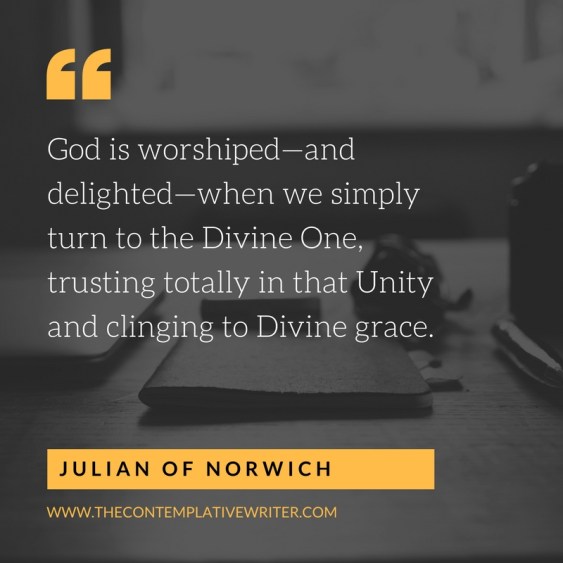
What came to mind next was the way we pray: in our ignorance and incomprehension of love, we use many methods for asking God what we want. But I realized now that God is worshiped—and delighted—when we simply turn to the Divine One, trusting totally in that Unity* and clinging to Divine grace.

*****

Even if we were to practice all the prayer techniques ever used, they would never be enough to connect our souls to God with utter wholeness and fullness, for God’s goodness is the entire whole of reality, a unity that lacks absolutely nothing. By focusing our attention here—on the absolute Unity that never fails—we achieve the truest form of prayer.

*****

Resting in this Unity is the highest prayer, and it reaches down to our deepest needs. It brings our souls to life; it brings us more of life’s fullness; and our lives expand with grace and strength.

*****

*Note: In this edition of the Revelations, Julian’s word “goodness” is translated as “unity” to express the idea of the fullness of God, the way he encompasses every part of creation.

*****

Julian of Norwich (1342 – c. 1416) was an English visionary, mystic, anchoress, and writer. Read about her here.

I’ve been enjoying the Divine Revelations in a modern translation entitled All Shall Be Well.

For reflection:

Julian of Norwich - week 1

FRIDAY FAVORITES FOR PRAYER AND WRITING

Each Friday I share some of my favorite finds related to praying or writing. If I think it could help you pray or write better, or just “be” better, I’ll include it below.

I found so many good articles and posts this week: some deeply spiritual, some funny, some practical the internet was on fire, it seemed! If you have someone else’s article to nominate, be sure to let me know next week before noon on Thursday.

*****

Laser Listening: Paying Attention from Inside Out (an interview with author Adam S. McHugh)

Liturgical Meditations: Pentecost (a video meditation from Fuller Studio)

I want to be all flame via Morgan Guyton (on becoming overwhelmed by the brilliance of God)

This Is the Place via Carolyn Arends (a video reflection on the intersection of spirituality, music, and songwriting)

Prayer for a New Day of Promise and Opportunity via April Yamasaki (“The day lies before us like a page waiting to be written . . .”)

Finding God in Fairytales via Tanya Marlow (how stories, imagery, and faraway worlds help us connect with God)

Getting to the Core of Your Distractions via C. S. Lakin (identifying what most distracts you and keeps you from being productive)

The Writer’s Process via Hallie Cantor (hilarious . . . because if you don’t laugh, you’ll cry)

CONTEMPLATIVE PROFILE: PRAYING WITH WALTER HILTON

I love the vivid images medieval mystics use to describe God and prayer. A case in point is the writing of the English mystic Walter Hilton. In his treatise providing instruction on prayer and the contemplative life, Hilton writes a beautiful passage likening prayer to fire:

*****

If you pray in this way, you can pray well: for prayer is nothing else than a mounting desire of the heart into God through withdrawal from every earthly thought. And this is why it is compared with a fire, which by its own nature mounts from the earth, always up into the air. In just the same way, your desire in prayer, when it is touched and illumined by that spiritual fire which is God, by nature always mounts to Him from Whom it came.

*****

Notice that Hilton, in the last line of the passage, emphasizes that our desire to pray to God always comes from God.

*****

Source.

Walter Hilton (c. 1340 – 1396) was an Augustinian canon and a mystic. He was the first person to write a treatise on mysticism in the English language.


We All Need Time To Dream

One day, my daughter was frustrated because she was trying to write some song lyrics and could not make the words come. I suggested she go do something else for awhile. Later, when she was bopping down the hallway and thinking about other things—things related to but not directly about her song—she found the words she was looking for. When she wasn’t being “productive,” productivity came.

This phenomenon is addressed in an article in Collaborative Fund: The Advantage Of Being A Little Underemployed. I was put off by the title (that’s a story for another time), but I resonated strongly with the author’s main idea: if you’re in a “thought job,” you need unstructured time to wander, think, be curious, and dream. Sitting at a desk for hours on end isn’t always the best road to getting things done.

The article mostly addresses office jobs that have scheduled hours, but I think it also applies to my own non-office, writerly kind of work. If I force myself to churn out articles, blog posts, or book chapters, I often get stuck. If I give myself time to step back and wander off, I can see my way through. In fact, the the best part of my day or week is when I don’t make progress on a particular writing project but spend some time dreaming about the big questions I’m trying to answer or about new projects I want to tackle. Is it the same with you?

The Collaborative Fund article begins with some history of the current 40-hour work week and concludes:

Since the constraints of physically exhausting jobs are visible, we took decisive action when things weren’t working, like the Adamson Act. But the limits of mentally exhausting jobs are nuanced and less visible, so we get trapped in a spot where most of us work a schedule that doesn’t maximize our productivity, yet we do nothing about it.

*****

Then we hear the research and theory behind time-away-from-work or less structured work days:

Not all jobs require creativity or critical thinking. But those that do function better with time devoted to wandering and being curious, in ways that are removed from scheduled work but actually help tackle some of your biggest work problems.

*****

The “larger questions” often can’t be tackled at work, because creativity and critical thinking require uninterrupted focus – like going for a walk or sitting quietly on a couch by yourself. Or a bike ride. Or talking to someone outside your field.

*****

Since the butt-in-chair kind of productivity is so ingrained in our culture, we have to be intentional about building unstructured time into our day.

How do you work when you’re not actually working?

Read the article here.

WEEKLY PRAYER

This week’s prayer is from the Liturgy of St. Mark (2nd century):

O Soverign and almighty Lord, bless all thy people, and all thy flock. Give thy peace, thy help, thy love unto us thy servants, the sheep of thy fold, that we may be united in the bond of peace and love, one body and one spirit, in one hope of our calling, in thy divine and boundless love.

Source.

FRIDAY FAVORITES FOR PRAYER AND WRITING

Each Friday I share some of my favorite finds related to praying or writing. If I think it could help you pray or write better, or just “be” better, I’ll include it below.

Do you have someone else’s article or post to share? Join the Contemplative Writers Facebook group, comment on today’s post on my Facebook page, or follow me on Twitter (@LisaKDeam) to nominate your favorite articles, blog posts, and books by Thursday at noon each week.

*****

A ‘Fully Human Solution’ to War: Thomas Merton on Christian Nonviolence via Greg Hillis (Thomas Merton on peace and dialogue)

Summer Book Club: The Brothers Karamozov via Chris Fann (an opportunity to read a great book with D. L. Mayfield and the Off the Page community)

3 Contemplative Practices That Will Improve Your Writing via Phileena Heuertz (a repost from January with restorative practices for the writing life)

When Money, Fame, and Admiration Aren’t Enough via Shawn Smucker (asking difficult questions about what writers really want)


CONTEMPLATIVE PROFILE: WRITING WITH HILDEGARD OF BINGEN

Have you ever thought of writing as a duty? The 12th-century German visionary Hildegard of Bingen introduced this idea to me. In the preface to her best-known work, the Scivias, Hildegard describes a series of visions God gave to her. One of these visions included the instruction to write down all that she had seen. But Hildegard hesitated. In the passages below, Hildegard recounts what happened when she refused the duty God gave her to write down her visions:

*****

But I, although I had seen and heard these things, nevertheless because of the doubt and bad opinion and divers remarks of men, refused for a long time the duty of writing, not in obstinacy but in humility, until I fell on a bed of sickness, cast down by the scourge of God, until at length I was compelled to write by many infirmities.

*****

When Hildegard didn’t write, she fell ill! Finally, she began setting down her visions:

*****

I said and wrote [these visions and words] not according to the curious invention of my heart, nor of any man, but as I saw, heard, and perceived them in a heavenly way, through the secret mysteries of God. And again I heard a voice from Heaven saying to me, “Cry aloud therefore, and write thus.”

*****

It took Hildegard of Bingen ten years to write down her visions, and they still inspire and challenge the Church today. Let that be an encouragement if you, like me, are a slow and sometimes reluctant writer.

*****

Hildegard of Bingen (1098-1179) was a Benedictine abbess, a visionary, and a writer. Read a selection of her visions here.

Reflection: Have you ever felt that God has given you the duty to “cry aloud” and write something? Have you ever hesitated or refused?