Blog

CONTEMPLATIVE HISTORY: BEATRIJS OF NAZARETH

Beatrijs of Nazareth (c. 1200 – 1268), a Flemish Cistercian nun, was prioress of the Abbey of Our Lady of Nazareth in Brabant (present-day Belgium). She is often studied in the context of the beguine movement since she received her education from beguines before becoming a nun. In the mid-thirteenth century, Beatrijs wrote The Seven Manners of Loving, a mystical treatise that describes the soul advancing in love for God.

I’m drawn to the striking imagery that mystics often use to describe spiritual growth. Beatrijs of Nazareth does not disappoint! In one passage of her treatise, she likens the soul to a housewife putting everything in order. Although housework seems down to earth, it characterizes a very advanced kind of love in Beatrijs’s treatise.

In the sixth manner, as the bride of our Lord advances and climbs into greater holiness, she feels love to be of a different nature, and her knowledge of this love is closer and higher.

The soul has advanced this far because she has prepared her house for love . . .

And you may see that now the soul is like a housewife who has put all her household in good order and prudently arranged it and well disposed it; she has taken good care that nothing will damage it, her provision for the future is wise, she knows exactly what she is doing, she acquires and discards, she does what is proper, she avoids mistakes, and always she knows how everything should be.

I suppose that calling anyone or anything a “housewife” sounds a little out of date today. I wouldn’t want to be called that! And Beatrijs’s standards for housework seem impossibly high. But I do like the image of the soul bustling around preparing and making room for love.

The rewards of this spiritual work are great. When the inner house is ready, love moves in, and the soul is able to have a “close comprehension of God.”

And then love makes the soul so bold that it no longer fears man nor friend, angel or saint or God himself in all that it does or abandons, in all its working and resting. And now the soul feels indeed that love is within it, as mighty and as active when the body is at rest as when it performs many deeds.

Does Beatrijs’s household imagery resonate with you? Can you picture your soul bustling around preparing an inner home for love? For more examples of this kind of imagery in medieval devotional literature, see the post Finding Christ in the Kitchen by Louise Campion.

For more on Beatrijs of Nazareth, see, among other sources, Medieval Women’s Visionary Literature by Elizabeth Alvilda Petroff.

FRIDAY FAVORITES FOR PRAYER AND WRITING

Each Friday I share some of my favorite finds related to praying or writing. If I think it could help you pray or write better, or just “be” better, I’ll include it below.

Do you have someone else’s article or post to share? Join the Contemplative Writers Facebook group, comment on today’s post on my Facebook page, or follow me on Twitter (@LisaKDeam) to nominate your favorite articles, blog posts, and books by Thursday at noon each week.

*****

Resting Takes a Lot of Work? via Ed Cyzewski (Why is rest so much work?? Read Ed’s take.)

The Spiritual Practice of Honoring Milestones via Jean Wise (honoring the stones along the path of life)

For the Well-Seekers via Caris Adel (“there is a place for you, where your words are wanted, where your feelings are not too much, where the loneliness can be abated.”)

The Belly of the Whale via Richard Rohr (the way of descent in the spiritual life)

Are You Real? via Seth Haines (in a digital world, what does it mean to be real?)

The Adventurous World of Medieval Maps via Lisa Deam (on the Spark My Muse podcast, I am interviewed about medieval maps as guides for our spiritual journey)

State of the Blog Union via Tsh Oxenreider (what does the changing world of blogging mean for you, your writing, and your voice?)

Tweet of the week:


FEATURED ARTICLE: Every Christian is a Mystic

This article in Seedbed is a couple years old, but it’s one of my favorite pieces of writing on Christian mysticism. Why? Because it takes some of the mystery out of mysticism. We often think that a mystical experience must be ecstatic, perhaps involving tears and visions. Or that it’s the preserve of a very saintly kind of person.

Donald Richmond, a clergyman and a Benedictine oblate, explains that this is not the case. Mysticism is not only practical but also essential to a vibrant, everyday faith   it “is central to the revealed religion of the Bible.” Every Christian who longs to encounter God, who wants her faith to be real and lived, is a mystic. Richmond writes:

When we read our Bibles . . . mystical experiences were frequently referenced. Enoch walked with God. Moses had his burning bush. Abraham entertained “angels.” Gideon spoke with “God.” Samson experienced supernatural strength. Mary spoke with an angel. The disciples saw Jesus transfigured and personally worked wonders. Mysticism is Bible-based religion.

What is mysticism, why does it matter, and how are we practical mystics? The answer to these questions partially resides in formulating a proper definition. After many years of thought, I have arrived at the following: Mysticism is a direct encounter with God by Christ through the Holy Spirit as often (although not always) mediated through Holy Scripture, Sacraments, and Christians living as “saints.”

Christian mysticism is direct encounter. That is, mysticism is experiential religion. It is philosophy (the love of wisdom) practiced.

*****

Practical mysticism matters. We are hardwired for an experiential faith. We want to “know” penetratingly intense intimacy with God. When the Psalmist wrote, “my flesh yearns for [God],” his words highlighted both desert experience and ardent desire.

*****

Read more.

Reflection: Have you ever thought of yourself as a mystic?

WEEKLY PRAYER

A prayer from St. Ambrose:

O God, creation’s secret force,
Thyself unmoved, all motion’s source,
Who from the morn til evening ray,
Through all its changes guidest the day.

Come, Holy Ghost, with God the Son,
And God the Father, ever one;
Shed forth Thy grace within our breast,
And dwell with us a ready guest.

By every power, by heart and tongue,
By act and deed, Thy praise be sung;
Inflame with perfect love each sense,
That others’ souls may kindle thence.

O Father, that we ask be done
Through Jesus Christ, Thine only Son.
Who, with the Holy Ghost, and Thee
Still live and reign eternally.

Source

FRIDAY FAVORITES FOR PRAYER AND WRITING

We’re back with Friday Favorites! I hope you enjoy this selection of links I’ve found around the web.

Do you have someone else’s article or post to share? Join the Contemplative Writers Facebook group, comment on today’s post on my Facebook page, or follow me on Twitter (@LisaKDeam) to nominate your favorite articles, blog posts, and books by Thursday at noon each week.

*****

Living Wholeheartedly Today via Alia Joy (living with faithfulness in the here and now)

Sacred Interruptions via Lisa Deam (this is my article for the Redbud Post on learning about parenting from a medieval mystic)

Living Is Part Of the Writing Process via Lyndsay Knowles (could a short break help your writing process?)

The Spiritual Journey of Self-Publishing :: Writing as an Act of Worship via Kris Camealy (writing, refining, self-publishing, and obedience)

So You’re an Author Without a Social Media Presence: Now What? via Jane Friedman (the pros and cons of social media plus links to other helpful articles)

The death of reading is threatening the soul via Philip Yancey (fortunately we’re all readers here, right?)


WEEKLY PRAYER

A prayer from Clement of Alexandria (c. 150 – 215):

O Educator, be gracious to thy children, O Educator, Father, Guide of Israel, Son and Father, both one, Lord. Give to us, who follow thy command, to fulfill the likeness of thy image, and to see, according to our strength, the God who is both a good God and a Judge who is not harsh. Do thou thyself bestow all things on us who dwell in thy peace, who have been placed in thy city, who sail the sea of sin unruffled, that we may be made tranquil and supported by the Holy Spirit, the unutterable Wisdom, by night and day, unto the perfect day, to sing eternal thanksgiving to the one only Father and Son, Son and Father, Educator and Teacher with the Holy Spirit.

Source

BOOK OF THE MONTH: THE ILLUMINED HEART

Week Four: The Jesus Prayer

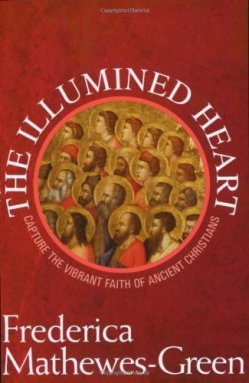
Illumined Heart cover

This month we’ve been reading The Illumined Heart: Capture the Vibrant Faith of Ancient Christians. In this short book, Frederica Mathewes-Green explores the wisdom and practices of the early Church to guide us on our walk of faith today. Our previous posts looked at repentance and fasting. Today, we’ll examine the Jesus Prayer.

The Jesus Prayer arose in the early centuries of eastern Christianity. The prayer involves repeating a single phrase: “Lord Jesus Christ, Son of God, have mercy on me.”

Mathewes-Green explains the rationale behind this prayer:

The Jesus Prayer arose as a way to practice unceasing prayer. It offered a short and simple form that can be repeated in an unhurried way no matter what else a person is doing. Since the prayer is silent and interior, it can be kept going in all situations.

*****

Why ask Jesus for mercy?

We keep lapsing into ideas of self-sufficiency, or get impressed with our niceness, and so we lose our humility. Asking for mercy reminds us that we are still poor and needy, and fall short of the glory of God. Those who do not ask do not receive, because they don’t know their own need.

*****

What about when we just can’t do it?

Do not cease praying when prayer comes hard, for fear of doing it imperfectly. If you cease praying when you can’t do it right, the devil gets a victory. So keep offering a broken prayer, and remember that you are only an unworthy servant, and yet Jesus wants you.

*****

Read more.

For Reflection:

Mathewes-Green week 4

CONTEMPLATIVE PROFILE: ST. JOHN CHRYSOSTOM ON PRAYER

In last week’s contemplative profile, we looked at two sources on the Jesus Prayer: Lord Jesus Christ, have mercy on me, a sinner. Historically, this prayer has been thought to be a response to Paul’s instructions to “pray continually.”

St. John Chrysostom also advises the Christian to pray constantly because prayer vanquishes our enemy. The Jesus Prayer sounds so gentle; yet many of the Church Fathers speak of prayer as a weapon. In fact, they often use a violent imagery that has mostly fallen out of favor today. If nothing else, this imagery impresses on us the efficacy of prayer in our lives. Chrysostom says:

Prayer is the cause of salvation, the source of immortality, the indestructible wall of the Church, the unassailable fortress, which terrifies the demons and protects us in the work of righteousness… Prayer is a great weapon, a great protection. Zealous prayer is the light of mind and soul, a constant, inextinguishable light. Therefore during prayer our bitter enemy floods our mind and drenches our soul with a measureless filth of thoughts and collects together qualities of things which had never entered our heads…

And:

By this remembrance (the Jesus Prayer) a soul forcing itself to this practice can discover everything which is within, both good and bad. First it will see within, in the heart, what is bad — and later — what is good. This remembrance is for rousing the serpent, and this remembrance is for subduing it. This remembrance can reveal the sin living is us, and this remembrance can destroy it. This remembrance can arouse all the enemy hosts in the heart, and little by little this remembrance can conquer and uproot them. The name of the Lord Jesus Christ, descending into the depths of the heart, will subdue the serpent holding sway over the pastures of the heart, and will save our soul and bring it to life. Thus abide constantly with the name of our Lord Jesus Christ, so that the heart swallows the Lord and the Lord the heart, and the two become one.

Read more.

Reflection: Have you ever thought of prayer in the forceful and passionate terms of St. John Chrysostom?

WEEKLY PRAYER

Today’s prayer is from the Canticle of the Sun by St. Francis of Assisi (1181/1182 – 1226):

Be praised, my Lord,
For all your creatures,
And first for brother sun,
Who makes the day bright and luminous.
He is beautiful and radiant
With great splendor,
He is the image of You,
Most high.

Be praised, my Lord,
For sister moon and the stars.
You placed them in the sky,
So bright and twinkling.

Source