Blog

WEEKLY PRAYER


A Prayer Meditation for All Saints Day by Safiyah Fosua:

We give you thanks, O God, for all the saints who ever worshiped you
Whether in brush arbors or cathedrals,
Weathered wooden churches or crumbling cement meeting houses
Where your name was lifted and adored.

We give you thanks, O God, for hands lifted in praise:
Manicured hands and hands stained with grease or soil,
Strong hands and those gnarled with age
Holy hands
Used as wave offerings across the land.

We thank you, God, for hardworking saints;
Whether hard-hatted or steel-booted,
Head ragged or aproned,
Blue-collared or three-piece-suited
They left their mark on the earth for you, for us, for our children to come.

Thank you, God, for the tremendous sacrifices made by those who have gone before us.
Bless the memories of your saints, God.
May we learn how to walk wisely from their examples of faith, dedication, worship, and love.

Source


FRIDAY FAVORITES FOR PRAYER AND WRITING

Friday Favorites is back after a break last week! I love sharing my favorite finds related to prayer and writing, and I hope you enjoy this week’s selections.

Do you have someone else’s article or post to share? Join the Contemplative Writers Facebook group, comment on today’s post on my Facebook page, or follow me on Twitter (@LisaKDeam) to nominate your favorite articles, blog posts, and books by Thursday at noon each week.

*****

On Discerning the Meaning of Spiritual Experience via Carl McColman (how do you know if a spiritual experience is God-inspired?)

Climate Change via Richard Rohr (can science and religion be partners in stewarding Creation?)

Daily Lectio Divina: Isaiah 43:14-15 via Laura K Cavanaugh (a guided lectio divina podcast)

Saying No In Order to Make Room via Grace P. Cho (saying no to embrace life-giving rhythms)

Hobbies With a Purpose via April Yamasaki (loving God and loving others in our “spare” time)

The Uncontrolling Love of God via Exile Liturgy (Ryan Cagle of Exile Liturgy interviews Thomas J. Oord about God’s providence, knowledge, and non-coercive love)

Don’t Back Down: Choose the Writing Territory You Can Defend Long and Fiercely via Ginger Moran (a guest post on Jane Friedman’s blog)

CONTEMPLATIVE PROFILE: HADEWIJCH OF ANTWERP

Hadewijch of Antwerp was a writer, poet, and mystic of the thirteenth century. Not much is known about her life. She lived in present-day Belgium, wrote in Middle Dutch, and was probably part of a beguine community.

In her works, Hadewijch wrote frequently about love and about Christ’s humanity. But she wasn’t afraid of showing a little fire, too. In a letter addressed (probably) to a woman in a beguine community, she wrote about the God complex so many people have. When we have a God complex, we want God’s glory and divinity but not his humanity. This has grave consequences, for it means we’re not willing to suffer as Christ suffered. Hadewijch writes:

[P]eople wish to live with God in consolations and repose, in wealth and power, and to share the fruition of his glory. We all indeed wish to be God with God, but God knows there are few of us who want to live as men with his Humanity, or want to carry his cross with him, or want to hang on the cross with him and pay humanity’s debt to the full. Indeed we can rightly discern this as regards ourselves, in that we are so little able to hold out against suffering in all respects. An unexpected sorrow, though slight, goes to our heart; or a slander, or a lie that people tell about us; or someone’s robbing us of our honor, or our rest, or our own will: How quickly and deeply any of this wounds us all!

By this we show plainly that we do not live with Christ as he lived; neither do we forsake all as Christ did, nor are we forsaken by all as Christ was . . . We do not live with Christ, and we do not carry that cross with the Son of God, but we carry it with Simon who received pay because he carried our Lord’s cross (Matt. 27:32).

I’m really struck by Hadewijch’s comment that we carry the cross for pay – we’re always looking to get paid, either by earning God’s favor or the regard of other people:

We hold in great esteem what we do or suffer for him, and we never resign ourselves to being left without recompense, or without knowing and feeling that it pleases God; we very quickly accept from him pay in the hand, namely satisfaction and repose; we also accept pay a second time in our self-complacency; and a third time, when we are satisfied that we have pleased others, and we accept commendation, honor, and praise from them.

Did you catch that? We get paid three times for carrying Christ’s cross! That, at least, is the temptation. If we don’t (or, rather, shouldn’t) carry this cross for pay, why should we do it? How do we carry the cross with Christ rather than with Simon? We’ll look at Hadewijch’s answer next week.

Until then, think on what Hadewijch said and reflect on this quesion: what kind of pay have you accepted for carrying Christ’s cross this week?




WEEKLY PRAYER

A prayer from the Sarum Breviary:

Thou, who art the eternal protection and salvation of our souls, arm us, we entreat Thee, with the helmet of hope, and the shield of Thy invincible defence; that so, helped by Thee in the straits of our necessities, we may be filled with joy and gladness with those who love Thee, through Jesus Christ our Lord. 

Source

FRIDAY FAVORITES FOR PRAYER AND WRITING

Each Friday I share some of my favorite finds related to praying or writing. If I think it could help you pray or write better, or just “be” better, I’ll include it below. I’m extremely encouraged by this week’s favorites, which include the writings of a medieval mystic, reflections on the psalms, a reading list, and encouraging words for some of the difficult paths we find ourselves on in life.

Do you have someone else’s article or post to share? Find me on Twitter (@LisaKDeam) to nominate your favorite articles, blog posts, and books by Thursday at noon each week.

*****

“And then we shall all come into our Lord, knowing ourselves clearly and wholly possessing God” via Fr Aidan Kimel (a beautiful passage from Julian of Norwich)

Ordinary Saints via Father SJMC (a liturgical poem that might convince you that *you* are a saint)

The Secret to Praying During Horrible Times via Kate Bowler (how do we pray when our souls have been pummeled by tragedy?)

5 Reasons to be Inspired by Psalm 111 via April Yamasaki (be inspired by this Psalm of thanksgiving)

How to walk in another person’s shoes by Sharon R. Hoover (check out this awesome book list!)

Cancer Does Not Have the Final Say via Redbud Writers Guild (read these hopeful articles in the October issue of The Redbud Post)

What It Means to Be a Writer – and To Emerge as a Writer via Albert Flynn DeSilver (an extremely helpful and encouraging guest post at Jane Friedman’s site)


WEEKLY PRAYER

This week, we are praying Thomas Merton’s most well-known prayer:

My Lord God,
I have no idea where I am going.
I do not see the road ahead of me.
I cannot know for certain where it will end.
nor do I really know myself,
and the fact that I think I am following your will
does not mean that I am actually doing so.
But I believe that the desire to please you
does in fact please you.
And I hope I have that desire in all that I am doing.
I hope that I will never do anything apart from that desire.
And I know that if I do this you will lead me by the right road,
though I may know nothing about it.
Therefore will I trust you always though
I may seem to be lost and in the shadow of death.
I will not fear, for you are ever with me,
and you will never leave me to face my perils alone.

FRIDAY FAVORITES FOR PRAYER AND WRITING

Each Friday I share some of my favorite finds related to praying or writing. If I think it could help you pray or write better, or just “be” better, I’ll include it below.

This week’s favorites begin with two reflections on the tragedy in Las Vegas. If you’re like me, you can always use help processing and praying through these terrible events.

As always, please let me know if you have suggestions for Friday Favorites. You can find me on Twitter @LisaKDeam.

*****

A Prayer for the Victims of the Las Vegas Shooting via Chelsen Vicari (prayer is more than a hashtag . . .)

Weary In Well-Doing? via Michelle Van Loon (in the face of national tragedy, how do we avoid becoming weary in doing good?)

What If Christians Need Empowerment More Than Oversight via Ed Cyzewski (can leaders and Christians help one another examine theology and spirituality?)

How Meister Eckhard Inspires Letting Go for Love via Mark S. Burrows (the startling appeal of the wisdom of a medieval mystic)

The outsider via Glynn Young (a poem after Isaiah 56:6-8)

Why we need Silence via Ian Paul (a book review and thoughts on silence in ministry and spirituality)

Deliberate Acts of Kindness via Lisa DeLay and Meredith Gould (a Spark My Muse podcast on service as a spiritual practice)


WEEKLY PRAYER

Today the Church celebrates the feast day of St. Francis of Assisi. This week’s prayer is Francis’s Peace Prayer:

Lord, make me an instrument of your peace:
where there is hatred, let me sow love;
where there is injury, pardon;
where there is doubt, faith;
where there is despair, hope;
where there is darkness, light;
where there is sadness, joy.

O divine Master, grant that I may not so much seek
to be consoled as to console,
to be understood as to understand,
to be loved as to love.
For it is in giving that we receive,
it is in pardoning that we are pardoned,
and it is in dying that we are born to eternal life.

Amen.

BOOK OF THE MONTH: HILDEGARD OF BINGEN: A SPIRITUAL READER

Week 4: Get Your Sparkle On

41XzfkDXhhL._SY346_

In reading Hildegard of Bingen’s work, it becomes clear that she highly valued creation and creativity. In our final week exploring Hildegard of Bingen: A Spiritual Reader, we’ll see what she says about this theme.

Two songs that Hildegard wrote tell of God as designer and animator (the titles to these songs were added by Carmen Butcher, who compiled the selections in the spiritual reader):

The First Daylight


You’re the Word of our Father,
the light of the first sunrise,
God’s omnipotent thought.
Before anything was made,
You saw it,
You designed it, and
You tucked Your all-seeing nature in the middle of Your sinew,
like a spinning wheel
with no beginning and no end,
still encircling everything.

*****

The First Verb


The Holy Spirit animates
all, moves
all, roots
all, forgives
all, cleanses
all, erases
all
our past mistakes, and then
puts medicine on our wounds.
We praise this Spirit of incandescence
for awakening
and reawakening
all
creation.

*****

In her letters, Hildegard frequently reminded others of God’s creativity. To the Abbess of Bamberg, she wrote:

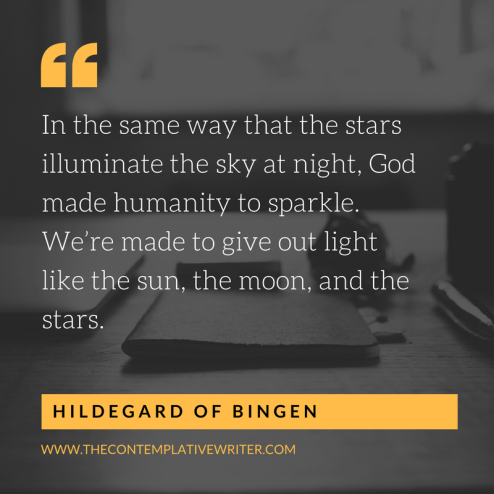
In the same way that the stars illuminate the sky at night, God made humanity to sparkle. We’re created for maturity. We’re made to give out light like the sun, the moon, and the stars. If a black cloud covered these, the earth and every creature in it would worry that the end had come.

*****

In a letter to Pope Anastasius IV, Hildegard makes a striking moral statement about creativity. She tells the pope that we must reject corruption, injustice, and evil because they are not creative. They are a form of anti-creativity:

Don’t forget that whatever God made, radiates. So listen. Before God made the world, He said to Himself, “There’s My dear Son!” and from this original Word, the world was formed. Then God said, “Be!” and all kinds of animals appeared. Our God creates, but evil is never creative. It’s nothing, merely the by-product of rebellion. Through His Son, God saved humanity, clearly rejecting immorality—stealing, stubbornness, murder, hypocrisy, and bullies.


That’s why you as pope must never collude with corruption. If you do, you confuse those who look to you as their leader, because, in effect, you’re saying to them, “Embrace what’s really nothing.”

*****

Read more.

For reflection:

Hildegard week 4.png