Blog

WEEKLY PRAYER

A prayer from John Wesley (1703-1791):

O Lord, take full possession of my heart, raise there your throne,
and command there as you do in heaven.
Being created by you, let me live for you;
being created for you, let me always act for your glory;
being redeemed by you, let me give to you what is yours;
and let my spirit cling to you alone, for your name’s sake.

Source

FRIDAY FAVORITES FOR PRAYER AND WRITING

Welcome to Friday Favorites, my weekly round-up of posts about prayer, writing, and living the contemplative and connected life. I hope you’ll enjoy this week’s finds.

As always, if you have someone else’s article or post you’d like to see featured, please let me know by Thursday at noon.

Be blessed!

*****

Love Each Other Deeply via April Yamasaki (a beautiful litany for Mother’s Day, which is this Sunday)

What’s the difference between Ignatian Spirituality and Centering Prayer? via Carl McColman (exploring the differences between two historical prayer practices)

For the Ones in Hiding via Tasha Burgoyne (what if our fragility is the one thing that we all have in common?)

You’d Never Know It From Looking At Her via Alia Joy (for those who need to know that they are not alone)

What To Do When Other People’s Words Leave You Feeling Bad via Traci Rhoades (when you’re haunted by hurtful words)

You Are Not The Problem via Heather Caliri (on the struggle of writing and learning to write)

Remember This the Next Time You Are Rejected via Courtney E. Martin (if you’ve ever applied to something or submitted your work, you need to read this letter)

*****

I also wanted to remind you, friends, about the upcoming Writers’ Retreat hosted by Andi Cumbo-Floyd, Shawn Smucker, and Kelly Chripczuk on June 22-24 in Radiant, Va. Read about it here and join us for 3 days dedicated to recharging, relaxing, and refocusing on our writing life.

Writers Retreat1

*****

Keep the Contemplative Writer Sustainable

The Contemplative Writer is ad-free and never shares sponsored content, but it is a lot of work to maintain. We rely on affiliate links from the books we share and the generous donations of our readers. Even a gift of $5 goes a long way to sustaining our mission to provide contemplative prayer resources for our readers.

Learn how your support can keep this website running: Support Us Today


BOOK OF THE MONTH: NO MAN IS AN ISLAND BY THOMAS MERTON

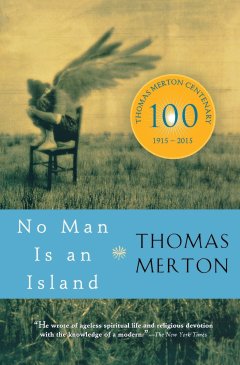
No Man Is an IslandWeek 2: Christian Renunciation

Our Book of the Month is No Man Is an Island by Thomas Merton. Last week, we looked at being versus doing. In chapter 6, Merton tackles the difficult topic of renunciation or asceticism. I’m interested in this topic because the mystics and contemplatives from the past sometimes engaged in asceticism and are often misunderstood for it.

So what is Christian asceticism or renunciation? What were all those mystics up to? And what are we up to when we fast or otherwise sacrifice some of our comforts—during Lent but also at other times?

Merton writes:

Self-denial delivers us from the passions and from selfishness. It delivers us from a superstitious attachment to our own ego as if it were a god.

But Merton has a warning. Renunciation is not a matter of ruthlessly denying or perpetrating violence upon our bodies. It begins with God, not us:

It delivers us from the “flesh” in the technical New Testament sense, but it does not deliver us from the body. It is no escape from matter or from the senses, nor is it meant to be. It is the first step toward a transformation of our entire being in which, according to the plan of God, even our bodies will live in the light of His divine glory and be transformed in Him together with our souls.

Here are more of Merton’s thoughts on Christian renunciation:

There is only one true asceticism: that which is guided not by our own spirit but by the Spirit of God. The spirit of man [and woman] must first subject itself to grace and then it can bring the flesh in subjection both to grace and to itself. “If by the Spirit you mortify the deeds of the flesh, you shall live” (Romans 8:13).

*****

Those, then, who put their passions to death not with the poison of their own ambition but with the clean blade of the will of God will live in the silence of true interior peace, for their lives are hidden with Christ in God. Such is the meek “violence” of those who take Heaven by storm.

*****

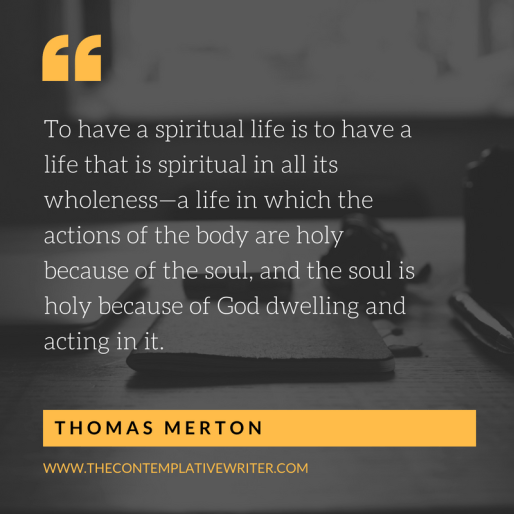
We cannot become saints merely by trying to run away from material things. To have a spiritual life is to have a life that is spiritual in all its wholeness—a life in which the actions of the body are holy because of the soul, and the soul is holy because of God dwelling and acting in it.

*****

And here’s a wonderful thought. True asceticism, as in the passages above, can lead us to love and serve other people:

To say that Christian renunciation must be ordered to God is to say that it must bear fruit in a deep life of prayer and then in works of active charity. Christian renunciation is not a matter of technical self-denial, beginning and ending within the narrow limits of our own soul. It is the first movement of a liberty which escapes the boundaries of all that is finite and natural and contingent, enters into a contact of charity with the infinite goodness of God, and then goes forth from God to reach all that He loves.

*****

You can read No Man Is an Island here.

*****

For reflection:

Merton week 2

WEEKLY PRAYER: JULIAN OF NORWICH

The English mystic Julian of Norwich (1342 – c. 1416) is remembered on May 8 (in the Anglican, Episcopalian, and Lutheran churches). This week, let’s pray one of her beautiful prayers:

In you, Father all-mighty, we have our preservation and our bliss.
In you, Christ, we have our restoring and our saving.
You are our mother, brother, and Saviour.
In you, our Lord the Holy Spirit, is marvellous and plenteous grace.
You are our clothing; for love you wrap us and embrace us.
You are our maker, our lover, our keeper.
Teach us to believe that by your grace all shall be well, and all shall be well,
and all manner of things shall be well. Amen

Source

FRIDAY FAVORITES FOR PRAYER AND WRITING

Each Friday I share some of my favorite finds related to praying or writing. If I think it could help you pray or write better, or just “be” better, I’ll include it below.

This week, more posts than usual focus on writing (and reading)—these are the ones that struck me this time around. I hope you’ll enjoy them and find something in them to nurture your own creativity. Be blessed!

*****

Humility Is Not Fun via Kaitlin Curtice (humility may not be fun, but it’s the road to the Mysteries of God)

Sabbath for Caregivers and Helpers via J. Dana Trent (making time for rest and sabbath, especially when you’re a caregiver or helper)

God of the Anxious via Leah Everson (finding the God who meets us in the wilderness of our anxiety)

Writing Saved Me from Drowning, and Other Tales of Creativity via Ashley Hales (on writing, creativity, and mothering–and giving our stories for others)

Elevating Women’s Voices at IVP via InterVarsity Press (an inspiring collection of women authors to read and follow) #ReadWomen

When The Art You Create Disappoints You via Shawn Smucker (what to do with the inevitable disappointment that comes with creating)

One Fiction Writer’s Manifesto via Erendira Ramirez-Ortega (a collection of statements on the craft of writing and a discussion of the question: why do we write and for whom?)

*****

Keep the Contemplative Writer Sustainable

The Contemplative Writer is ad-free and never shares sponsored content, but it is a lot of work to maintain. We rely on affiliate links from the books we share and the generous donations of our readers. Even a gift of $5 goes a long way to sustaining our mission to provide contemplative prayer resources for our readers.

Learn how your support can keep this website running: Support Us Today

BOOK OF THE MONTH: NO MAN IS AN ISLAND BY THOMAS MERTON

Week 1: Being and Doing
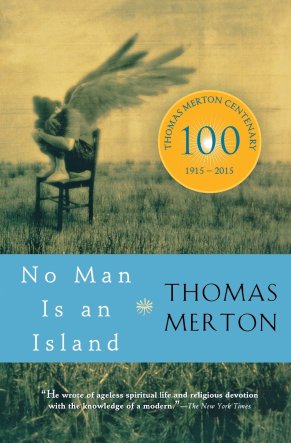
No Man Is an Island
Our Book of the Month for May is No Man Is an Island by Thomas Merton (1915–1968), the Trappist monk, mystic, and writer. In this classic, Merton reflects on the spiritual life in sixteen chapters.

Chapter 7 opens with a beautiful reflection on being and doing:

We are warmed by fire, not by the smoke of the fire. We are carried over the sea by a ship, not by the wake of a ship. So, too, what we are is to be sought in the invisible depths of our own being, not in our outward reflection of our own acts.

Yet we so often seem drawn to obsess over our actions and achievements (or lack thereof) and to pursue more and more of them. If left unchecked, this impulse can be damaging to our innermost selves. In this chapter of his book, Merton reminds us that:

  • we find ourselves in being, not in doing
  • we find peace in contemplating God, not ourselves
  • we find peace in being content to be “little”

I’ve pulled out a few quotes from this chapter that spoke to me. Here Merton talks about pursuing greatness and playing the comparison game. I know that game all too well; it’s something I constantly have to guard against. So Merton is really speaking into my soul when he writes these words.

***

Our Christian destiny is, in fact, a great one: but we cannot achieve greatness unless we lose all interest in being great. For our own idea of greatness is illusory, and if we pay too much attention to it we will be lured out of the peace and stability of the being God gave us, and seek to live in a myth we have created for ourselves. It is, therefore, a very great thing to be little, which is to say: to be ourselves. And when we are truly ourselves we lose most of the futile self-consciousness that keeps us constantly comparing ourselves with others in order to see how big we are.

***

The deep secrecy of my own being is often hidden from me by my own estimate of what I am. My idea of what I am is falsified by my admiration for what I do. And my illusions about myself are bred by contagion from the illusions of other men. We all seek to imitate one another’s imagined greatness.

***

To counter these illusions and games, we sometimes need to remind ourselves to just be:

There are times, then, when in order to keep ourselves in existence at all we simply have to sit back for a while and do nothing. And for a man [or woman] who has let himself be drawn completely out of himself by his activity, nothing is more difficult than to sit still and rest, doing nothing at all. The very act of resting is the hardest and most courageous act he can perform: and often it is quite beyond his power.

***

Read No Man Is an Island here.

For reflection: When was the last time you sat back for a while and did nothing? How difficult was this for you?


Merton week 1


WEEKLY PRAYER: ST. PATRICK

A prayer from St. Patrick (excerpted from St. Patrick’s Breastplate):

Christ with me,
Christ before me,
Christ behind me,
Christ in me,
Christ beneath me,
Christ above me,
Christ on my right,
Christ on my left,
Christ when I lie down,
Christ when I sit down,
Christ when I arise,
Christ in the heart of every man who thinks of me,
Christ in the mouth of everyone who speaks of me,
Christ in every eye that sees me,
Christ in every ear that hears me.

Source

FRIDAY FAVORITES FOR PRAYER AND WRITING

Welcome back to Friday Favorites after a hiatus of a couple weeks. I was at the Festival of Faith and Writing one week, and last week had some computer problems (I’m sure you know what that’s like . . .). I’m glad to be back and bringing you some of my favorite finds related to prayer, writing, and being and living well.

Many of today’s Friday Favorites feature writers I met for the first time at the Festival of Faith and Writing a couple weeks ago. It was wonderful to meet these writers in person, and it’s a joy to show you their work; I know that you’ll be blessed by these pieces.

*****

Saying Yes and Staying Humble: Lesson 1 from the Festival of Faith and Writing via Amanda Cleary Eastep (a report from the Festival about humility, God, gifts, and saying yes to books and writing)

Call for Creative Communion via Sister Julia Walsh (on worshiping, creating, and receiving in vulnerability and community)

In April (poem) via Prasanta Verma (a poem of awakening)

Dread Leads You Deeper via Tara Owens (Tara shares an excerpt from a wonderful new book, Mystics and Misfits: Meeting God Through St. Francis and Other Unlikely Saints, by Christiana Peterson)

Still Life via Michael Wright (I recommend this enriching newsletter about art, poetry, and life)

Speak Easy via Patricia Raybon (biblical counsel on keeping our words loving and short)

Being is the Greatest Act of Resistance via Carolina Hinojosa-Cisneros (in the work of justice and peacemaking, we remain faithful to the call on our lives)

Write Your Own Obituary via Ann Kroeker (Ann suggests a unique exercise for creative writing and for life)

*****

The Contemplative Writer is ad-free and never shares sponsored content, but it is a lot of work to maintain. We rely on affiliate links from the books we share and the generous donations of our readers. Even a gift of $5 goes a long way to sustaining our mission to provide contemplative prayer resources for our readers.

Learn how your support can keep this website running: Support Us Today

CONTEMPLATIVE PROFILE: ST. AUGUSTINE AND DENISE LEVERTOV

Last week, I posted on a passage from St. Augustine’s Confessions in which Augustine longs for God to come into the house of his soul. A little home expansion is necessary, and this marks the beginning of a mystical journey–a journey inward to meet, love, and be filled by God.

Recently I found a poem by Denise Levertov (1923-1997), an American poet, which riffs on this passage from the Confessions. It’s a wonderful tribute to Augustine that sheds light on the spiritual restoration for which the saint yearns.

Take a moment to relish Levertov’s poem:

***

FOR THE ASKING

‘You would not seek Me if you did not already possess Me.’

-Pascal


Augustine said his soul
was a house so cramped
God could barely squeeze in.
Knock down the mean partitions,
he prayed, so You may enter!
Raise the oppressive ceilings!

Augustine’s soul
didn’t become a mansion large enough
to welcome, along with God, the women he’d loved,
except for his mother (though one, perhaps,
his son’s mother, did remain to inhabit
a small dark room). God, therefore
would never have felt
fully at home as his guest.

Nevertheless,
it’s clear desire
fulfilled itself in the asking, revealing prayer’s
dynamic action, that scoops out channels
like water on stone, or builds like layers
of grainy sediment steadily
forming sandstone. The walls, with each thought,
each feeling, each word he set down,
expanded, unnoticed; the roof
rose, and a skylight opened.

***

In the last stanza of the poem, we see another theme shared by many mystics, such as Julian of Norwich–the idea of finding God in the seeking; being answered in the asking. Like Levertov, Julian of Norwich often said that seeking God is the same as finding God. But back to the matter at hand.

As I think about my own formation, about what I need to get my journey started (and in many ways it begins anew each day), I like to read Augustine and Levertov together. Levertov’s poem helps me receive Augustine’s words and provides a model for how I might converse with him.

Augustine and Levertov, a Church Father and an American poet, help me to believe that soul-expansion is possible. It starts with nothing more than a cry to God. May this spiritual expansion be mine and yours today–may a skylight open in the house of our soul.

Source