Scattered, broken particles
must be remade
after life on earth snaps,
crushes each bone, sinew, organ
into first-born
molecules
Dust catches in throat
chokes irrelevancy
Smeared ashes
reconstruct
into wooden cross beams
unmade – made – remade
***
Prasanta Verma, a poet, writer, and artist, is a member of The Contemplative Writer team. Born under an Asian sun, raised in the Appalachian foothills, Prasanta currently lives in the Midwest, is a mom of three, and also coaches high school debate. You can find her on Twitter @ pathoftreasure, Instagram prasanta_v_writer, and at her website: https://pathoftreasure.wordpress.com/.
Today (Feb. 26) is Ash Wednesday and the beginning of the Lenten season. Psalm 51, a psalm of repentance, is often recited in Ash Wednesday services, and this will be our prayer of the week (as taken from the Book of Common Prayer).
***
1 Have mercy on me, O God, according to your
loving-kindness;
in your great compassion blot out my offenses.
2 Wash me through and through from my wickedness
and cleanse me from my sin.
3 For I know my transgressions,
and my sin is ever before me.
4 Against you only have I sinned
and done what is evil in your sight.
5 And so you are justified when you speak
and upright in your judgment.
6 Indeed, I have been wicked from my birth,
a sinner from my mother’s womb.
7 For behold, you look for truth deep within me,
and will make me understand wisdom secretly.
8 Purge me from my sin, and I shall be pure;
wash me, and I shall be clean indeed.
9 Make me hear of joy and gladness,
that the body you have broken may rejoice.
10 Hide your face from my sins
and blot out all my iniquities.
11 Create in me a clean heart, O God,
and renew a right spirit within me.
12 Cast me not away from your presence
and take not your holy Spirit from me.
13 Give me the joy of your saving help again
and sustain me with your bountiful Spirit.
14 I shall teach your ways to the wicked,
and sinners shall return to you.
15 Deliver me from death, O God,
and my tongue shall sing of your righteousness,
O God of my salvation.
16 Open my lips, O Lord,
and my mouth shall proclaim your praise.
17 Had you desired it, I would have offered sacrifice;
but you take no delight in burnt-offerings.
18 The sacrifice of God is a troubled spirit;
a broken and contrite heart, O God, you will not despise.
Welcome to Friday Favorites! This week’s faves have been specially chosen by Prasanta Verma and me to help us get ready for Lent. During Lent, we journey into a kind of darkness: we go into the desert, we go into the darkness that Jesus experienced, we go into a place of sorrowing and repentance. This place is necessary to help us prepare for new life.
Today’s posts help us explore darkness in our lives — and to find God there. He will not leave us alone in the inky places.
Last week, we explored Julian of Norwich’s famous phrase, “All will be well.” We found that it refers to the “necessity” of sin and God’s grand plan of salvation. It points us to the end of time, when God’s purposes for the world will be accomplished. But I want to emphasize that Julian’s saying is also full of comfort for the here and now.
In the Showings, Julian continues to marvel and reflect on the idea that “all will be well.” She says:
He [God] wants us to know that he takes heed not only of things which are noble and great, but also of those which are little and small, of humble men and simple, of this man and that man. And this is what he means when he says: Every kind of thing will be well. For he wants us to know that the smallest thing will not be forgotten.(231-232)
How I love this thought. The smallest thing will not be forgotten. We have a God who sees the small and the simple. And that means that he sees us; sees you and me. God delights not (just) in grand gestures and great deeds; he notices the humblest acts of faith. He loves not just the heroes and saints; he loves this particular man and that particular woman. He loves us in all our marvelous idiosyncracies. In our unique presence. Our ordinariness. And in our insignificance.
This passage on smallness reminds me of one of Julian’s earlier visions. God showed Julian something no bigger than a hazelnut lying in the palm of her hand.
Julian says, “I looked at it and thought: What can this be? And I was given this general answer: It is everything which is made.” (130) God preserves such a small thing, Julian writes, because he created it and loves it.
In something as small as a hazelnut, the whole world can be contained. In something as small as you and me, God finds something of incredible value. Something worth rectifying the world for.
We have to wait until the end – until God’s time – to see exactly how he will rectify every thing, both large and small. But we have this consolation now: we are not lost. We are not forgotten. God takes heed of us. We are swept up in his plans to make all things well.
Julian says that in God’s promise to make well even the smallest of things, we find rest and peace. We are powerfully comforted.
Do you believe, as small and insignificant as you are, that “all will be well” both for the world and for you? I leave you with Lady Julian’s encouragement:
“Accept it now in faith and trust, and in the very end you will see truly, in fulness of joy.”
Friday Favorites is back after a break last week. Prasanta Verma and I are glad you’re with us!
This week our links begin with a lectio divina exercise and end with a message of hope for our fallen world. In between are some beautiful, difficult, and necessary posts about spiritual crisis, exile, and healing racial wounds.
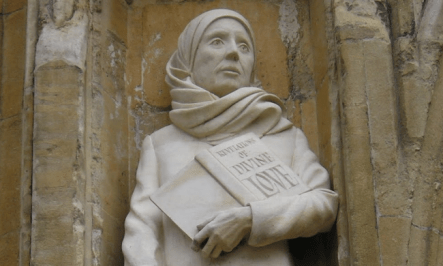
Julian of Norwich (1342 – c. 1416) is one of the most beloved medieval mystics. She lived for much of her life as an anchoress (someone who lives enclosed in a cell) and wrote the first known book in English to be written by a woman. This book, the Book of Showings, teaches us about the fullness of divine love and compassion; it is based on a series of revelations or visions that the mystic received in 1373.
Julian’s words are oft quoted, and the most famous passage from the Showings is one you’ve undoubtedly heard:
All will be well, and all will be well, and every kind of thing will be well.
We quote this passage when we need reassurance. When things are not going well. When we don’t have much hope for the future. I myself have quoted and tweeted it many times.
Today and next week, I want to explore the context of this famous passage. Reading Julian’s Showings, I found that “all shall be well” is not just one sentence, but a theme that spans some six chapters of the book. The passage has a larger context that is usually not considered.
That context is sin.
Julian utters her famed saying in a portion of the Showings in which she sorrows over sin. She realizes that sin is keeping her from close communion with God, and she wonders why God ever allowed sin to come into the world.
God reassures Julian, saying:
Sin is necessary, but all will be well, and all will be well, and every kind of thing will be well. (225)
There are two main things to note about this passage. First, it has an opening clause that is often omitted (“sin is necessary”). And second, we are to understand it as something that God himself said to Julian. The passage means that, despite the pain and suffering of humankind because of sin, God has promised to make things right.
Statue of Julian of Norwich by David Holgate, 2014
In case you’re wondering, no, I don’t like the statement that “sin is necessary” and cannot pretend to fully understand it. Julian herself is troubled by this notion and persists in asking God how things can possibly be well given the destructive consequences of sin. She won’t let this issue go. For several chapters, she pesters God about it. How can it be well? How, God? And why . . . why did you allow sin to come into the world? These questions make her a kindred spirit to those of us who wrestle with tough questions. Why, God?
God doesn’t quite answer Julian’s questions. But he tells her, very tenderly, to contemplate the atonement, which is far more glorious than sin ever was harmful. And he tells her to trust him. God says to Julian:
For since I have set right the greatest of harms [original sin], then it is my will that you should know through this that I shall set right everything which is less.(228)
“All will be well” refers to nothing less than God’s grand plan of salvation – for setting right the world and the human heart. It does not mean, alas, that things will be okay tomorrow or in a particular circumstance in our life. It could be that, like Moses, we will not see with human eyes the fulfillment of God’s promise to make things “well.”
“All will be well” is not a phrase to throw around lightly. It requires a lot of faith to affirm. Look around you at the world right now. And then look at your own heart. It’s hard to believe that all will be well, isn’t it? It’s hard partly because God is keeping to his own timeline, not ours. And because he is working in ways that we cannot fathom (more on this topic next week).
As we wait on God, we work with him in the grand plan of salvation (because waiting is active, not passive). We suffer and groan. We sorrow in our sin. But we believe: in God’s time and in God’s way, every kind of thing will be well.
Today’s prayer comes from Evelyn Underhill, a 20th-century poet, spiritual author, and theologian.
***
Give me, O Lord, I beseech you, courage to pray
for light and to endure the light here,
where I am on this world of yours,
which should reflect your beauty but which we
have spoiled and exploited.
Cast your radiance on the dark places,
those crimes and stupidities I like to ignore and gloss over.
Show up my pretensions, my poor little claims and
achievements, my childish assumptions of importance,
my mock heroism.
Take me out of the confused half-light in which I live.
Enter and irradiate every situation and every relationship.
Show me my opportunities, the raw material of love,
of sacrifice, of holiness, lying at my feet,
disguised under homely appearance
and only seen as it truly is, in your light.
Welcome to Friday Favorites! This week, Prasanta Verma and I are bringing you a lovely round-up of links related to finding God, beauty, connection, and “fresh bread” in our lives. These short, poetic reads are just right for shining a light in the long days of winter.


 This passage on smallness reminds me of one of Julian’s earlier visions. God showed Julian something no bigger than a hazelnut lying in the palm of her hand.

 The Contemplative Writer