Blog

WEEKLY PRAYER: FREDERICK BUECHNER

A Resurrection prayer from Frederick Buechner:

O Thou who didst rise again,

Thou Holy Spirit of Christ, arise and live within us now, that we may be thy body, that we may be thy feet to walk into the world’s pain, thy hands to heal, thy heart to break, if need must be, for the love of the world.

Thou risen Christ, make Christs of us all. Amen.

Source


FRIDAY FAVORITES FOR PRAYER AND WRITING

Welcome to Friday Favorites! This week, Prasanta Verma and I are featuring five readings for Good Friday. May God bless you as you mark this day and journey to the resurrection.

***

Good Friday: the first 12 Stations of the Cross via Malcolm Guite (a guided experience of the stations)

When It’s Holy Week and You Don’t Feel Holy via Leslie Leyland Fields (why it’s going to be enough, no matter how you feel)

Finding Sacred Space in the Upper Room via Catherine McNeil (how do we do Holy Week in a locked room?)

Lamentation: The Weight of Grief via Shemaiah Gonzalez (experiencing the grief of Good Friday through a startling work of art)

Beneath Thy Cross via Christina Rossetti (a poem for Good Friday)

Cloister; A Poem via Ana Lisa de Jong (for our times)


Talking to God with Ignatius of Loyola

In 1548, Ignatius of Loyola published one of the most popular devotional books in Christian history – the Spiritual Exercises. This book is a compilation of meditations, prayers, and other practices. It is intended for use of a spiritual director, who is to guide individuals through the exercises.

I haven’t yet had the opportunity to do the Exercises with a spiritual director. Reading through them, however, I was struck by a couple things. One is Ignatius’s use of imaginative prayer, a form of contemplation that places us at the scene of a biblical story, inviting us to interact and converse with the characters. This is a very different type of contemplation than centering prayer, in which the mind is quiet and still, emptied of everything except a prayer word.

I was also intrigued by the “colloquy,” which is a conversation with God. Ignatius says that a colloquy is made “in the way one friend speaks to another . . . now begging a favor, now accusing oneself of some misdeed, now telling one’s concerns and asking counsel about them.” It usually occurs at the end of the exercise.

In the first Spiritual Exercise, which focuses on original sin, Ignatius suggests that we meditate on the cross of Christ. Then he suggests this colloquy, or conversation, with Christ:

Imagine Christ our Lord suspended on the cross before you, and converse with him in a colloquy: How is it that he, although he is the Creator, has come to make himself a human being? How is it that he has passed from eternal life to death here in time, and to die in this way for my sins?

This colloquy could be an interesting exercise for Holy Week. I realize that I am taking it out of context, but I wonder if it could function as a form of visio divina, in which we prayerfully meditate on a scene of the Crucifixion. Ignatius probably means for us imagine this scene in our mind’s eye, but I’m pairing it here with a painting of the Crucifixion (1627) by Francisco de Zurbarán, a Spanish artist who lived a bit later than Ignatius.

Zurbarán, Crucifixion

In this painting, Zurbarán puts the Crucifixion before our eyes with no distractions. There are no other figures in the painting and no background. We become the figures standing before the cross.

As you look at this painting, think of what you might say to Jesus this Holy Week. In the Spiritual Exercises, Ignatius suggests three ways we can talk to God. First, as quoted above, he says that we begin by marveling at Christ’s work on the cross: How is it that he, although he is the Creator, has come to make himself a human being? How is it that he has passed from eternal life to death here in time, and to die in this way for my sins?

Ignatius also suggests that we examine ourselves. He says:

In a similar way, reflect on yourself and ask: What have I done for Christ? What am I doing for Christ? What ought I to do for Christ?

Finally, Ignatius suggests simply talking to God. As you gaze on Christ, “speak out whatever comes to your mind.”

Marveling, examining, conversing: three rich ways to prayerfully engage with God this Holy Week.

So . . . what is on your heart? What would you say to Jesus? You can be sure that he is listening to you.




A PRAYER FOR HOLY WEEK

A prayer for Holy Week by Origen (c. 185–254), early Christian theologian and philosopher:


Jesus, my feet are dirty. Come even as a slave to me, pour water into your bowl, come and wash my feet. In asking such a thing I know I am overbold, but I dread what was threatened when you said to me, “If I do not wash your feet I have no fellowship with you.” Wash my feet then, because I long for your companionship.


FRIDAY FAVORITES FOR PRAYER AND WRITING

Welcome to Friday Favorites! As we continue seeking hope and courage in the middle of a pandemic, Prasanta Verma and I bring you a round-up of posts and podcasts to help you on this journey. Enjoy liturgy, words of faith, writing encouragement, homeschooling tips, and more.

Blessings to you . . . and keep the faith.

***

A Liturgy During a Pandemic via Porter C. Taylor (a meaningful liturgy for groups or individuals)

Giving Up via Taryn R. Hutchison (When Lent started, Taryn knew what she wanted to give up. What she actually gave up was something altogether different; something more. You gave it up, too.)

How to Fight an Unseen Enemy via Shelly Wildman (what do we need to remember about God in these times?)

Stand Against Anti-Asian Racism in The Time of COVID-19 via Tasha Jun (every human being is made in the Imago Dei and is worthy of being treated as such; an invitation to take a stand)

Civic Housekeeping + Dietrich Bonhoeffer with Laura Fabrycky via Ashley Hales (now more than ever, we need the lessons Fabrycky brings us from Bonhoeffer’s life)

Poet Laura: Keeping Your Distance with Emily Dickinson via Tania Runyan (finding depth even in distance)

The Myth of Perfect Writing Locations via Erica Wright (do writers really need a “room of their own?”)

Tips for Homeschooling in a Pandemic…and Beyond via Ingrid Lochamire (tips for those who are suddenly faced with homeschooling)


The Prayers of St. Catherine of Siena: A Video Series

Given what has come upon us — the pandemic, social distancing, uncertainty, isolation — I wanted to put some encouragement into the world. I’ve begun a video series in which I read a prayer, or a portion of a prayer, by St. Catherine of Siena, the 14th-century mystic, lay Dominican, church reformer, and Doctor of the Church. The first two readings are posted below.

Catherine’s prayers are beautiful and passionate, and I hope they will encourage you during this difficult time. I’m especially moved that St. Catherine so often prays for mercy and salvation for the entire world.

In this first prayer, Catherine pleads for mercy for the world:


The following prayer is very short and is a personal plea for God to renew our spirit:


Blessings and peace to all of you!


WEEKLY PRAYER

Today’s prayer is from Dimitry of Rostov (1651-1709), bishop in the Russian Orthodox Church:

Come, my Light,
and illumine my darkness.

Come, my Life,
and revive me from death.

Come, my Physician,
and heal my wounds.

Come, Flame of divine love,
and burn up the thorns of my sins,

kindling my heart
with the flame of thy love.

Source


FRIDAY FAVORITES FOR PRAYER AND WRITING

If you’re like me, you may not be sure what day it is . . . most weekdays look alike right now. But I think it’s Friday, so…welcome to Friday Favorites!

Today, Prasanta Verma and I bring you words of hope for what Marlena Graves, in her article linked below, calls a “heavy season.” As Christians, we believe that, despite the weight of everything pressing down on us right now, there is still reason to hope . . . and to pray, believe, travel (vicariously), and write.

Read on, and keep the faith.

***

20 Prayers to Pray During This Pandemic via Jen Pollock Michel (prayers that address specific needs for communities and situations)

C. S. Lewis on Times of Fear, And A Much Needed Psalm via Chase Replogle (words of encouragement from a well-known author and Scripture)

Holding Space via Aaron J. Smith (sometimes, we need to believe for each other)

A Saving Practice Amid a Heavy Lenten Season via Marlena Graves (a reorienting practice for a heavy time)

Writing During a Pandemic via Leslie Verner (what can you do to keep writing now that home life, work live, and schedules have changed?)

30 National Parks Virtual Tours via Jill Mills (explore the country’s amazing parks without having to travel)


AN ANNUNCIATION PRAYER

Today (March 25) is the Feast of the Annunciation. Let’s say a prayer that we would have the faith of Mary, who said “yes” to God. The prayer comes from David Bennett, an author and speaker.

***

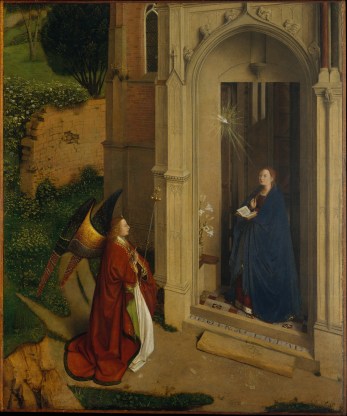
Annunciation - Christus
The Annunciation, Petrus Christus, ca. 1450

Lord Jesus Christ,
Eternal Word,
You became Incarnate as man
in the womb of the Blessed Virgin Mary.
You, through whom the universe was created,
began your earthly course,
in the womb of a humble and chaste Virgin.
At the annunciation of this miracle,
Mary responded in faith:
“let it be done to me
according to your word.”
May we who are made new creatures
by your grace,
respond with such faith,
when you call us to your service.

Amen


Source

I’ll Pass; Or, How to Age Like a Star

This week, I’m sharing an article I recently wrote for The Perennial Gen on aging like a star, with help from the medieval mystic Hildegard of Bingen. You can begin here and continue at The Perennial Gen’s website. Thanks for reading! And…shine on.

***

Dedicated to Polaris, “a rapidly aging giant star”


The other day, I played a little game with my husband. I asked him, “What do you think? Could I pass for forty?”

He looked at me. Squinted a little. “Yes,” he said, and I think he was telling the truth.

“What about thirty-eight?” I pressed.

“Sure,” he said.

I should have left it there, but something made me continue. “Thirty-five?”

At that point he began to look skeptical.

This game with my husband was affectionate; we laughed and teased. But behind it lies a serious hang-up. The fact is, I play this age game all the time. I don’t always play it overtly, but I do it in my mind. Because I have small children, I reason, that surely makes me seem younger to people I meet. Because I choose my best photo for my social media avatar, maybe I seem more youthful online.

When I play this game, I’m not just holding on to youthful beauty. I also want to be relevant. Vibrant. Involved. I want to have something to offer. So I try to convince myself (and others) that I can pass for a woman who is younger than she is.

Read the rest at The Perennial Gen.