Blog

WEEKLY PRAYER

Today’s prayer comes from the Book of Common Prayer, collect 24.

***

Almighty God our heavenly Father, you declare your glory
and show forth your handiwork in the heavens and in the
earth: Deliver us in our various occupations from the service
of self alone, that we may do the work you give us to do in
truth and beauty and for the common good; for the sake of
him who came among us as one who serves, your Son Jesus
Christ our Lord, who lives and reigns with you and the Holy
Spirit, one God, for ever and ever. Amen.


FRIDAY FAVORITES FOR PRAYER AND WRITING

Happy Friday, friends! Prasanta Verma and I hope you enjoy this week’s round-up of favorite links. You’ll find reflections on life during the pandemic and some articles/resources about important spiritual practices – daily prayer, spiritual mentoring, and letter writing. Enjoy, and be blessed.

***

Daily Prayers for Uncertain Times via Richella Parham (a prayer guide for you to download)

Breaking via Nichole Woo (when things break all over again)

Pandemic Journal: An Entry on Cutting Your Son’s Hair (and the Lilac Bush) via Laura Boggess (gifts during this pandemic season)

We Must Cure the Global Pandemic of Loneliness via Andrew Vanderput  (the pandemic helps us realize anew that we need our neighbors and they need us)

Help Wanted: Imperfect Mentors Only via Michelle Van Loon (wisdom about the practice of spiritual mentoring)

Letter Writing Isn’t a Lost Art in Egypt. It’s an Ancient Ministry via Phoebe Farag Mikhail and Bishoy Lamie Mikhai (letters re a physical connection in times of discouragement, loneliness, and grief)


Oneing with Julian of Norwich

The fourteenth-century mystic Julian of Norwich has taught me many things about hope, faith, and divine love. Recently she’s also taught me the value of words. I was reading Julian’s work, the Revelations of Divine Love, when I came across this sentence: “Prayer ones the soul to God.” This passage awakened my inner grammar queen. The last time I checked, “ones” wasn’t a verb.

Evidently Julian didn’t read the same grammar books that I did. Examples of oneing infuse her work, such as:

In our making God knit us and oned us to himself . . .

And the conclusion of this idea:

By the virtue of the same precious oneing, we love our Maker and seek God . . .

Julian’s oneing would not have sounded as jarring to her audience as it does to us. “To one” was a Middle English word meaning to unite or to join. But words change. If used today, oneing would constitute an egregious case of verbing — the act of turning a noun into a verb. You’ve probably seen many examples of this. Adulting is hard. Or, It’s time to introvert!

I think this is why some translators of Julian’s work don’t use her original wording: they’re concerned that she’s breaking today’s grammar rules. These translators often change the word “oned” to “united.” So, Julian’s phrase “prayer ones the soul to God” becomes “prayer unites the soul to God.”

JulianBut I much prefer Julian’s strange little verb. How much lovelier oneing is than uniting! The unfamiliarity of this word makes me pause, reread, and really grapple with its meaning. Uniting implies a joining of forces, but oneing suggests a knitting together that can never be undone, a union so seamless that you can no longer distinguish its individual parts.

Oneing implies more than intimacy. In the works of Julian of Norwich and other medieval mystics, it describes union with God himself. It encapsulates the mystery of our creation and our very being. Oneing is divine, in every sense of the word.

Not all examples of nouns-cum-verbs are as poetic as oneing. But Julian’s treatise has made me look at words differently, especially the trend of verbing. I haven’t always appreciated this trend. But thanks to Julian, I’m looking at it with new eyes. I’m ready to be surprised and disrupted, ready to see something new and possibly divine in the way we use words and break the rules. I’ve been bejulianed.

Perhaps we could all stand to be bejulianed. In an age of increasing verbiage and decreasing attention spans, we need language that disrupts; we need words that teach us about ourselves and the world instead of words that fly under our radar. In fact, it’s a thrill to discover that the English language can still trip us up. So when you see a strange word, perhaps even an example of verbing, pause, reread, think, and imagine. Above all, ask yourself this question: have I been oned with the divine today?

***

A version of this post originally appeared in the journal Upwrite.

WEEKLY PRAYER: JULIAN OF NORWICH

The English mystic Julian of Norwich (1342 – c. 1416) is remembered on May 13 (in the Catholic Church — and on May 8 in the Anglican, Episcopalian, and Lutheran churches).

This week, let’s pray one of her beautiful prayers:


Julian of Norwich


In you, Father all-mighty, we have our preservation and our bliss.
In you, Christ, we have our restoring and our saving.
You are our mother, brother, and Savior.
In you, our Lord the Holy Spirit, is marvelous and plenteous grace.
You are our clothing; for love you wrap us and embrace us.
You are our maker, our lover, our keeper.
Teach us to believe that by your grace all shall be well, and all shall be well,
and all manner of things shall be well. Amen.


Source

FRIDAY FAVORITES FOR PRAYER AND WRITING

Friday Favorites is back after a break of several weeks. We hope you are keeping well and sane. This week, Prasanta Verma and I have some beautiful posts, podcasts, and videos for you. They include thoughts on navigating the pandemic in our spiritual and writing lives, suffering and the church, and the ancient spiritual practice of remembering our death. We hope these words bless you this week. Be well!

***

Ask A Spiritual Director via Kimberly Pelletier and Samuel Ogles (Pandemic Series Part 2: How do I deal with people who think differently than me about this pandemic?)

Reading Hope in Trying Times with Barbara Brown Taylor via Writing for Your Life (thoughts on the pandemic, online experiences, and books)

Memento Mori: Memento Vivere via Raymond (Randy) Blacketer (remembering our death so that we can remember to live)

The Tender Way via Marlena Graves (God doesn’t cause our suffering, but uses it to change us)

Can the Church View Disabled Bodies as Jesus’ Body? via Amy Kenny (it’s time for the church to start treating people with disabilities as full members of the body of Christ)

Writing the Pandemic: Your Morning Walk with Sophfronia, May 1, 2020 via Sophfronia Scott (taking small steps in our writing lives during this time)


Setting the World on Fire

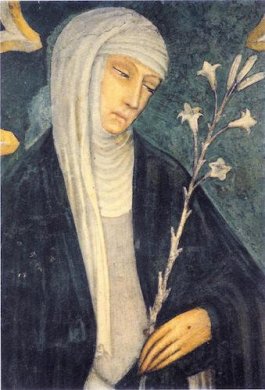
April 28 – Wednesday of last week – was the Feast Day of St. Catherine of Siena, the 14th-century saint, mystic, reformer, and Doctor of the Church. I wanted to post about St. Catherine last week, but I was swimming in book edits.

On Catherine’s Feast Day, I noticed the quotations everyone was posting, especially this one: “Be who God meant you to be and you will set the world on fire.” This is surely Catherine’s most popular saying today. We see in it an encouragement to fulfill our destiny and bring our unique spirit to the world. Very good. Except this isn’t what Catherine said. Not exactly.

The quote we know is a paraphrase from one of Catherine’s letters to a nobleman named Stefano di Corrado Maconi, one of her disciples. For a long time, she tried to persuade Stefano to enter the monastery because she saw his spiritual depth. She also needed his practical help. In a letter, she asks him to use his influence on the Sienese government to support Pope Urban VI against the antipope (Clement VII). At the end of the letter, she says,

If you are what you ought to be, you will set fire to all Italy, and not only yonder.

Setting fire to Italy is no small thing. Italy was Catherine’s and Stefano’s primary sphere of influence. But she adds the words “and not only yonder,” by which she perhaps means the larger Christian world as well.

Stefano is to light this fire by being who he “ought to be.” But not on his own. Reading Catherine’s letter, it’s clear that Stefano should be who he ought to be in Christ. He needs to be filled with the remembrance and love of God and so embrace his true identity. He is to do this in two ways. First, he needs to stop monkeying around about his faith. Catherine quotes the time Jesus warned Christians about being lukewarm:

I, Catherine, servant and slave of the servants of Jesus Christ, write to thee in His precious Blood: with desire to see thee arise from the lukewarmness of thy heart, lest thou be spewed from the mouth of God, hearing this rebuke, ‘Cursed are ye, the lukewarm! Would you had at least been ice-cold!’

CatherineofSienaAnd second, Catherine urges haste. Stefano seems to be dithering in his support of the Church and in what Catherine believes to be his true vocation. She writes her letter to him with an urgency that I love. I read her words as if written to us today. The time is short, she seems to say. The day draws to a close. And I —you, we—are called to step into being who we are in Christ. Don’t be lukewarm! Be on fire for Jesus! Be filled with gratitude. God needs us, so let’s get to work. Now!

Being who we are in Christ is no small thing. It is, in fact, one of our biggest tasks in life. The world needs what we, each of us uniquely, have been gifted. It needs our God-given passions. It needs our fire. It needs us to illuminate our little spheres of influence, “and not only yonder.” But to set our Italys on fire, we need first to be filled with the fire of the Spirit. We can’t do it on our own.

It was only after Catherine died that Stefano embraced his vocation and became a Carthusian monk. How about us? Will we dither? Or will we embrace our God-given fire? Why do we delay? The time is short. The world is waiting.


WEEKLY PRAYER: ST. ANSELM

Today’s prayer comes from St. Anselm of Canterbury (1033/4 – 1109). Let’s pray with him for all who are afflicted and distressed.

***

We bring before Thee, O Lord, the troubles and perils of people and nations, the sighing of prisoners and captives, the sorrows of the bereaved, the necessities of strangers, the helplessness of the weak, the despondency of the weary, the failing powers of the aged.

O Lord, draw near to each; for the sake of Jesus Christ our Lord. Amen.


Source

LIVING IN PANDEMIC TIME: by Prasanta Verma

We’ve heard of kairos time and chronos time. Maybe, tongue in cheek, now we have “pandemic time”. Indeed, how do we define time during a pandemic? There is the slow, thick movement of monotonous days at home during quarantines. Simultaneously, there is the sense of urgency and flurry of activity at a hospital in the epicenter, where mere moments matter in saving a life. Time moves at both of these ends as well as somewhere in the middle, in the in-between. Maybe we are even naming our days “B.P.” for “Before Pandemic” and “A.P.” for “After Pandemic.”

Perhaps this is how we do name this strange time: an in-between time, a “pandemic time”. We are in-between what life used to be and what life will be on the other end of this particular stretch of time. In a sense, though, we have always really existed in an in-between time: we are constantly between any two tasks of a day, between morning and evening, between life and death, between the temporal and eternal.

Yet perhaps now we feel the existence of this middle state a little more keenly than we did before. We are distinctly more aware of this space of waiting, this “in-between” time.

I am reminded of the words of Madeleine L’Engle, who wrote in Walking In Water, “When I am constantly running there is no time for being. When there is no time for being there is no time for listening.”

I ponder these words, “no time for “being.” Who was I “being” before? Who do I need to be now, amidst the pandemic? And how much of the running B.P. (Before Pandemic) was necessary, fruitful, helpful? Does anything need to change? Who do I need to “be” After Pandemic?

What do I need to listen to in the midst of social isolation? Who should I listen to? With the usual face-to-face meetings and group gatherings turned virtual or disappearing for a while, what am I listening to? What was I missing amidst the noise, during the other routine, the before routine? Even now, it is hard to stick to a routine with the lack of structure and all other activities put on hold. Yet, I am asking myself what am I listening to now, and what do I need to listen to after, in this in-between time?

L’Engle continues, “but BEing time is never wasted time. When we are BEing, not only are we collaborating with chronological time, but we are touching on kairos, and are freed from the normal restrictions of time.”

How freeing it is to consider that our “BEing time is never wasted.” Even as we are trying to balance working from home while children may be tugging at our knees, amidst the challenges of finding new routines, new work-flows, the lack of structure, and the new challenges and blessings of more family time, we are not wasting our days if we are truly being in them. Anytime we are truly being in our days is not wasted, pandemic or no pandemic.

“If we are to be aware of life while we are living it, we must have the courage to relinquish our hard-earned control of ourselves,” writes L’Engle. The unique factor about our situation is the encompassing nature of it, as the entire world has been catapulted into a new reality and we all experience it simultaneously, in varying degrees. This situation is occurring beyond our control and we are on the back-end, maneuvering our way through and beyond. While the people on this planet together share the uncertainty and trauma of this new state of being, we are also learning, each in our own unique way, how much control we did not have. We each have new boundaries, new norms, new paradigms, and we will all face a new state of being “after”. As we have never lived through such a pandemic, we have no fallbacks, no “way-back-whens”, no other comparables. We are walking into the future together, yet also separate, in our own aloneness and our own new states of post-pandemic being, with the lessons the pandemic taught us.

While we may be living in isolation these days, L’Engle reminds us that, “Our story is never written in isolation. We do not act in a one-man play. We can do nothing that does not affect other people, no matter how loudly we say, ‘It’s my own business.’ ”

As we stand in this in-between place of Before Pandemic and After Pandemic, we are not truly existing in isolation. While we may not yet be able to visualize the practicalities and realities of our post-pandemic world, we can be certain that even while we operate in social isolation, our stories and our “beings” are all woven together in a social fabric of connection and belonging.

We, as individuals, as nations, as a planet, are undergoing challenges to our previous ways of being. We certainly do not have all the answers yet for those realities, but one thing we can control is our own individual attentiveness to “being” present where we are. It may be months or years before all of the stories and truths learned from these days will be presented or even manifested. But for now they exist, simmering under the surface, breathing silently in these days of isolation, in these in-between days, waiting for the right time to be unveiled. Each untold story being written right now will have its own perfect time of being.

***

Prasanta Verma, a poet, writer, and artist, is a member of The Contemplative Writer team. Born under an Asian sun, raised in the Appalachian foothills, Prasanta currently lives in the Midwest, is a mom of three, and also coaches high school debate. You can find her on Twitter @VermaPrasanta, Instagram prasanta_v_writer, and at her website: https://pathoftreasure.wordpress.com/.


WEEKLY PRAYER: CATHERINE OF SIENA

Wednesday, April 29, is the Feast Day of St. Catherine of Siena, a Dominican laywoman, mystic, mentor of popes, and church reformer. Her prayers and spiritual writings continue to inspire us today.

For our prayers this week, I’m featuring two recent videos in my series, “The Prayers of St. Catherine of Siena.” Each is a burst of encouragement and hope that we need during this time.

In the following prayer, St. Catherine asks God for help in responding to our neighbors with love and generosity–perfect for this time of pandemic:


***

And in our second prayer, Catherine reflects on how God has given us his own nature, which is fire:


I hope these prayers bless you this week!


WEEKLY PRAYER: ST. ANSELM

Today is the Feast Day of St. Anselm of Canterbury, (1033 – 1109), a Benedictine monk, abbot, philosopher, and theologian. We are praying one of his meditations:

Lord, because you have made me, I owe you the whole of my love; because you have redeemed me, I owe you the whole of myself; because you have promised so much, I owe you my whole being. Moreover, I owe you as much more love than myself as you are greater than I, for whom you gave yourself and to whom you promised yourself. I pray you, Lord, make me taste by love what I taste by knowledge; let me know by love what I know by understanding. I owe you more than my whole self, but I have no more, and by myself I cannot render the whole of it to you. Draw me to you, Lord, in the fullness of your love. I am wholly yours by creation; make me all yours, too, in love.


Source