FRIDAY FAVORITES FOR PRAYER AND WRITING

Each Friday I share some of my favorite finds related to praying or writing. If I think it could help you pray or write better, or just “be” better, I’ll include it below.

Do you have someone else’s article or post to share? Join the Contemplative Writers Facebook group, comment on today’s post on my Facebook page, or follow me on Twitter (@LisaKDeam) to nominate your favorite articles, blog posts, and books by Thursday at noon each week.

*****

Prayer Made Sense When Henri Nouwen Told Me To Give Up via Ed Cyzewski

Martin Sheen: Spirituality of Imagination via Krista Tippett

The Contemplative Way as a Practice in Death via Drew Jackson

101 Books to Dive into this Summer: A Massive Reading List via Rebekah Barnett and Chelsea Catlett (TED-speaker recommended books – just in case you don’t have enough piled on your nightstand right now)

7 Prayers I Pray for People I Love via Judy Douglass

Nothing and Everything (Reflections on a Retreat) via Lisa Bartelt

BOOK OF THE MONTH: THE REVELATIONS OF DIVINE LOVE

Week Four: Desire and Divine Will

All Shall Be Well

In The Revelations of Divine Love, Julian of Norwich describes our desires and the divine will as these relate to prayer. God gives us what he wills us to have, and then he makes us yearn for it.

I’m pretty blown away by the idea that in prayer, we ask for what God already plans to give us. It’s hard to wrap my mind around that concept! Here’s what Julian says:

Christ told me from whom our prayers come when He said, “I am the Ground.” And we see how they come to life in the centers of our being when He said, “It is my will first that you have whatever it is, and then I make you yearn for it.” The second thing God wants us to understand about prayer is how we should carry it out. The answer to this is that we choose with all our mental powers to align our desires with the Divine Will; this is what He meant when He said, “Then I make you yearn for it.”

*****

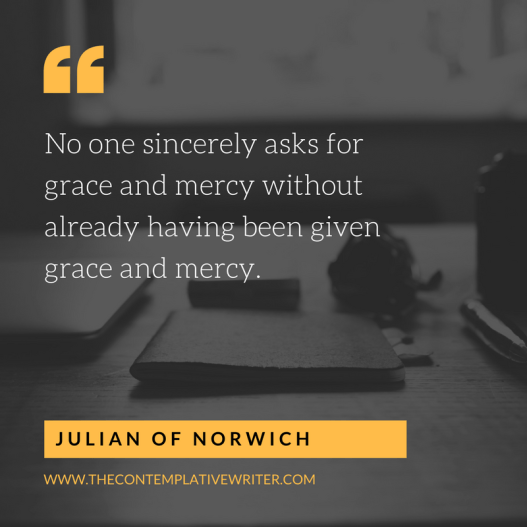
No one sincerely asks for grace and mercy without already having been given grace and mercy.

*****

[T]he greatest acts of God have already been accomplished (just as the Church teaches), and as we meditate on this, we pray for the action that is already being accomplished: that God directs us while we live on Earth, so that God is enriched by our lives, and that we be brought to Divine Joy in Heaven. And then God will have accomplished everything.

*****

Our Protector wants us to pray for everything, whether in general or in particular, that God has laid out to happen. As far as I can see, the thanks, joy, delight, and worth that God grants us in return is beyond our ability to comprehend!

*****

Julian of Norwich (1342 – c. 1416) was an English visionary, mystic, anchoress, and writer. Read about her here.

I’ve been enjoying the Divine Revelations in a modern translation entitled All Shall Be Well.

For reflection:

Julian of Norwich Week 4

FRIDAY FAVORITES FOR PRAYER AND WRITING

Each Friday I share some of my favorite finds related to praying or writing. If I think it could help you pray or write better, or just “be” better, I’ll include it below.

Do you have someone else’s article or post to share? Join the Contemplative Writers Facebook group, comment on today’s post on my Facebook page, or follow me on Twitter (@LisaKDeam) to nominate your favorite articles, blog posts, and books by Thursday at noon each week.

*****

Of Killer Whales and Killers via Leslie Leyland Fields (on not giving up on despair, longing, our country, and God)

Why Do We Bother? via Emily Polis Gibson (“We get up to see just what might happen…”)

The Skeptic’s Guide to Spiritual Practices: Prayer via Stina Cook (in which Marilla Cuthbert helps us learn the value of structured prayer)

Many Ways to Pray: Walking A Labyrinth via Jodi Gehr (discover how to pray using this ancient practice)

To discover one’s heart is an act of reintegration . . . via Fr Aidan (Alvin) Kimel (linking our breath to the Jesus Prayer)

You know you’re a Serious Reader when . . . via Anne Bogel (Anne dishes with Shawn Smucker on favorite books and summer reading)

GUEST POST: An Excerpt from Flee, Be Silent, Pray by Ed Cyzewski

Flee be silent pray cover ebook final copyToday, I’m excited to offer an excerpt from Flee, Be Silent, Pray: An Anxious Evangelical Finds Peace with God through Contemplative Prayer, a new book by Ed Cyzewski, founder of The Contemplative Writer. Ed’s book released this week.

In the excerpt below, Ed explains why solitude, rather than more information and more effort, might be a good place to start when struggle, burn out, or crisis occurs. I know you’ll appreciate the wisdom he offers here.

*****

A spiritual struggle, burn out, or breakdown in my conservative Christian tradition is often treated with more information. The assumption is that you forgot something, never learned it, or distorted the information in the first place, despite your best efforts. I remember worrying that my own sincerity or grasp of the information didn’t click. If I could just line up the right information with the proper mental outlook, things would finally fall into place. This is why so many young evangelicals struggle with sin and then pray the sinner’s prayer again (and again) or rededicate their lives to God.

The sentiment is admirable, as we can all relate to wanting to grow spiritually or getting on the right path, but such an approach to spiritual transformation remains more or less in our control and fails to proceed beyond a confession of faith. Professing our faith and commitment to Christ is certainly a good place to start, but it’s hardly what mature, growing followers of Jesus need.

Solitude isn’t my cure-all that guarantees a vibrant spiritual life, but it has become a vital refuge that saves me from my own inadequate remedies and faulty illusions of myself and others. Nouwen speaks of solitude as the furnace of transformation. “Without solitude we remain victims of our society and continue to be entangled in the illusions of the false self” (The Way of the Heart 25). I can think of no better thing for anxious evangelicals who have come to the limits of personal effort and knowledge. Entering solitude with open hands can free us to receive whatever God will give us. I have often gone into solitude with my own plans and agenda.

I’m not naturally comfortable with mystery, especially with a mysterious God, after dedicating so much time to theological study. Solitude strips away the script that theology can provide for God. In silence before God alone, I am forced to surrender any scripture verses that I may be tempted to manipulate in my moment of need, as if I could trap God by using his own words against him. I can only surrender to the mystery of God in the silence.

There are deep mysteries to God’s love and presence, and solitude is one of the ways I have inched closer to them. What I know of God’s love and presence feels very much like drops of water from a limitless stream. What we’ve come to believe and trust may crumble to dust in the pursuit of solitude. This is just as well. Any illusions or false conceptions of ourselves or of God will crumble eventually regardless.

Solitude allows us to preemptively expose these illusions before they let us down in the midst of a crisis. In solitude, we “die” to ourselves so that God can raise us up. Nouwen wrote, “In solitude, our heart can slowly take off its many protective devices, and can grow so wide and deep that nothing human is strange to it” (Out of Solitude 45).

*****

The desert fathers and mothers saw solitude as a way to replace martyrdom when Christianity became the official religion of the Roman Empire. In his introduction to the spirituality of the desert fathers and mothers, John Chryssavgis writes, “The voice of the desert’s heart replaced the voice of the martyr’s blood. And the Desert Fathers and Mothers became witnesses of another way, another Kingdom” (In the Heart of the Desert 17).

There was no surer way to strip away what they depended on in place of God. This was a kind of “death” for them that lead to new life. They sought the union with Christ that Paul spoke of (1 Corinthians 6:17; Romans 8:9-11) and set aside every possible distraction. Nouwen assures us that “solitude molds self-righteous people into gentle, caring, forgiving persons who are so deeply convinced of their own great sinfulness and so fully aware of God’s even greater mercy that their life itself becomes ministry” (The Way of the Heart 37).

Flee, Be Silent, Pray is available now, $2.99 as an eBook, $9.99 for print:
Kindle | Print | iBooks | Kobo | B&N
Download a Sample Chapter Here

Ed Cyzewski Author Cafe Square


Ed Cyzewski is the author of A Christian Survival GuideFlee, Be Silent, PrayPray, Write, Grow; and other books. He writes at www.edcyzewski.com and is on Twitter at @edcyzewski.



GUEST POST: The Blessings from the Animals by Andi Cumbo-Floyd

Welcome to a new feature here at The Contemplative Writer. Every so often, I’ll be having guest writers share with you their thoughts on prayer, writing, and the contemplative life. I think their voices will bless you.

Our first guest post from Andi Cumbo-Floyd introduces a spiritual pause or practice that caps the day on her farm near the Blue Ridge Mountains. It also references one of my favorite books! Enjoy the richness of Andi’s words . . .

*****

Animals - Andi Cumbo-Floyd
Most evenings, when my husband has come home from work and I have put away the computer, the smart phone, and the e-reader, when the chores are finished and all the animals fed, he and I sit side-by-side in wrought-iron chairs he rescued from a dumpster and watch our rabbits eat and play.

It’s one of the highlights of my day.

**

There’s something about the simple expansive of animals that fills my soul. Their eyes gaze deep, and their bodies never mask what they are feeling in spirit and flesh.

As long as I am kind, their affection and trust in me grows. Their motives are pure, and they are never influenced by intentions that are hidden or impure. They are, ultimately, self-serving, but they are, ultimately, intimate, wide-open, innocent.

**

“Safe?” said Mr. Beaver; “don’t you hear what Mrs. Beaver tells you? Who said anything about safe? ‘Course he isn’t safe. But he’s good. He’s the King, I tell you.”

Of all the lines in all the books I’ve read, this is, perhaps, my favorite. It’s spoken of Aslan, the Lion, the great King of Narnia and all the worlds. On days when I doubt that the world can be good, when even the sweet spirit of our animals cannot cheer me, I remember these words . . . I remember the Lion – not always safe but always good.

**

In the evening, as our rabbits play beneath the walnut tree, my husband and I sit. We listen to the goats tussle for grain and hay. We hear the rooster crow from beyond the farm house and hear the up-ended cluck of a hen laying. In the distance, a neighbor’s donkey, Lugnut, brays, and another’s cattle low.

Just then, when that chorus of animal song takes a fermata of breath, one rabbit launches himself into the air, his feet sideways in joy, and I laugh long and hard.

Not always safe but always good.

*****

Andi Cumbo-Floyd is a writer, editor, and farmer who lives at the edge of Virginia’s Blue Ridge Mountains with her husband, 4 dogs, 4 cats, 6 goats, 40 chickens, and 3 rabbits. You can read more of her writing at Andilit.com and more about her farm at godswhisperfarm.com.

FRIDAY FAVORITES FOR PRAYER AND WRITING

Each Friday I share some of my favorite finds related to praying or writing. If I think it could help you pray or write better, or just “be” better, I’ll include it below. This week’s finds tend more toward spirituality than writing; some weeks are just like that.

Do you have someone else’s article or post to share? Join the Contemplative Writers Facebook group, comment on today’s post on my Facebook page, or follow me on Twitter (@LisaKDeam) to nominate your favorite articles, blog posts, and books by Thursday at noon each week.

*****

12 Best Practices for Finding Time, Energy, and Inspiration to Write + A Prayer for Writers via Sarah Bessey (notes from Sarah’s workshop at the Princeton Theological Seminary’s Frederick Buechner Writer’s Workshop)

Franciscan Spirituality: Week 1 via Richard Rohr (on St. Francis, a “second Christ”)

Putting on the Mind of Christ via Chuck DeGroat (what is “unknowing” and how does it relate to putting on the mind of Christ?)

The Wonder Of It All via Sharon Brani (finding God in the beauty of the cosmos; after you read this essay, check out the entire June issue of The Redbud Post on finding God in creation)

Meditation Monday: Rest In The Peace Beyond Understanding via Christine Sine (how to journey peacefully amidst life’s challenges)

Exploring Summer Sabbath via Whitney R. Simpson (soul care tips for your summer)

Books Can Keep You Stitched Together via Velynn Brown (on the power of story and books as friends)


CONTEMPLATIVE PROFILE: WALTER HILTON

In last week’s post, we saw that the English mystic Walter Hilton likened prayer to fire. He continues this analogy in a letter to a layperson. He writes a beautiful description of what he calls the “mixed life:” a life marked by a rhythm of labor and prayer.

[T]he will and desire you have toward God is like a little coal of fire in your soul. It gives you a certain amount of spiritual heat and even light, but it is quite little, and threatens to grow cold in idleness and want of fuel. At that point it is good that you should put against it some sticks of wood—good labors of the active life. And if it seems for a time that these duties shroud or overshadow the coal of your desire, that it does not burn as cleanly and fervently as you would want, then do not be fearful, but rather be patient awhile.


Then blow at the fire—after doing your proper duties and service, go alone to your prayer and meditation, and lift up your heart to God, praying him of his goodness that he will accept the work that you have done as unto his pleasure.

I’m encouraged by Hilton’s conviction that the active life is a way to serve God.

Source.

Walter Hilton (c. 1340 – 1396) was an Augustinian canon and a mystic. He was the first person to write a treatise on mysticism in the English language.

FRIDAY FAVORITES FOR PRAYER AND WRITING

Each Friday I share some of my favorite finds related to praying or writing. If I think it could help you pray or write better, or just “be” better, I’ll include it below.

I found so many good articles and posts this week: some deeply spiritual, some funny, some practical the internet was on fire, it seemed! If you have someone else’s article to nominate, be sure to let me know next week before noon on Thursday.

*****

Laser Listening: Paying Attention from Inside Out (an interview with author Adam S. McHugh)

Liturgical Meditations: Pentecost (a video meditation from Fuller Studio)

I want to be all flame via Morgan Guyton (on becoming overwhelmed by the brilliance of God)

This Is the Place via Carolyn Arends (a video reflection on the intersection of spirituality, music, and songwriting)

Prayer for a New Day of Promise and Opportunity via April Yamasaki (“The day lies before us like a page waiting to be written . . .”)

Finding God in Fairytales via Tanya Marlow (how stories, imagery, and faraway worlds help us connect with God)

Getting to the Core of Your Distractions via C. S. Lakin (identifying what most distracts you and keeps you from being productive)

The Writer’s Process via Hallie Cantor (hilarious . . . because if you don’t laugh, you’ll cry)

BOOK OF THE MONTH: BEFRIENDING SILENCE

Week Four: The Community of Prayer

Befriending Silence

Reading Carl McColman’s Befriending Silence, I found the two biggest takeaways to be the importance of living a life in community and a life of prayer. These two ways of life might at first seem like opposites. Contemplative prayer, after all, is often undertaken in solitude. If we happen to be writers, we spend even more time alone!

Yet McColman reminds us that prayer, even silent prayer, makes us part of a larger community. This is a gift and, for non-monastics, sometimes a challenge. Here’s what McColman has to say about community:

The Cistercian way of life rests on the idea that spirituality needs community.

*****

Monks and nuns enjoy the support of a community that prays together multiple times every day, where everyone is expected to take part in the liturgy in a public way. Those of us who are not monastics . . . do not have an abbot or abbess who will check up on us if we start skipping prayers, so we have to be truly intentional about our decision to make prayer a priority.

*****

Christian prayer always has a communal or social dimension to it, even when we pray in solitude . . . Prayer makes a difference in our lives, not just in terms of personal spiritual growth but also as a means by which we discover God’s love and compassion expressed for the world.

*****

When we pray for our family, friends, neighbors, coworkers, our community and nation, as well as our adversaries, enemies, competitors and opponents, the space to slowly, gradually grow in compassion and love opens within us.

*****

Read more here.

For reflection:

McColman Week 4

FRIDAY FAVORITES FOR PRAYER AND WRITING

Each Friday I share some of my favorite finds related to praying or writing. If I think it could help you pray or write better, or just “be” better, I’ll include it below.

Do you have someone else’s article or post to share? Join the Contemplative Writers Facebook group, comment on today’s post on my Facebook page, or follow me on Twitter (@LisaKDeam) to nominate your favorite articles, blog posts, and books by Thursday at noon each week.

Slow Down (An Invitation) via Kelly Chripczuk ( a lovely poem to help you be in the moment)

Memorise a poem – reciting one can be as calming as mindfulness via Allie Esiri (what a wonderful idea!)

Now, Courage Looks Like This via Shawn Smucker (for days when inspiration . . . waits)

A Responsibility to Light: An Illustrated Manifesto for Creative Resilience and the Artist’s Duty in Dark Times via Maria Popova (“Feel all the things. Feel the hard things ….”)

A Writer’s Worst Fear via William Kenower (on approval, solitude, and fearless writing)

So you want to be a writer? Essential tips for aspiring novelists via Colum McCann (some practical tips)