How Exercising Helps Us Pray and Write

Don’t let today’s featured article about running and writing turn you away if you can’t fathom the practice of running daily. Nick Ripatrazone writes in The Atlantic about the benefits of running for writers and the ways that the flow of running connects with the flow of writing.

I have personally found that most of this article also applies to contemplative prayer. Both writing and prayer can thrive when we immerse ourselves in a simple, repetitive practice that allows our minds to be clear and our imaginations to wander.

Whether you walk, swim, bike ride, run, or do something else to exercise, your writing and your prayer will benefit over the long term. It may take a while to train your mind alongside your body, but I was personally shocked at all of the benefits I saw after only three months of running four days a week. Here are a few key quotes from Ripatrazone’s article:

*****

“In many ways running is a natural extension of writing. The steady accumulation of miles mirrors the accumulation of pages, and both forms of regimented exertion can yield a sense of completion and joy. Through running, writers deepen their ability to focus on a single, engrossing task and enter a new state of mind entirely—word after word, mile after mile.”

*****

“Once I built a tolerance for distance my runs became incubators for writing ideas. The steady, repetitive movement of distance running triggers one’s intellectual autopilot, freeing room for creative thought. Neuroscientists describe this experience as a feeling of timelessness, where attention drifts and imagination thrives.”

*****

“Writing exists in that odd mental space between imagination and intellect, between the organic and the planned. Runners must learn to accept the same paradoxes, to realize that each individual run has its own narrative, with twists and turns and strains.”

*****

Read more at The Atlantic.


Keep the Contemplative Writer Sustainable

The Contemplative writer is ad-free and never shares sponsored content, but it is a lot of work to maintain. We rely on affiliate links from the books we share and the generous gifts of our readers. An automated monthly gift as low as $1 per month or a one-time gift of $5 goes a long way to sustaining our mission to provide contemplative prayer resources for our readers. Thank you!

Choose a recurring monthly donation:

support-patreon-orange

Make a one-time gift via PayPal (credit cards accepted!)


Donate Now Button

Learn more about how to support us.


Featured Contemplative Book: 100 Days in the Secret Place

100-days-secret-placeWeek Two: Overcoming Distraction During Prayer

When I ask subscribers about their greatest struggles for prayer, I routinely hear about distraction. If we aren’t already struggling with feeling worthy before God, focusing our attention on prayer is extremely difficult. The quotes from our book of the month should prove helpful with their simple advice.

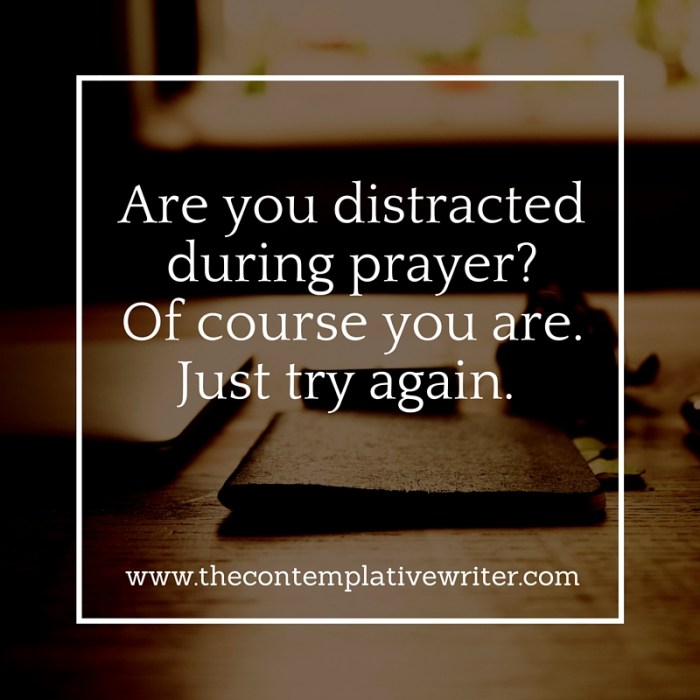
The short version is this: Are you distracted during prayer? Of course you are. Just try again. 

Gene Edwards, author of Divine Romance, has gathered together key writings from three notable Christian mystics from the seventeenth century: 100 Days in the Secret Place: Classic Writings from Madame Guyon, Francois Fenelon, and Michael Molinos on the Deeper Christian Life by Gene Edwards. Here are several quotes to consider today:

*****

Your imagination may ramble over an infinite number of thoughts, yet, I assure you, the Lord has not left. Continue your perseverance in prayer. Remember that He prays within you, and He prays in spirit and in truth. The distraction of the mind—which is not intended—does not rob the prayer of its fruit.

*****

Faith and intention are always enough.

*****

If you should sin (or even if it is only a matter of being distracted by some circumstances around you), what should you do? You must instantly turn within to your spirit.

*****

Do not become distressed because your mind has wandered away. Always guard yourself from being anxious because of your faults. First of all, such distress only stirs up the soul and distracts you to outward things

*****

Learn more here.

Keep in Touch

Get our latest blog posts delivered to your inbox or sign up for the weekly contemplative email and receive a free eBook: The Contemplative Writer.


For Reflection

Featured book May 9, 2016


Saturday Prayer: God the Father, Heavenly Light

Today’s prayer comes from the Divine Hours:

God the Father, Heavenly Light
O Trinity of blessed light, O Unity of princely might, The fiery sun now goes his way; Please shed within our hearts your ray To you our morning song of praise, To you our evening prayer we raise; O grant us with your saints on high To praise you through eternity. To God the Father, heavenly Light, To Christ revealed in earthly night, To God the Holy Ghost we raise Our equal and unceasing praise.
Latin, 6th C.

Follow this updated page of the Divine Hours.

Friday Favorites for Prayer and Writing

Each Friday I share some of my favorite finds related to praying or writing. If I think it could help you pray or write better, then I’ll include it below.

Do you have someone else’s article or post to share? Join the Contemplative Writers Facebook group, comment on today’s post on my Facebook page, or follow me on Twitter (@edcyzewski) to nominate your favorite articles, blog posts, and books by Thursday at noon each week.

One Googler’s Take on Managing Your Time (I included a really helpful bit below)

Your energy levels run the course of a wave throughout the week, so try to plan accordingly: Aim to do the following:

  • Monday: Energy ramps out of the weekend — schedule low demand tasks like setting goals, organizing and planning.
  • Tuesday, Wednesday: Peak of energy — tackle the most difficult problems, write, brainstorm, schedule your Make Time.
  • Thursday: Energy begins to ebb — schedule meetings, especially when consensus is needed.
  • Friday: Lowest energy level — do open-ended work, long-term planning and relationship building.

Always bias your Make Time towards the morning, before you hit a cycle of afternoon decision fatigue. Hold the late afternoon for more mechanical tasks.

How to Pray through Interruptions via Lisa Deam

The Curious Blessing of Rejection via Tanya Marlow

What Slowing Down Teaches You That Rushing Never Will via Amy Julia Becker

Off Brand by Sarah Bessey (Let’s just give the entire Internet to Sarah.)

Religion Is the Only Hope for the American Church by Morgan Guyton

The Slant Letter by Stephanie Smith

Looking for more recommendations? Check out our Prayer Resources page.


Why We Need the Restoration of Silence

I’m somewhere in the middle of the Highly Sensitive spectrum, so I’m very aware of how noise impacts my anxiety levels and ability to concentrate. However, some of the most recent research in neuroscience is finding that we don’t just need silence as a break from the noise. We need silence in order for our brains to process information and to more or less “recover” from the noise of life.

Studies are finding that children who grow up near airports, highways, and other noisy environments have higher levels of stress and tend to struggle to concentrate in school. Without down time, our brains become overloaded.

One of the most important benefits of practicing contemplative prayer has been a greater awareness of my mental state and when I need to take a break. Prayer is much easier when my brain isn’t spinning out of control! Here are a few helpful quotes from a LifeHacker article on the importance of silence:

*****

When the brain rests it is able to integrate internal and external information into “a conscious workspace,” said Moran and colleagues.

When you are not distracted by noise or goal-orientated tasks, there appears to be a quiet time that allows your conscious workspace to process things. During these periods of silence, your brain has the freedom it needs to discover its place in your internal and external world.

*****

It has been found that noise can have a pronounced physical effect on our brains resulting in elevated levels of stress hormones. The sound waves reach the brain as electrical signals via the ear. The body reacts to these signals even if it is sleeping. It is thought that the amygdalae (located in the temporal lobes of the brain) which is associated with memory formation and emotion is activated and this causes a release of stress hormones. If you live in a consistently noisy environment that you are likely to experience chronically elevated levels of stress hormones.

*****

According to the attention restoration theory when you are in an environment with lower levels of sensory input the brain can ‘recover’ some of its cognitive abilities. In silence the brain is able to let down its sensory guard and restore some of what has been ‘lost’ through excess noise.

*****

Read the rest of the LifeHacker article here.


Keep the Contemplative Writer Sustainable

The Contemplative writer is ad-free and never shares sponsored content, but it is a lot of work to maintain. We rely on affiliate links from the books we share and the generous gifts of our readers. An automated monthly gift as low as $1 per month or a one-time gift of $5 goes a long way to sustaining our mission to provide contemplative prayer resources for our readers. Thank you!

Choose a recurring monthly donation:

support-patreon-orange

Make a one-time gift via PayPal (credit cards accepted!)


Donate Now Button

Learn more about how to support us.


Featured Contemplative Book: 100 Days in the Secret Place

Week 1: Healing through Our Suffering

100-days-secret-placeIf you’re looking for a book that will offer a challenge to seek the deeper spiritual life with God and to make prayer a higher priority, 100 Days in the Secret Place is at the top of my list.

Gene Edwards, author of Divine Romance, has gathered together key writings from three notable Christian mystics from the seventeenth century: Miguel de Molinos, Madame Jeanne Guyon, and Francois Fenelon: 100 Days in the Secret Place: Classic Writings from Madame Guyon, Francois Fenelon, and Michael Molinos on the Deeper Christian Life by Gene Edwards.

This week I’m highlighting a series of quotes on the ways that God works with us in the midst of suffering, failure, and disappointment.

*****

Do you want to experience true happiness? Submit yourself peacefully and simply to the will of God, and bear your sufferings without struggle. Nothing so shortens and soothes your pain as the spirit of nonresistance to your Lord.

*****

Let God use trials to help you grow. Do not try to measure your progress, your strength, or what God is doing. His work is not less efficient because what He is doing is invisible.

*****

With people you love you do not need to continually say, “I love you with all my heart.” Even if you do not think about how much you love Him, you still love God every bit as much. True love is deep down in the spirit—simple, peaceful, and silent.

*****

Do not disturb yourself by trying to manufacture an artificial sense of God’s presence. Slowly you will learn that all the troubles in your life—your job, your health, your inward failings—are really cures to the poison of your old nature. Learn to bear these sufferings in patience and meekness.

*****

God wants to build a relationship with you that is based on faith and trust and not on glamorous miracles.

*****

These mystics don’t suggest that God intentionally brings suffering to us. Rather, God remains with us in the midst of our sufferings, bears our burdens, and ministers to and through us as we bear hardships.

Keep in Touch

Get our latest blog posts delivered to your inbox or sign up for the weekly contemplative email and receive a free eBook: The Contemplative Writer.


For Reflection or Sharing

How is God reaching out to you today?

Week 1 Featured book May 2, 2016.jpg

Saturday Prayer from St. Francis

This Saturday’s prayer from St. Francis comes from Jon Sweeney’s biography: The Road to Assissi:

“Great and glorious God, and you, Lord Jesus,

I pray you, shed abroad your light in the darkness of my mind. . . .

Be found in me, Lord, so that in all things I may act only in accordance with your holy will.”

Friday Favorites for Prayer and Writing

Each Friday I share some of my favorite finds related to praying or writing. If I think it could help you pray or write better, then I’ll include it below.

Do you have someone else’s article or post to share? Join the Contemplative Writers Facebook group, comment on today’s post on my Facebook page, or follow me on Twitter (@edcyzewski) to nominate your favorite articles, blog posts, and books by Thursday at noon each week.

When the Darkness Lifts by Kelly J. Youngblood

The Liturgists Podcast: An Interview of Richard Rohr

How Our Salvation Begins by Kelly Chripczuk

Rest Easy, You’re Loved No Matter What by Aundi Kolber

Keep Showing Up and Finishing Stuff by Me (Read the comments!)

13 Powerful Women Mystics Who Helped Shape Christianity

Looking for more recommendations? Check out our Prayer Resources page.

Contemplative Profiles: Margery of Kempe

Some of the most important reforms (or attempts at reforms!) in the history of the church came from women who not only held themselves to far more rigorous standards than men but who were rarely trusted. In fact, many female contemplatives were threatened with death, exile, or imprisonment.

Margery Kempe was one of the spiritual leaders of the Medieval Church who predated many of the critiques leveled by the Reformation, calling Christians to love and devotion to Christ rather than relying on external practices.

Today’s contemplative profile of Margery Kempe comes from a list of Women in the Medieval Church featured in Christianity Today: 

*****

“Accused by her contemporaries of fraud or heresy, and often ridiculed by later scholars as hysterical or even crazy, Margery Kempe was born in Lyon, England, c. 1373, and died after 1438. She was an illiterate laywoman turned religious enthusiast who dictated her spiritual autobiography, The Book of Margery Kempe. It is the earliest known autobiography in English…”

*****

“Margery’s message is the exhortation to a simple, direct relationship with Christ based on unconditional faith and fervent love. She repeatedly downplays the importance of externals (such as fasting and the wearing of hair shirts), which, as Christ teaches her, are nothing compared to fervent love and devotion.”

*****


Reflection

In what ways can external practices become a substitute for devotion to Christ today?

Take 5 minutes to receive the love of Christ for you without precondition or limits.

How Boundaries Help Our Faith and Families Thrive

A spiritual director once told me that the concept of having “balance” in your life is often unhelpful. If anything, striving for balance creates false expectations and sets us up for failure.

I have personally found it far more helpful to think in terms of words like “intentional,” “boundary,” and “sustainability.” We can find healthy spirituality and healthy relationships by intentionally scheduling our time with clear boundaries. Our relationships and spiritual practices need to be the guarded non-negotiables that we make so easy to pursue that we eventually turn to them as a matter of habit.

That isn’t an easy place to arrive at. I know it’s a struggle each week for me. However, the more I get used to my schedule and the more I set boundaries around my day, the more I can settle into these daily habits.

While I don’t love the title of this Fast Company article about work-life balance, it offers some helpful tips for arranging your priorities and creating healthy habits for your spiritual life and relationships. Here are a few tips to consider:

*****

“People who have managed to carve out a work-life balance that works for them don’t just wait to see what time is left over after work. They make a point of planning and booking time off to spend outside of work and powerfully guard this time. While emergencies happen and situations come up that need their attention at work on occasion, they strongly resist any intrusion on this time.”

*****

“People who maintain balance are able to turn off their electronic devices to enjoy quality uninterrupted time doing matters they enjoy. They realize that multitasking is a myth and focus on the task at hand. Having developed the ability to compartmentalize their time, they seek out moments to simply enjoy the experience and savor life. Often they have discovered meditation, music, physical activity, or some other interest that allows them to get away from the pressures of everyday life…”

* * * * *

One other thing: If you asked me, most people could stand to get rid of their televisions, cancel cable, and see what happens for two months. I suspect you’ll end up having more conversations, reading more books, and having more time enjoyable activities. It’s so crazy that it just may work.

Keep the Contemplative Writer Sustainable

The Contemplative writer is ad-free and never shares sponsored content, but it is a lot of work to maintain. We rely on affiliate links from the books we share and the generous gifts of our readers. An automated monthly gift as low as $1 per month or a one-time gift of $5 goes a long way to sustaining our mission to provide contemplative prayer resources for our readers. Thank you!

Choose a recurring monthly donation:

support-patreon-orange

Make a one-time gift via PayPal (credit cards accepted!)


Donate Now Button

Learn more about how to support us.