FRIDAY FAVORITES FOR PRAYER AND WRITING

Sunday, December 1 marked the first day of the Advent season. For the next three weeks, Prasanta Verma and I want to provide some lovely links to nourish you during this season of anticipation, of waiting, of darkness pierced with the glimmering of light.

With this in mind, below you will find links to prayers, poetry, resources, reflections, and writing tips for the Advent season.

Be blessed as you await the coming of the light.

***

A Litany for the First Week of Advent via Christine Sine (welcome Advent with this prayer of supplication)

Surprised by Advent via Jen Pollock Michel (the first in a series of Advent audio reflections)

No Country for Two Kings via Leslie Leyland Fields (this is Leslie’s first Christmas poem in 20 years—she’s tried, but nothing…until now)

Advent–Waiting via Jody Lee Collins (a poem for Advent)

Advent Companions: The Books And Music I Love In The Season Of Waiting via Sarah Clarkson (we love this list of Advent resources)

Do You Have a Holiday Writing Plan? via Rachelle Gardner (some tips for surviving and thriving as a writer during this season)

***

With love to you,
Lisa and Prasanta


A Medium Aevum Advent

I’m heartened to see more and more Christians keeping Advent—not rushing to the feast, but spending time in holy expectation. The historian in me approves. When we observe Advent, we deepen our preparation for Christ’s coming by embracing the liturgical rhythms of the ancient Church. Some historical Advent practices, such as fasting, many of us do not keep today. Others, like the annual Christmas pageant, are still going strong (in the medieval Church the pageant was performed by choirboys).

This year, as I watch my daughters perform one of their own practices, I’ve been drawn to some wonderful medieval teachings on Advent. Perhaps I should say Advents. In one of his sermons for the season, written in the mid twelfth century, Bernard of Clairvaux speaks of not one but three comings of Christ. A century later, Thomas Aquinas adds yet another. That’s three more comings than most of us prepare for. It has taken my two children to help me absorb what these four advents might mean for me.

***

Christ’s first coming–no surprise here–is his historical advent. My daughters have developed an elaborate practice to prepare for this event: the manger scene. My girls set up their manger with the precision of an HGTV reality show. Everything must be just so. The picture on the box is consulted: Mary must stand here, Joseph there. The manger must be centered. Then and only then is the baby tenderly placed therein. But not for long; Jesus requires much more attention than that. He is taken out and taken care of, cradled and coddled until it is deemed the right time to lay him down again. I sometimes think God sent his son as a baby for the benefit of maternally inclined five-year-olds.

My girls’ mothering reminds me of a beautiful fourteenth-century devotional text, Meditations on the Life of Christ. In this text, readers are asked to imagine their way into the manger scene: “Kiss the beautiful little feet of the infant Jesus who lies in the manger and beg his mother to let you hold him a while.” Later, we are advised to step in and help Mary: “Be ready to give your services as if you could, meditate on them, delight and rejoice in them . . . and often gaze upon that face which angels desire to look upon.” Caring, with all our imaginative and spiritual faculties, for the baby Jesus: what a wonderful meditational exercise for the Advent season. I wonder if the infant Jesus slept through the night?

This exercise leads to another, perhaps deeper, form of preparation. In his sermon, Saint Bernard notes that Jesus not only came in the flesh. He also comes to our heart. He is hidden there: “Only his chosen see him in themselves, and they shall heal their souls.” I like to think of Jesus’ indwelling in us as a continuation of Mary’s work. Mary gave birth to Jesus and cared for him physically. Now it is our job to spiritually receive Christ and raise him up. He must grow to maturity in our heart.

My daughters pick baby Jesus up and put him down. They take him to town. They sing to him. Watching them play reminds me how much care Jesus needs to grow in me. It makes my heart tender but also afraid. I feel keenly my own lack. Sometimes I fail to care for my children the way I should. How can I possibly provide for Jesus? I need not only the baby but also the full-grown savior. My yearning for Christ’s grace is as great as my desire to cradle him in my heart.

Of course we know that Jesus’ cradle leads to the cross and the grace we so desperately need. These two yearnings are depicted in one of my favorite paintings, the Adoration of the Magi by the Flemish artist Rogier van der Weyden.
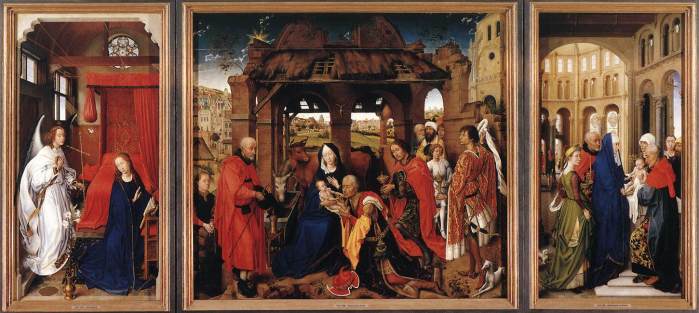
St. Columba Altarpiece

As one of the kings leans forward to kiss the infant Jesus, almost exactly as recommended by the Meditations on the Life of Christ, we see a small crucifix nailed to a post above his head.

Columba detailThis is a good painting for Advent because it keeps us from sentimentalizing the birth of Christ. If you want to grow up the baby Jesus, remind yourself that he’s headed to the cross. That will do it every time.

But Advent looks even farther ahead in the life of Christ. In his sermon, Bernard of Clairvaux reminds the Church that within Christ’s coming in the flesh is embedded the promise of his coming again. Jesus will return to earth, and the world will be made new. We are assured that whatever darkness surrounds us, God will bring his story to the glorious conclusion he foretold.

As we reflect on the teaching of the Mellifluous Doctor, we realize that Advent is truly ancient-future. It harks back to the birth of Jesus (and before that to the prophecies about him). It takes place in the present as he is born in our heart. And it looks forward to the end of earthly time. Advent is a season to meditate on the entire history of salvation through Jesus Christ, a season to both celebrate and yearn for the world’s redemption.

Admittedly, my girls seem far more earthly than eschatological when they play with their manger scene:

“He doesn’t want his blanket.”

“Yes, he does! All babies need their blanket!”

But, as Saint Bernard shows, the birth of Jesus is wrapped up in his other advents, even the ones that are invisible or that take place in a distant future. Christ’s comings cannot be separated one from another; one form of yearning leads to the next. It is strange to watch my daughters play and feel so much ache mixed in with my delight. When my girls are older I will tell them about the complex theology behind their childlike faith.

I could end my Advent meditation here. Bernard of Clairvaux does. His sermon, as I mentioned, teaches three comings of Christ—in the flesh, in our hearts, and at the end of time. But in an Advent sermon preached in 1271, Thomas Aquinas adds a fourth coming of Jesus. Christ comes, writes the Angelic Doctor, at the hour of our death. This coming is necessary to bring his “just ones” not only grace, but also glory.

I confess that with this teaching, my yearning grinds to a halt. It seems easier to long for the end of time than for my personal end. Yet Saint Thomas is not the only one to advise me on this subject. Centuries earlier, the desert father Pachomius said, “Have, therefore, the hour of your death ever before your eyes.” Even in Advent? Even when my children are so full of life and the whole world is telling me to be joyful? Upon reflection, I conclude that there is no better time. During this season, we prepare for a savior who came to defeat death—yes, even our own. When he comes for us, it will be to take us to glory.

And so, as I watch over my children, I learn to watch my heart. I coax and guide it to think on its final hour. If I can’t yet yearn for this coming of Christ, I can at least be alert. I ask my heart, are you ready? Christ will return for you one day, and this advent is every bit as real as his birth in the flesh and his coming again.

Thanks to two daughters and two doctors of the church, my Advent preparations are a strangely medieval mix of delight, yearning, and rather intense soul-searching. As a mother, I look for the coming of a baby, one as fleshy and sweet as my girls. I also remember that the baby Jesus grew up to save the world and that he will come again, both at the end of time and, likely before that, for me. May my heart be prepared to mother him now and to meet him when my time comes.

***

This essay was originally published on my website, lisadeam.com.

WEEKLY PRAYER: St. Ambrose

St. Ambrose (4th c.) was bishop of Milan and one of the original Doctors of the Church. His Feast Day is this week, on December 7. Today we’re praying Ambrose’s very moving prayer of healing, which follows his sermon on the healing of the paralyzed man in Luke 5 (17-26).

*****

Thee alone I follow, Lord Jesus, Who heals my wounds. For what shall separate me from the love of God, which is in Thee? Shall tribulation, or distress, or famine? I am held fast as though by nails, and fettered by the bonds of charity.

Remove from me, O Lord Jesus, with Thy potent sword, the corruption of my sins. Secure me in the bonds of Thy love; cut away what is corrupt in me. Come quickly and make an end of my many, my hidden and secret afflictions. Open the wound lest the evil humor spread. With Thy new washing, cleanse in me all that is stained. Hear me, you earthly men, who in your sins bring forth drunken thoughts: I have found a Physician. He dwells in Heaven and distributes His healing on earth.

He alone can heal my pains Who Himself has none. He alone Who knows what is hidden, can take away the grief of my heart, the fear of my soul: Jesus Christ. Christ is grace, Christ is life, Christ is Resurrection. Amen.

(Source)

A THANKSGIVING PRAYER

This Thanksgiving . . .

Let those of us who have much and those who have little gather at the welcoming table of the Lord. At this blessed feast, may rich and poor alike remember that we are called to serve one another and to walk together in God’s gracious world. With thankful hearts, we praise our God who like a loving parent denies us no good thing.


(Source)

FRIDAY FAVORITES FOR PRAYER AND WRITING

Welcome, friends, to Friday Favorites! Each week, Prasanta Verma and I round up our favorite links related to prayer, spirituality, and writing. We hope it will enrich your life and help you to find the best the web has to offer.

Read, enjoy, and be blessed.

***

Gratitude in a Time of Drought via Norann Voll (gratitude turns the little we have in this moment into enough for today)

How to Have a Slow Christmas in a Hurry Up World via Shelly Miller (join the Slow Christmas community this year)

Welcome to the Playroom via Ray Hollenbach (“you don’t need to be perfect to live here”)

First Sunday via Sally Thomas (prepare for the season with this Advent poem)

“Chasin’ Wild Horses” via Bruce Springsteen (from Springsteen’s 2019 album, Western Stars)

Sparrows, Breath, Memory: On Writing and Identity via Catherine DiMercurio (“I think of every word I have ever written . . . as an attempt to understand identity and allow it to sing”)


WEEKLY PRAYER: Mechthild of Magdeburg

Today’s beautiful prayer comes from Mechthild of Magdeburg (ca. 1207 – ca. 1282), a German mystic and a Beguine. She was one of the first mystics to write in German rather than Latin. Her feast day is today, November 19.

Mechthild

*****

Ah, Lord, love me passionately, love me often, and love me long.

For the more passionately you love me, the purer I shall become.

The more often you love me, the more beautiful I shall become.

The longer you love me, the holier I shall become here on earth.

(Source)


FRIDAY FAVORITES FOR PRAYER AND WRITING

Welcome, friends, to Friday Favorites! Each week, Prasanta Verma and I round up our favorite links related to prayer, spirituality, and writing. We hope it will enrich your life and help you to find the best the web has to offer.

Do you have someone else’s article or post that you’d like to see on Friday Favorites? Find me on Twitter (@LisaKDeam) to nominate your favorite articles, blog posts, etc. by Thursday noon each week.

Read, be encouraged, and be blessed.

***


Kyrie Eleison: A Prayer for Heavy Times via Jessica Sanborn (when you have a hard time praying, try these ancient words)

Friendsgiving and Why It Matters To Me via Elizabeth Ríoѕ (the beautiful tradition of yearly friendship gatherings)

David K. Weber (in what ways does the ascetic practice of pilgrimage bless the pilgrim?)

My Advice to Struggling Artists: Seek First God’s Kingdom via Andrew Peterson (the key to creativity is worship and prayer)

Time, Space, and Materials via Austin Kleon (what artists and children need to do their work)

Is Multitasking Ruining Your Productivity? via Sarah Bolme (the myth of multitasking; or, do less and accomplish more)


What Is Your Vocation?

I’m someone who has long struggled with work and vocation. I have a sketchy employment history. I’ve had trouble paying the bills. I frequently wonder just what it is that God is calling me to do with my life.

On the subject of vocation, I’ve often come across the following quote from Frederick Buechner, the writer and theologian: “The place God calls you to is the place where your deep gladness and the world’s deep hunger meet.” It’s a beautiful thought; I can see why it’s quoted so often. But it hasn’t helped me much in my own struggles.

Like a Bible verse, Buechner’s quotation is often lifted out of context. There’s a lot more to it than just that one sentence. The quote comes from the book, Wishful Thinking. In this book, Buechner defines vocation as the work God calls a person to do. Then, in the first edition of the book, he writes:

The kind of work God usually calls you to is the kind of work (a) that you need most to do and (b) that the world most needs to have done. If you really get a kick out of your work, you’ve presumably met requirement (a), but if your work is writing TV deodorant commercials, the chances are you’ve missed requirement (b). On the other hand, if your work is being a doctor in a leper colony, you have probably met requirement (b)…


The place God calls you to is the place where your deep gladness and the world’s deep hunger meet.

I still think the last sentence of this passage is lovely. But when I read the paragraph preceding it, my first reaction was, What on earth is wrong with writing deodorant commercials? I actually think this job is worthwhile, and I think this for two reasons. First, because the world needs deodorant. So, yes, let’s write some ads and sell more of it! Second and more importantly–what if your job writing deodorant ads is what enables you to put food on the table? Provide for your family? Pay the bills?

Some of us, maybe even most of us, will not have jobs that in themselves fulfill the world’s deepest hunger. We cannot all be doctors in leper colonies, pastors, missionaries, hospice workers, or counselors. I deeply admire Buechner and have learned much from him (in fact, you’ll probably see me quoting some of his Advent writing pretty soon). However, I have reservations about Buechner’s treatment of vocation because it implies that some jobs are worth more to God than others. If you’re not a doctor or something similar, you’re somehow missing the mark. You’re not fulfilling your vocation. I think this view is wrong. It’s more than a bit elitist.

There was a time in my life when I was a college professor and a time when I was a Kelly Girl. I can tell you which job my peers most admired me for. But during my stint as a temp worker, I was pretty happy to be bringing in some much-needed income. I think I was fulfilling my vocation by working hard and helping my family, even if this work didn’t meet Buechner’s definition.

And what about the other part of Buechner’s famous quotation? The “deep gladness” part? Well, I wish that we could all find jobs that stem from a deep well of joy. But let’s face it, sometimes work is a 9 to 5 kind of thing. Sometimes it is just what pays the bills. And there is no shame in that. We should do the work we can in a way that glorifies God.

We do this because a job is not the same thing as a vocation. Originally, a vocation meant a divine call to the religious life. Its common usage gradually broadened to mean the particular gifts or interests God has given us or the call to a certain kind of life. But above all, a person’s vocation is her call to follow Jesus Christ in and through whatever work or tasks she does.

Let’s say that God has given you the gift of hospitality. Making others feel welcome, heard, cared for, and important is what gives you deep gladness. You could live out this calling in any number of jobs. An auto mechanic can show hospitality. So can a nurse. And a college professor. And a Kelly Girl. You can live out the joy of hospitality when you meet people on the street, when there’s a new face in your book group, or when you invite people to your home after church on Sunday. Our true vocations are never a 9 to 5 thing. They are a part of us, our spiritual core, and we can practice them wherever we are and whatever we do.

In the revised version of Wishful Thinking, the section on vocation was changed. The example of a “missed vocation” is not deodorant ad writer but cigarette ad writer (119). I suppose this makes a little more sense. Given what we know about cigarettes, we could conclude that promoting a harmful product would not be an ideal job OR vocation.

But I still don’t see what is wrong with writing commercials in general. Go and work. Pay your bills. Support yourself and your family. Pray. Love. Serve. Glorify God in all the tasks of daily life. This is your true vocation.

WEEKLY PRAYER: St. Clement of Rome

Today’s prayer comes from St. Clement of Rome (1st c.). He was a Pope of Rome and an early Apostolic Father. Clement’s Feast Day is coming up on November 23.

*****

We beseech thee, Master, to be our helper and protector. Save the afflicted among us; have mercy on the lowly; raise up the fallen; appear to the needy; heal the ungodly; restore the wanderers of thy people; feed the hungry; ransom our prisoners; raise up the sick; comfort the faint-hearted.


(Source)


FRIDAY FAVORITES FOR PRAYER AND WRITING

Welcome, friends, to Friday Favorites! Each week, Prasanta Verma and I round up our favorite links related to prayer, spirituality, and writing. We hope it will enrich your life and help you to find the best the web has to offer.

Do you have someone else’s article or post that you’d like to see on Friday Favorites? Find me on Twitter (@LisaKDeam) to nominate your favorite articles, blog posts, etc. by Thursday noon each week.

Read, be encouraged, and be blessed.

***

Engaging Scripture With Our Whole Selves via Nicole T. Walters (experiencing God through the Ignatian practice of imaginative prayer)

Encouragement When the World Feels Like a Mess via Julia Walsh (inspiration when the outer and inner world is just a mess)

Laughter Came From Every Brick via Ryan Cagle (listen to Ryan read a beautiful poem by the contemplative mystic Teresa of Avila on the Signposts podcast)

12 Essential Books on Writing for National Novel Writing Month via Modern Mrs. Darcy (are you participating in NaNoWriMo? check out these writing reads for help and motivation)

The Best Poems for November via Interesting Literature (new month…new poems)

Your Morning Walk with Sophfronia via Sophfronia Scott (in this episode, lessons learned from Madeleine l’Engle about writing and dry spells)