Will All Be Well?

Julian of Norwich (1342 – c. 1416) is one of the most beloved medieval mystics. She lived for much of her life as an anchoress (someone who lives enclosed in a cell) and wrote the first known book in English to be written by a woman. This book, the Book of Showings, teaches us about the fullness of divine love and compassion; it is based on a series of revelations or visions that the mystic received in 1373.

Julian’s words are oft quoted, and the most famous passage from the Showings is one you’ve undoubtedly heard:

All will be well, and all will be well, and every kind of thing will be well.

We quote this passage when we need reassurance. When things are not going well. When we don’t have much hope for the future. I myself have quoted and tweeted it many times.

Today and next week, I want to explore the context of this famous passage. Reading Julian’s Showings, I found that “all shall be well” is not just one sentence, but a theme that spans some six chapters of the book. The passage has a larger context that is usually not considered.

That context is sin.

Julian utters her famed saying in a portion of the Showings in which she sorrows over sin. She realizes that sin is keeping her from close communion with God, and she wonders why God ever allowed sin to come into the world.

God reassures Julian, saying:

Sin is necessary, but all will be well, and all will be well, and every kind of thing will be well. (225)

There are two main things to note about this passage. First, it has an opening clause that is often omitted (“sin is necessary”). And second, we are to understand it as something that God himself said to Julian. The passage means that, despite the pain and suffering of humankind because of sin, God has promised to make things right.

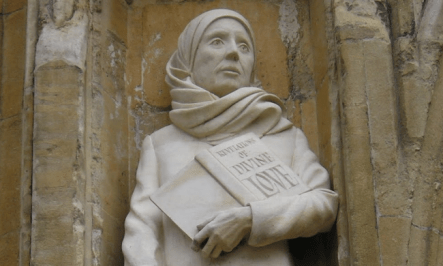
Julian of Norwich
Statue of Julian of Norwich by David Holgate, 2014

In case you’re wondering, no, I don’t like the statement that “sin is necessary” and cannot pretend to fully understand it. Julian herself is troubled by this notion and persists in asking God how things can possibly be well given the destructive consequences of sin. She won’t let this issue go. For several chapters, she pesters God about it. How can it be well? How, God? And why . . . why did you allow sin to come into the world? These questions make her a kindred spirit to those of us who wrestle with tough questions. Why, God?

God doesn’t quite answer Julian’s questions. But he tells her, very tenderly, to contemplate the atonement, which is far more glorious than sin ever was harmful. And he tells her to trust him. God says to Julian:

For since I have set right the greatest of harms [original sin], then it is my will that you should know through this that I shall set right everything which is less. (228)

“All will be well” refers to nothing less than God’s grand plan of salvation – for setting right the world and the human heart. It does not mean, alas, that things will be okay tomorrow or in a particular circumstance in our life. It could be that, like Moses, we will not see with human eyes the fulfillment of God’s promise to make things “well.”

“All will be well” is not a phrase to throw around lightly. It requires a lot of faith to affirm. Look around you at the world right now. And then look at your own heart. It’s hard to believe that all will be well, isn’t it? It’s hard partly because God is keeping to his own timeline, not ours. And because he is working in ways that we cannot fathom (more on this topic next week).

As we wait on God, we work with him in the grand plan of salvation (because waiting is active, not passive). We suffer and groan. We sorrow in our sin. But we believe: in God’s time and in God’s way, every kind of thing will be well.


The Mindset for a New Year: A Post by Prasanta Verma

For last year’s words belong to last year’s language
And next year’s words await another voice.
And to make an end is to make a beginning.

-T. S. Eliot


I am sitting in a room with about 70 other people, at a business conference, and the speaker transitions into a message of mindset. We are seated in six long tables on each side of the room, in a large conference center with picture windows overlooking a snowy hill with a half-frozen river at the bottom of the hill. A picturesque scene outdoors delights the attendees; indoors, the audience sits in rapt attention to the dynamic and energetic speaker.

We have two choices, the speaker says. She asks us some questions, poses a few hypothetical scenarios, and then asks us to consider what side we are on.

Abundance? Or scarcity?

As I sit listening, I thought I had already dealt with that particular mind-devil.

Hadn’t I already proclaimed that truth to myself? Hadn’t I already called out the lies of irrelevancy, worthlessness, and lack of confidence? I know the half-empty/half-full glass mindset.

Yet, the taunts of a hidden department of the scarcity mindset were peeping through, so tiny and barely perceptible, I almost missed it.

The difference, I realized, was the circumstance. I had dealt with the scarcity mindset on the personal level. Now, here I was, starting a new business, and recognized that troublesome voice lurking in my life, waiting for its chance to reappear. I had never started a new kind of business, and the monsters of depravity sought to destroy what I was building before I had barely begun.

The scarcity mindset was appearing in unwelcome thoughts such as, “There is no way you can do this.” Or, “You can’t succeed; you will fail.” And, “No one will call you, or hire you.” And other such negative thinking.

All of this is in stark contrast to the abundance mindset, which of course, says, things like, “You can do this.” Or, “You don’t have to be perfect, you just need to make progress.” Or, “You are here for a purpose and you are not alone.” Or, “You have something to offer. People will find you.” And so on.

I realized I had been living in the land of scarcity in regard to my work, though I thought I had slayed that particular demon.

The verse about “abundant life” came to mind, and it brought a new meaning, a new idea of abundance to me. “The thief comes only to steal and kill and destroy. I came that they may have life and have it abundantly.” John 10:10 (RSV).

The abundant life also applies to my thought life. I had not quite thought of it in that way before. My mind was living in a dry place, when a verdant and fruitful place was available to me. Moreover, the thief was still sneaking around, with intentions to destroy me.

As this new reality dawns upon me, I think it is a good way to begin a brand new year: with a mindset of abundance as opposed to scarcity.

With God, I have abundance and life. I have more than enough, and I am enough. I do not know what the year ahead holds, but there is a place for scarcity and its words: in the past. Abundance is our inheritance; it belongs in the future. And that is a better place to dwell.

***

Prasanta Verma, a poet, writer, and artist, is a member of The Contemplative Writer team. Born under an Asian sun, raised in the Appalachian foothills, Prasanta currently lives in the Midwest, is a mom of three, and also coaches high school debate. You can find her on Twitter @ pathoftreasure, Instagram prasanta_v_writer, and at her website: https://pathoftreasure.wordpress.com/.

On Turning in a Book

As some of you may know, I’m writing a book on medieval pilgrimage. It features mystics like Margery Kempe and Walter Hilton and lots of pilgrims, both known and unknown, who journeyed to Jerusalem in the Middle Ages. From these pilgrims, we can learn about our own journey of faith today.

I have some news about said book. A few days ago, I turned in the manuscript to my editor.

I feel all the things a writer usually feels. For example, elation. I did it! I just completed 40,000 polished words! And anxiety. Will my editor like it? What revisions will she want me to do?

But I did not expect to feel . . . grief. I miss the project that has been so much a part of my life the past ten or so months. I miss working with such wonderful historical material: researching it, shaping it, seeing it come together, finding the words to make it sing. I even miss the less glamorous aspects: looking up niggling details, double-checking facts, formatting endnotes. I miss the way this writing project weighed on my mind. I miss sweating bullets and wondering whether I’d be able to pull it off. I miss waking up on mornings when I had a whole glorious day to do nothing but work on this book.

I really did not want to turn in my manuscript. Which is why I held onto it and tinkered with it for about two months longer than I should have (don’t tell my editor).

pilgrims cross alps
Pilgrims cross the Alps in the prayer book of Bishop Leonhard von Laymingen of Passau, Walters Manuscript W.163, fol. 1v

I miss my project because, for me, writing is perhaps my purest expression of faith. It is where I bare my soul–first and foremost to God, and then to my readers. When I write about pilgrims’ journeys, I walk this road in my heart. In footsteps and stories and metaphors, I am pouring out my belief in this road we all take to our interior Jerusalem. My desire to reach this destination. My awe and fear over how difficult it is. My heartfelt cry that God would make the going just a little bit easier. I cannot express these beliefs in any other way than through the words in my book. Writing is a form of worship, prayer, and wrestling with the angel.

So, I’m a little at a loss this week. Happy, but out of sorts. Relieved, but scared. Resting, but feeling loss.

Fortunately, the journey goes on. I await the next steps . . . revisions and then getting the book into your hands so that you can walk this road with me.

May God grant each of us the grace to walk our portion of the road today. Travel well, perigrini.


Praying for a World in Need

January 12 was the Feast Day of Aelred of Rievaulx (c. 1110 – 1167), an English Cistercian monk and the abbot of Rievaulx Abbey in Yorkshire.

You might know some of Aelred’s thoughts on spiritual friendship, which have been written about by Wesley Hill, among others. But today I want to share a bit about Aelred’s life and other work.

A fellow monk, Walter Daniel, wrote a biography of St. Aelred. He said that Aelred often repeated the phrase, for crist luve— that is, “for the love of Christ.” It was like a short, spontaneous prayer. Aelred apparently preferred to say “Christ” in English rather than Latin (Christus) because the one-syllable English word is “easier to utter, and in some ways sweeter to hear.”

Aelred’s desire for brevity reminds me of the later Cloud of Unknowing, a 14th-century spiritual treatise that also advises choosing a short and sweet word (or two) for prayer (see my post on this). “A short prayer penetrates heaven,” to paraphrase the Cloud‘s author.

Aelred of Rievaulx
Possible portrait of Aelred of Rievaulx in De Speculo Caritatis, ca. 1140

But my favorite thing about Aelred is a beautiful passage he wrote about prayer. What good is prayer? It is useful, Aelred says. Practical. Prayer is of infinite value. And the world needs it so desperately. In his Rule for a Recluse, Aelred wrote:

What is more useful than prayer? Give it. What is more gracious than pity? Spend it. Hold the whole world in one embrace of love; consider the good to congratulate them, the wicked to grieve over them; behold the afflicted and compassionate the oppressed; call to mind the miseries of the poor, the groans of orphans, the desolation of widows, the sorrows of those who weep, the needs of pilgrims, the vows of virgins, the perils of men on the sea, the temptation of monks, the cares of the clergy, the hardships that soldiers endure. Open your heart to all, spend your tears on them, pour forth your prayers for them.

You may have seen me quote this passage before. I love it so much that I can’t stop sharing it. I think you’ll agree that we need this kind of selfless prayer more than ever today.

***

Source: For Crist Luve: Prayers of Saint Aelred Abbot of Rievaulx


December Solstice: A Poem by Prasanta Verma

December Solstice

Solstice darkness persists longer
than sun’s extended rays which reach
my fingertips eight minutes later
than when they first sizzled
out of their thermogenic home.

Electromagnetic radiation warms
cool blue earth, invisibly touches
my skin.
In the chill of Cimmerian nights,
we wait for tender light to pierce
the crepuscular twilight.

Underneath December’s star,
silence stirs the night,
souls transgress, progress.
Recollect perpetual anticipation,
the deep agony of waiting in darkness
with hope of morning light.

Let heat of long-awaited star touch you,
ignite long-awaited desire,
your spirit a smoldering wick,
spangling streaks in caliginous expanse.

Witness the world’s pain cauterized by a birth,
humanity’s death incinerated
by a small heavenly body
gifted to creation.

***

Prasanta Verma, a poet, writer, and artist, is a member of The Contemplative Writer team. Born under an Asian sun, raised in the Appalachian foothills, Prasanta currently lives in the Midwest, is a mom of three, and also coaches high school debate. You can find her on Twitter @ pathoftreasure, Instagram prasanta_v_writer, and at her website: https://pathoftreasure.wordpress.com/.

Advent Is For Pilgrims

Have you noticed that journeys abound everywhere you look in the Christmas story? Mary and Joseph journey to Bethlehem. Then they take the infant Jesus to Jerusalem forty days after his birth. The wise men journey from afar. And the Holy Family flees to Egypt.

And what about us? Well, the Incarnation sets us on a journey, too.

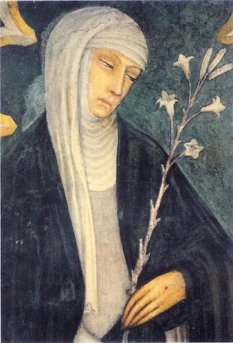
CatherineofSiena
Fresco of St. Catherine from the Basilica of San Domenico, Siena, ca. 1400

In ca. 1378, the Italian mystic Catherine of Siena wrote:

You see this gentle loving Word born in a stable while Mary was on a journey, to show you pilgrims how you should be constantly born anew in the stable of self-knowledge, where by grace you will find me born in your soul.

This passage is from St. Catherine’s Dialogue. In the passage, God is instructing the soul. Notice, first, that God calls us “pilgrims.” You pilgrims. Hey, you pilgrims! Mary is not the only one on a journey this year. We are, too. We’re on our way to the stable, and we’re going there, in Catherine’s words, to be born anew.

To be precise, we will be “born anew in the stable of self-knowledge.” This phrase sounds remarkably modern. But by self-knowledge, I don’t think Catherine means “finding ourselves.” She means knowing ourselves as we can only truly be known . . . and that is through our rebirth in Christ. Even on a daily basis, we can be renewed in our spirit and regenerated in our heart by traveling to the source. To the stable. Born into Christ, into his great love, we know who we are and we know whose we are. This is surely one of the great yearnings we experience during the season of Advent – to see Christ come into time, into a hurting world, and make us new and tell us who we are.

In The Magnificent Defeat, Frederick Buechner speaks of this journey of renewal. Riffing on The Wizard of Oz, he writes, “For outlandish creatures like us, on our way to a heart, a brain, and courage, Bethlehem is not the end of our journey but only the beginning…” What he describes here is like a rebirth – an acquiring or knitting together of all the parts we need to make us whole.

Both Catherine of Siena and Frederick Buechner really speak to me this year. I’ve been feeling so fragmented, so pulled apart by circumstances and people and the warring desires of my heart. For me, rebirth means to be knit together as a whole creation. When this happens, I will not become something or someone entirely new. I will be most fully myself. This is Catherine’s “stable of self-knowledge.”

I like the way Catherine rephrases her thoughts on birth at the end of the passage quoted above. God says, “you will find me born in your soul.” To be reborn in Christ is to have him be born in our soul. It is a double birth.

If Christ is born in us, we can then bring him forth into the world. We can bring the love of Jesus to our neighbors, our friends, our family, and to our hurting communities. In his commentary on Luke, St. Ambrose said, “Christ has only one mother in the flesh, but we all bring forth Christ in faith.” Our own rebirth helps birth Christ for a world in need.

So this year, I am making a pilgrimage to Bethlehem. I hope you’ll come with me. We will travel to the stable like Mary so that we can find God born in our soul. And we’ll travel as our own broken selves so that we can be born into new life. Jesus and us, born on Christmas day.


A Medium Aevum Advent

I’m heartened to see more and more Christians keeping Advent—not rushing to the feast, but spending time in holy expectation. The historian in me approves. When we observe Advent, we deepen our preparation for Christ’s coming by embracing the liturgical rhythms of the ancient Church. Some historical Advent practices, such as fasting, many of us do not keep today. Others, like the annual Christmas pageant, are still going strong (in the medieval Church the pageant was performed by choirboys).

This year, as I watch my daughters perform one of their own practices, I’ve been drawn to some wonderful medieval teachings on Advent. Perhaps I should say Advents. In one of his sermons for the season, written in the mid twelfth century, Bernard of Clairvaux speaks of not one but three comings of Christ. A century later, Thomas Aquinas adds yet another. That’s three more comings than most of us prepare for. It has taken my two children to help me absorb what these four advents might mean for me.

***

Christ’s first coming–no surprise here–is his historical advent. My daughters have developed an elaborate practice to prepare for this event: the manger scene. My girls set up their manger with the precision of an HGTV reality show. Everything must be just so. The picture on the box is consulted: Mary must stand here, Joseph there. The manger must be centered. Then and only then is the baby tenderly placed therein. But not for long; Jesus requires much more attention than that. He is taken out and taken care of, cradled and coddled until it is deemed the right time to lay him down again. I sometimes think God sent his son as a baby for the benefit of maternally inclined five-year-olds.

My girls’ mothering reminds me of a beautiful fourteenth-century devotional text, Meditations on the Life of Christ. In this text, readers are asked to imagine their way into the manger scene: “Kiss the beautiful little feet of the infant Jesus who lies in the manger and beg his mother to let you hold him a while.” Later, we are advised to step in and help Mary: “Be ready to give your services as if you could, meditate on them, delight and rejoice in them . . . and often gaze upon that face which angels desire to look upon.” Caring, with all our imaginative and spiritual faculties, for the baby Jesus: what a wonderful meditational exercise for the Advent season. I wonder if the infant Jesus slept through the night?

This exercise leads to another, perhaps deeper, form of preparation. In his sermon, Saint Bernard notes that Jesus not only came in the flesh. He also comes to our heart. He is hidden there: “Only his chosen see him in themselves, and they shall heal their souls.” I like to think of Jesus’ indwelling in us as a continuation of Mary’s work. Mary gave birth to Jesus and cared for him physically. Now it is our job to spiritually receive Christ and raise him up. He must grow to maturity in our heart.

My daughters pick baby Jesus up and put him down. They take him to town. They sing to him. Watching them play reminds me how much care Jesus needs to grow in me. It makes my heart tender but also afraid. I feel keenly my own lack. Sometimes I fail to care for my children the way I should. How can I possibly provide for Jesus? I need not only the baby but also the full-grown savior. My yearning for Christ’s grace is as great as my desire to cradle him in my heart.

Of course we know that Jesus’ cradle leads to the cross and the grace we so desperately need. These two yearnings are depicted in one of my favorite paintings, the Adoration of the Magi by the Flemish artist Rogier van der Weyden.
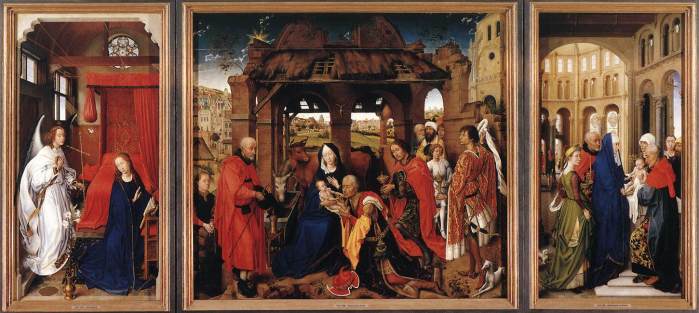
St. Columba Altarpiece

As one of the kings leans forward to kiss the infant Jesus, almost exactly as recommended by the Meditations on the Life of Christ, we see a small crucifix nailed to a post above his head.

Columba detailThis is a good painting for Advent because it keeps us from sentimentalizing the birth of Christ. If you want to grow up the baby Jesus, remind yourself that he’s headed to the cross. That will do it every time.

But Advent looks even farther ahead in the life of Christ. In his sermon, Bernard of Clairvaux reminds the Church that within Christ’s coming in the flesh is embedded the promise of his coming again. Jesus will return to earth, and the world will be made new. We are assured that whatever darkness surrounds us, God will bring his story to the glorious conclusion he foretold.

As we reflect on the teaching of the Mellifluous Doctor, we realize that Advent is truly ancient-future. It harks back to the birth of Jesus (and before that to the prophecies about him). It takes place in the present as he is born in our heart. And it looks forward to the end of earthly time. Advent is a season to meditate on the entire history of salvation through Jesus Christ, a season to both celebrate and yearn for the world’s redemption.

Admittedly, my girls seem far more earthly than eschatological when they play with their manger scene:

“He doesn’t want his blanket.”

“Yes, he does! All babies need their blanket!”

But, as Saint Bernard shows, the birth of Jesus is wrapped up in his other advents, even the ones that are invisible or that take place in a distant future. Christ’s comings cannot be separated one from another; one form of yearning leads to the next. It is strange to watch my daughters play and feel so much ache mixed in with my delight. When my girls are older I will tell them about the complex theology behind their childlike faith.

I could end my Advent meditation here. Bernard of Clairvaux does. His sermon, as I mentioned, teaches three comings of Christ—in the flesh, in our hearts, and at the end of time. But in an Advent sermon preached in 1271, Thomas Aquinas adds a fourth coming of Jesus. Christ comes, writes the Angelic Doctor, at the hour of our death. This coming is necessary to bring his “just ones” not only grace, but also glory.

I confess that with this teaching, my yearning grinds to a halt. It seems easier to long for the end of time than for my personal end. Yet Saint Thomas is not the only one to advise me on this subject. Centuries earlier, the desert father Pachomius said, “Have, therefore, the hour of your death ever before your eyes.” Even in Advent? Even when my children are so full of life and the whole world is telling me to be joyful? Upon reflection, I conclude that there is no better time. During this season, we prepare for a savior who came to defeat death—yes, even our own. When he comes for us, it will be to take us to glory.

And so, as I watch over my children, I learn to watch my heart. I coax and guide it to think on its final hour. If I can’t yet yearn for this coming of Christ, I can at least be alert. I ask my heart, are you ready? Christ will return for you one day, and this advent is every bit as real as his birth in the flesh and his coming again.

Thanks to two daughters and two doctors of the church, my Advent preparations are a strangely medieval mix of delight, yearning, and rather intense soul-searching. As a mother, I look for the coming of a baby, one as fleshy and sweet as my girls. I also remember that the baby Jesus grew up to save the world and that he will come again, both at the end of time and, likely before that, for me. May my heart be prepared to mother him now and to meet him when my time comes.

***

This essay was originally published on my website, lisadeam.com.

Open, Starry Spaces: A Thanksgiving Memory (A Post by Prasanta Verma)

Gently the dark comes down over the wild, fair places,
The whispering glens in the hills, the open, starry spaces;
Rich with the gifts of the night, sated with questing and dreaming,
We turn to the dearest of the paths where the star of the homelight is gleaming.
-L.M. Montgomery  

When I was in elementary school, my classmates would speak eagerly of family gatherings with grandparents and cousins for Thanksgiving and Christmas. I felt a sense of mystery, wistfulness, and even a tinge of jealousy, wondering what it would be like to experience a holiday with relatives bustling about and a table crammed with food and people. My family lived solitary in that sense, in my small southern hometown, often celebrating holidays on our own.

Except for one person.

One friend often visited our house on Thanksgiving and some holidays. Grandma Sue, as she became known to me and my siblings, visited our small Thanksgiving table. Grandma Sue, a widow, lived alone, her three children lived far away, and she was the first close friend of my family while growing up. The meals were not fancy, and were most definitely southern, with a turkey and the usual assortment of casseroles, ending with pumpkin and pecan pies.

Our family and Grandma Sue not only shared a holiday table, but often otherwise. Before she grew too old and stopped baking, she would stop over on occasion with a steaming loaf of freshly baked homemade sourdough bread, wrapped in a leftover cellophane covering from a grocery store bought loaf. Once, Grandma Sue brought me a gift from a trip she had taken to Mexico: a little donkey figurine wrapped in brightly colored threads. No one else brought me gifts when they traveled. When I was in middle school, she taught me how to paint my nails and how to use the different tools in my small nail manicure kit. This must be what a relative would do, I reasoned.

Grandma Sue was the closest person in my life to what a grandmother might have been. Because my relatives lived on the other side of the world, I did not grow up knowing any of my grandparents, uncles, aunts, or cousins, meeting them only once or a few times in my entire life.

My mother visited Grandma Sue during the day when my siblings and I were in school. As an adult, I realized that Grandma Sue was perhaps the closest person in my mother’s life to a mother or a mentor. She had left all family behind and moved to a foreign country.

When I was young, I had dreams of my future kids enjoying the experience of knowing their cousins, aunts, uncles, and grandparents—reminiscing about what I had missed while growing up. But as a grown adult, I find myself in the same sort of situation as my parents did—the Thanksgiving holiday is often not a reunion table full of immediate and extended relatives, each year growing older. Gatherings do occur, albeit infrequently, because the reality is that we all live and work in cities hundreds of miles apart. I replaced my naïve childhood imaginings with the reality of migrating for jobs and living in a more transient society.

The Thanksgiving holiday table of my adult life changes scenes every year: one year we travel, another year, we host Thanksgiving at our own home with international students invited to the table, and sometimes we enjoy a feast and games at a friend’s home. If there is one thing I can count on, it is that each year Thanksgiving will look different from the previous one. No one particular picture characterizes the holiday; rather a collage of varying memories marks the season, like a patchwork quilt.

Yet the memory of celebrating the holidays with someone else in my small hometown who was also alone remains a memory of hope and a call to an enlargement of the table. The friendship our family had with Grandma Sue remains one of my happiest memories of growing up. It represented a space between two very different families—a Southern woman and an immigrant family—occupied with genuine affection.

I did not realize what an important relationship that was until many years later. It showed me that immigrants could be welcome in another place. It taught me that both sides had to open their hearts to each other and could meet on the same table. It exemplified how friendship blossoms in a small town with perhaps the unlikeliest of persons.

I draw upon these memories made in my childhood home nestled between emerald hills surrounding my cozy southern valley, and I remember what is good to remember.

As you prepare for the upcoming holidays, consider enlarging the table to include someone else in your community: a lonely widow, an international student, or a neighbor with no relatives.

Your homelight can be a place of gleaming, an open, starry space, a place for a lonely person to find a place of rest and warmth, whether it is just for a day or if it turns out to be something more. Who knows? It could be the start of a new tradition—or a lifelong friendship.

***

Prasanta Verma is a member of The Contemplative Writer team. She’s a writer, poet, and artist. Born under an Asian sun, raised in the Appalachian foothills, Prasanta currently lives in the Midwest, is a mom of three, and also coaches high school debate. You can find her on Twitter @ pathoftreasure, Instagram prasanta_v_writer, and at her website: https://pathoftreasure.wordpress.com/.


What Is Your Vocation?

I’m someone who has long struggled with work and vocation. I have a sketchy employment history. I’ve had trouble paying the bills. I frequently wonder just what it is that God is calling me to do with my life.

On the subject of vocation, I’ve often come across the following quote from Frederick Buechner, the writer and theologian: “The place God calls you to is the place where your deep gladness and the world’s deep hunger meet.” It’s a beautiful thought; I can see why it’s quoted so often. But it hasn’t helped me much in my own struggles.

Like a Bible verse, Buechner’s quotation is often lifted out of context. There’s a lot more to it than just that one sentence. The quote comes from the book, Wishful Thinking. In this book, Buechner defines vocation as the work God calls a person to do. Then, in the first edition of the book, he writes:

The kind of work God usually calls you to is the kind of work (a) that you need most to do and (b) that the world most needs to have done. If you really get a kick out of your work, you’ve presumably met requirement (a), but if your work is writing TV deodorant commercials, the chances are you’ve missed requirement (b). On the other hand, if your work is being a doctor in a leper colony, you have probably met requirement (b)…


The place God calls you to is the place where your deep gladness and the world’s deep hunger meet.

I still think the last sentence of this passage is lovely. But when I read the paragraph preceding it, my first reaction was, What on earth is wrong with writing deodorant commercials? I actually think this job is worthwhile, and I think this for two reasons. First, because the world needs deodorant. So, yes, let’s write some ads and sell more of it! Second and more importantly–what if your job writing deodorant ads is what enables you to put food on the table? Provide for your family? Pay the bills?

Some of us, maybe even most of us, will not have jobs that in themselves fulfill the world’s deepest hunger. We cannot all be doctors in leper colonies, pastors, missionaries, hospice workers, or counselors. I deeply admire Buechner and have learned much from him (in fact, you’ll probably see me quoting some of his Advent writing pretty soon). However, I have reservations about Buechner’s treatment of vocation because it implies that some jobs are worth more to God than others. If you’re not a doctor or something similar, you’re somehow missing the mark. You’re not fulfilling your vocation. I think this view is wrong. It’s more than a bit elitist.

There was a time in my life when I was a college professor and a time when I was a Kelly Girl. I can tell you which job my peers most admired me for. But during my stint as a temp worker, I was pretty happy to be bringing in some much-needed income. I think I was fulfilling my vocation by working hard and helping my family, even if this work didn’t meet Buechner’s definition.

And what about the other part of Buechner’s famous quotation? The “deep gladness” part? Well, I wish that we could all find jobs that stem from a deep well of joy. But let’s face it, sometimes work is a 9 to 5 kind of thing. Sometimes it is just what pays the bills. And there is no shame in that. We should do the work we can in a way that glorifies God.

We do this because a job is not the same thing as a vocation. Originally, a vocation meant a divine call to the religious life. Its common usage gradually broadened to mean the particular gifts or interests God has given us or the call to a certain kind of life. But above all, a person’s vocation is her call to follow Jesus Christ in and through whatever work or tasks she does.

Let’s say that God has given you the gift of hospitality. Making others feel welcome, heard, cared for, and important is what gives you deep gladness. You could live out this calling in any number of jobs. An auto mechanic can show hospitality. So can a nurse. And a college professor. And a Kelly Girl. You can live out the joy of hospitality when you meet people on the street, when there’s a new face in your book group, or when you invite people to your home after church on Sunday. Our true vocations are never a 9 to 5 thing. They are a part of us, our spiritual core, and we can practice them wherever we are and whatever we do.

In the revised version of Wishful Thinking, the section on vocation was changed. The example of a “missed vocation” is not deodorant ad writer but cigarette ad writer (119). I suppose this makes a little more sense. Given what we know about cigarettes, we could conclude that promoting a harmful product would not be an ideal job OR vocation.

But I still don’t see what is wrong with writing commercials in general. Go and work. Pay your bills. Support yourself and your family. Pray. Love. Serve. Glorify God in all the tasks of daily life. This is your true vocation.

Have You Ever Tried to Run Away?

Many of us love the theologian, priest, and author Henri Nouwen for his insights and guidance on the spiritual life. I recently reread his book, The Genesee Diary: Report from a Trappist Monastery. This book is Nouwen’s diary about the seven months he spent as a “temporary monk” in the Abbey of the Genesee in New York. Nouwen took this extended retreat in 1974 while he was a professor at Yale Divinity School. He did so to face his restless self and to step back from a busyness and sense of self-importance that seemed to have a hold on him. He had questions about himself and questions for God.

Genesee Diary
My well worn copy of Nouwen’s book

Nouwen’s diary is full of insights about monastic life and the Christian faith. I highly recommend it. But the part that arrested me came at the very end, when Nouwen returned to his life and work as a professor.

Nouwen reports that soon after returning to his everyday life, his “demons” returned: restlessness, ambition, illusions, and compulsions. His seven months in the monastery, he says, did not change him. Did not improve him. Did not solve his problems. Did not even quiet his heart.

What a surprising denouement to this little book! After following Nouwen’s daily life in the monastery, the reader does not expect to learn that his retreat amounted to so little. We were looking for results: big changes, a new life, a renewed spirit.

At first, Nouwen was thrown by the return of his demons, too. He he wondered if his retreat had “failed.”

Eventually, however, he came to a different conclusion. The monastery, Nouwen says, “is not built to solve problems but to praise the Lord in the midst of them” (217). What a beautiful thought. Maybe we can learn to praise God right where we are, mired in the difficulties of life, and not look to him or to our experiences of him purely to solve our problems.

I have often fantasized about removing myself to a monastery or, I kid you not, a sanatorium. I have wanted to run away from my life and its problems. I do not think that running away is what Nouwen did, but it’s what I want to do. I want to find a place apart from the world where I can have a measure of peace. A place without the pressing everyday issues that sometimes seem to tear me apart. A place where I can find myself again, and, yes, find God, too.

Recently I tried to run away from my life (not to a monastery; just away). I thought I could find peace and freedom away from it all. But it didn’t work, and I’m both pleased and apprehensive to report that God called me back. He is restoring me to my life, with all its problems.

I’ve come to realize that there is no escape from life–not in a monastic community, not at a retreat, not anywhere. We cannot run away from our problems or our selves. My life—the hurts, the issues, the chaos—is my monastery. There may be moments I can retreat, but in general, I have to learn to praise God right here. In my world, just the way it is. And to rely upon a daily measure of grace to see me through.

It is a hard lesson. I think there will always be a part of me that wants to escape. But, following Nouwen’s example, I am learning to not run from the mess but to praise the Lord in the midst of it.